
Most Indian MSMEs did not plan for CBAM to hit this fast. By late January 2026, shipments were already stuck at European ports, orders were being cancelled, and carbon levies for exporters without verified data had tripled to EUR 240-300 per tonne under default values. One Mumbai-based exporter lost a 7,000-tonne steel order in a single week because CBAM made the numbers not work. Most businesses were unprepared because CBAM demands a level of carbon data infrastructure that most small exporters have never needed before and had no roadmap to build. Carbon levies for many MSMEs tripled from EUR 70 to EUR 240 to 300 per tonne overnight[1] [2] , simply because they had no verified emissions data to present. These were not compliance oversights by large corporations. These were small and mid-sized exporters who did not know what they did not know, and paid for it immediately. CBAM applies to everyone above the 50-tonne threshold equally on paper. But in practice, the compliance burden lands heaviest on the exporters with the least capacity to carry it. For Indian MSMEs, that gap between what the regulation demands and what a small business can realistically deliver has already started costing real contracts.
Why CBAM Hits Indian MSMEs Harder
The fundamental problem is the supply chain data gap, and it hits MSMEs disproportionately hard. CBAM requires plant-level, verified emissions data from every part of your production chain, not just your own facility. For a large exporter with centralized procurement and ERP systems, collecting this is difficult but doable. For an MSME sourcing from dozens of small vendors across industrial clusters, it is a structurally different challenge.
Three specific factors make MSMEs more vulnerable than larger exporters:
- No upstream data sharing: Large metal producers routinely withhold plant-level emissions data from the downstream MSMEs that source from them. If even one supplier in your chain cannot provide verified data, your entire shipment gets pushed into EU default values.
- Default values are punishing. CBAM may force steel, aluminium exporters to cut prices by 15-22%.
- The scale of exposure is massive. Between 25,000 and 30,000 MSMEs exporting indirectly to the EU are now exposed to CBAM risk, along with 3,000 to 4,000 direct exporters. Most of them have no compliance infrastructure at all.
The compliance burden is also completely disproportionate. A workshop with 15 workers has to meet the same emissions reporting standards as a billion-dollar steelmaker. That is the reality of CBAM for Indian MSMEs right now.
What a CBAM Consultant Does Differently for MSME Exporters
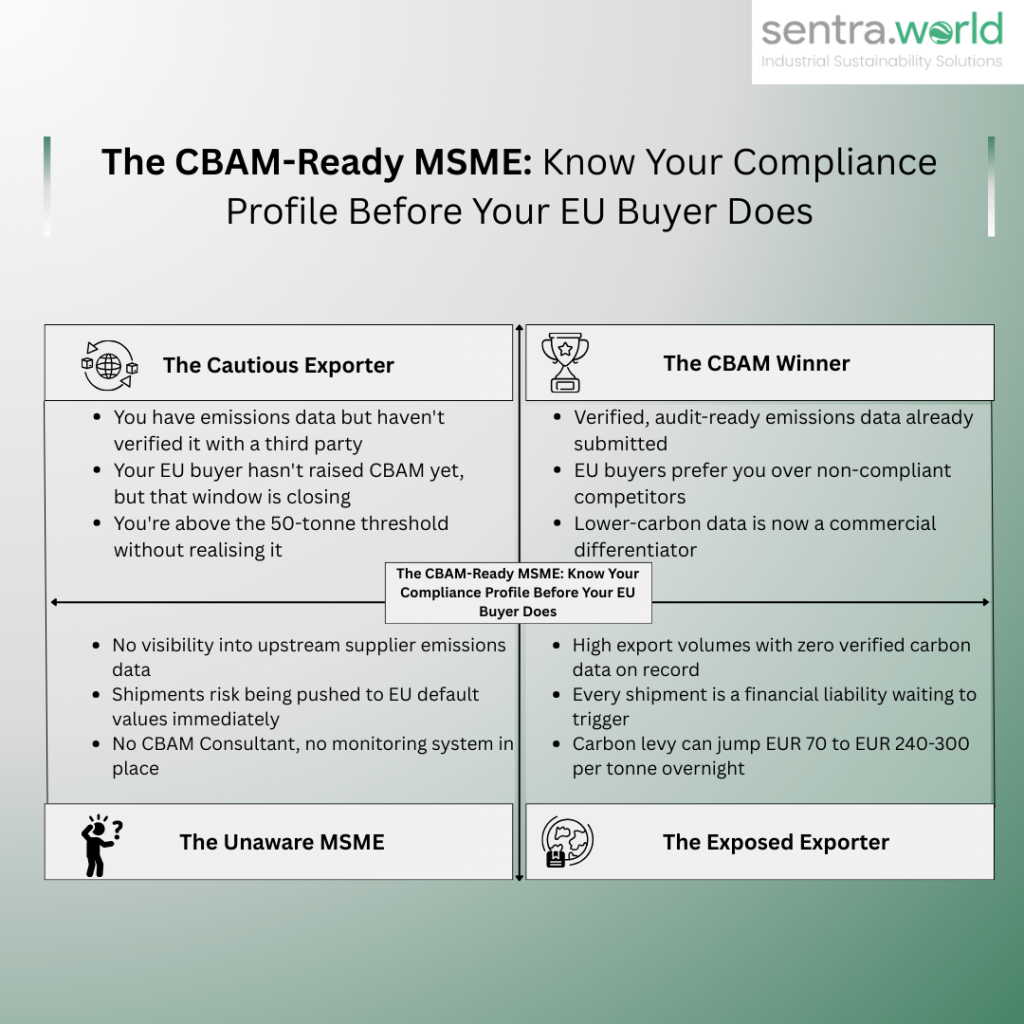
A CBAM Consultant working with an MSME does not follow the same approach as one working with a large corporation. The problems are different, resources are tighter, and the urgency is higher. The first job is to figure out exactly where your business falls under Regulation (EU) 2025/2083. Not every MSME crosses the 50-tonne annual threshold that triggers full CBAM obligations. Knowing that number changes everything about how you prioritise your compliance effort and budget. For those above the threshold, a CBAM Consultant works through your supply chain to identify data gaps and engage directly with your upstream suppliers to collect emissions data in the correct EU format. This is the part most MSME owners simply cannot do themselves. Explaining EU carbon accounting methodology to a small forging unit in Ludhiana requires both technical knowledge and time that most small exporters do not have. Most MSMEs also do not know what their actual liability number looks like before the conversation starts. At this stage, running your product CN code through Sentra’s CBAM Liability Calculator gives you an instant euros-per-tonne estimate based on your basic emissions data. That one number tells you exactly how much is at stake and gives your CBAM Consultant a concrete baseline to work from day one.
How a CBAM Consultant Keeps MSMEs Out of the Default Value Trap
Avoiding the default-value trap is where a CBAM Consultant delivers the most direct financial value to smaller exporters.
The moment your EU buyer cannot use your verified data, they default to the EU’s conservative benchmark and your cost exposure jumps. A CBAM Consultant prevents that by:
- Setting up a GHG monitoring system aligned to ISO 14064 at your facility
- Calculating embedded emissions using EU-approved methodology at the product and plant level
- Coordinating third-party verification with an ISO 14065-accredited auditor
The result is a verified emissions figure that reflects your actual production rather than the EU’s worst-case assumption. For an MSME where every rupee of margin is accounted for, that difference is not a compliance detail. It is the difference between keeping the contract and losing it.
The CBAM Consultant Advantage: Why Compliant MSMEs Win EU Business
Here is the part that most smaller exporters are not thinking about yet. Surviving CBAM is one outcome. Growing because of it is another. EU buyers are under pressure from investors and customers to meet their own ESG goals. They actively want suppliers who make compliance easy, not ones who create documentation gaps every quarter. An MSME that delivers clean, verified, audit-ready emissions data stands out sharply in a procurement process where most competitors are still scrambling. When two suppliers quote comparable prices, the one with verified lower-carbon data wins on buyer preference. For a smaller exporter, that is a real commercial opening, not just a compliance milestone. The MSME that invests in a CBAM Consultant today is not just avoiding penalties. It is building the supplier profile that EU buyers want to maintain long-term relationships with.