
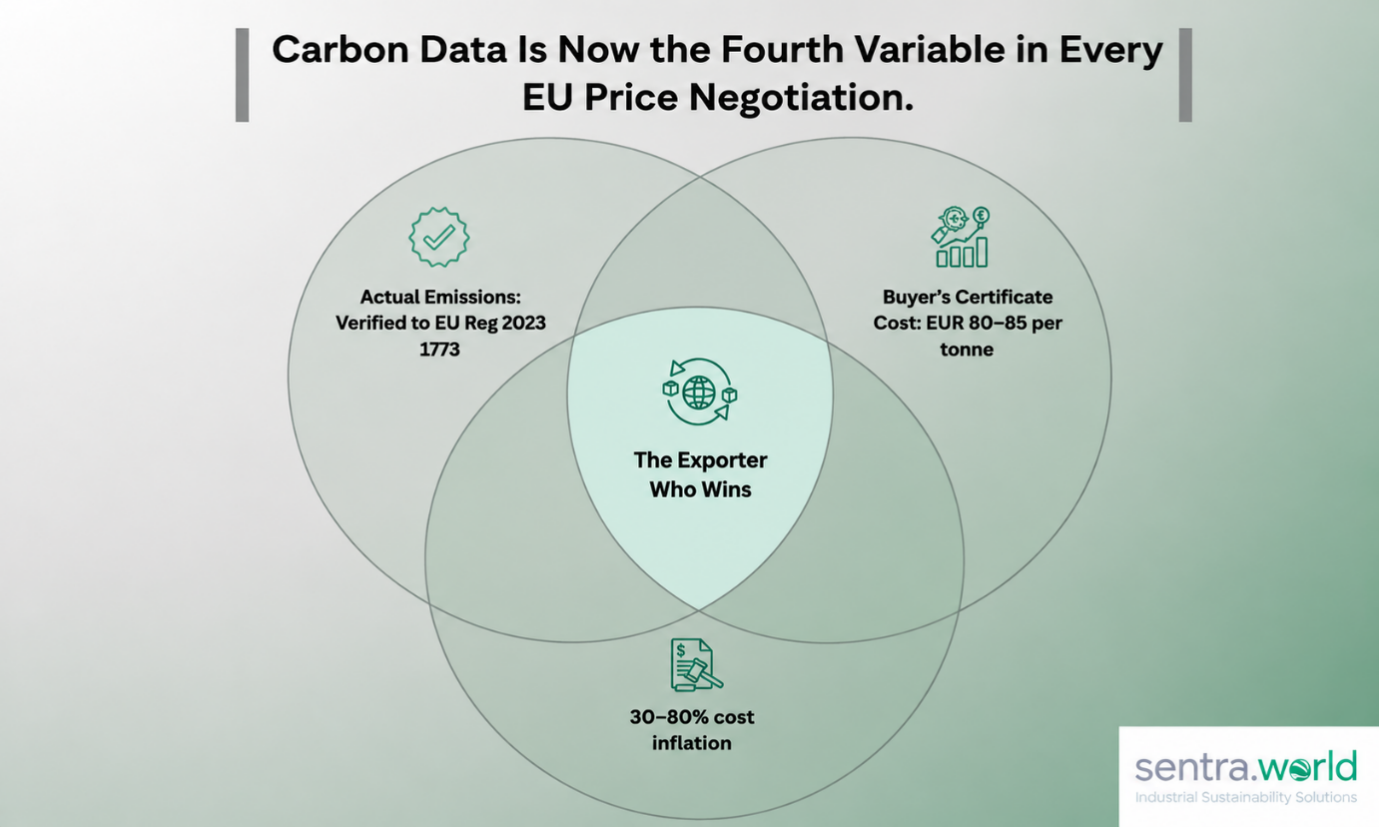
The price negotiation with your EU buyer used to have three variables. Price per tonne. Lead time. Quality certification. In 2026, there is a fourth variable on the table, and most Indian exporters are not prepared for it. That fourth variable is your carbon cost, and unlike the first three, your EU buyer cannot negotiate it away. They can only choose a supplier whose carbon cost is lower. When two suppliers quote similar prices, the one with a lower verified carbon footprint wins market access and buyer preference. That shift is already reflected in procurement decisions by European steel and aluminium buyers. It did not wait for the regulation to mature. India’s steel and aluminium exports to the EU dropped 24 percent in FY25 in anticipation of exactly this dynamic. The buyers who drove that drop were not waiting for CBAM declarations. They were already repricing carbon risk into their supplier mix. A CBAM Consultant does not just help you comply. They build the carbon data that determines which side of that repricing you end up on.
How CBAM Changed the EU Buyer’s Supplier Selection Equation and Why a CBAM Consultant Changes It Back
Before CBAM, carbon intensity was invisible in a trade contract. From January 2026, that changed. Every EU importer now carries a financial obligation tied directly to the embedded emissions of what they buy. The CBAM certificate cost is calculated quarterly using the EU ETS price, which was hovering between EUR 80 and EUR 85 per tonne of CO2 in early 2026. Every tonne of embedded carbon above the EU benchmark is a certificate the importer has to buy. Two suppliers selling at the same price per tonne of steel are not the same cost to the EU buyer if their carbon intensities differ. This is where the supplier selection conversation changes. An EU buyer managing their CBAM exposure will actively prefer the supplier who reduces their certificate liability. The Indian exporter who can demonstrate lower verified emissions is not just compliant, they are cheaper in total landed cost terms, even if their unit price is identical. A CBAM Consultant builds the verified emissions data that makes that argument visible. Without it, your EU buyer has no way to distinguish your carbon cost from a competitor’s. They fall back on EU default values for both of you, and the procurement decision reverts to price per tonne alone, which is exactly where Indian exporters are most vulnerable to competition from lower-cost origins.
What a CBAM Consultant Finds When Indian Exporters Have No Carbon Data Strategy
Most Indian exporters entering EU price negotiations in 2026 are doing so without any verified emissions data. Their EU buyer’s system assigns them a default value. Default values for CBAM-covered goods run 30 to 80 percent above actual emissions for most Indian producers. That inflated default becomes the carbon cost the EU buyer is carrying for your shipment, and it shows up in what they are willing to pay you. To absorb the carbon tax within their margins, Indian exporters may need to accept price reductions of 15 to 22 percent. That is not a fine. That is a structural discount applied to every contract where verified data is absent. A CBAM Consultant does the work that removes that discount from the table. The first thing they produce is a gap assessment: what your actual emissions are versus the default value the EU is currently using, and what that difference costs your EU buyer per tonne. That single number reframes the commercial conversation. It shows your buyer exactly what verified data saves them, which is the same as what it saves you. Before commissioning that work, A CBAM Liability Calculator gives you a starting estimate. Enter your CN code and basic production inputs, and the tool returns your carbon cost in euros per tonne, including the difference between verified actual and EU default values. That figure is the opening number for the conversation with your CBAM Consultant.
How a CBAM Consultant Turns Verified Carbon Data Into a Contract Retention Tool
Once your emissions data is built and verified, it does more than tick a compliance box. It becomes a commercial asset in every contract renewal discussion with your EU buyer.
A CBAM Consultant structures that asset in three ways:
- Producing a verified CBAM data pack that your EU buyer can use directly in their annual CBAM declaration, with no follow-up calls, no reformatting, and no delays. That frictionless experience matters to a procurement team managing dozens of suppliers across multiple origins.
- Tracking emissions performance year on year so that improvement is visible and documentable. Exporters who can demonstrate year-on-year emissions reduction are better positioned in supplier reviews and contract renewals. A declining carbon number is a pricing argument, not just a sustainability disclosure.
- Preparing the data in a format aligned to EU Implementing Regulation 2023/1773[1] , so it withstands the third-party verification the EU importer will require before using it in their declaration.
India is projected to bear 18 percent of total global CBAM costs, nearly double its share of EU import value. That structural exposure does not disappear. But the Indian exporters who have verified, improving carbon data are not competing on the same terms as those who do not. They are competing on a different dimension entirely, one where most of their Indian competitors have not yet shown up. Is your carbon data currently working for you in EU pricing conversations, or is it simply not there? A CBAM Consultant is where that changes.