

A steel trading company in Mumbai sources hot-rolled coils from three different mills in Maharashtra and Gujarat, consolidates the order, and ships to a buyer in the Netherlands. The mills made the steel. The trader just moved it. In 2026, that distinction does not reduce the trader’s exposure at all. CBAM does not care who made the product. It cares who is responsible for the emissions data attached to it when it clears EU customs. For a trading company that sources from multiple Indian manufacturers and sells to EU buyers, that data responsibility lands squarely in the middle of their business model, at exactly the point where they have the least visibility and the least control. A CBAM Consultant working with a trading company starts with that gap and works backward through every supplier in the chain.
Why CBAM Consultant Engagements for Traders Look Different from Manufacturer Engagements
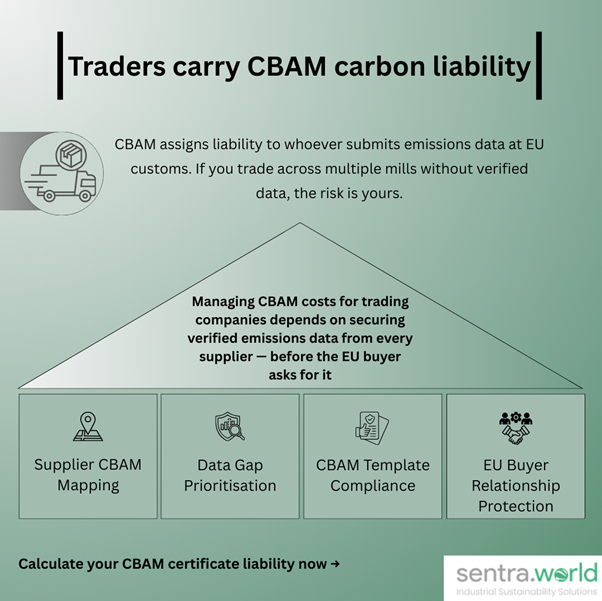
When a manufacturer hires a CBAM Consultant, the work begins at their own facility. The production data is on-site, the process is known, and the boundary for emissions calculation is their own installation. A trading company has none of that. They do not own the production facility. They cannot access the furnace logs, the electricity bills, or the fuel consumption records that EU Implementing Regulation 2023/1773 requires for a valid CBAM data submission. All of that sits with the mill or factory they sourced from, which may not have it in the right format, may not know what CBAM requires, or may not be willing to share it at all. Under CBAM, an indirect customs representative acting as an authorised declarant for an EU importer becomes directly subject to the obligations under Regulation EU 2023/956, including calculating and declaring embedded emissions. The contract structure and delivery terms determine exactly where that obligation falls, but in most standard merchant export arrangements, the trader is the one the EU importer calls when the data is missing. A CBAM Consultant maps that liability before the EU buyer’s compliance team starts asking.
What a CBAM Consultant Finds When Trading Companies Source From Multiple Suppliers
The data problem for a trading company compounds with every supplier they add. A manufacturer with one facility has one CBAM data gap to close. A trading company sourcing from five mills has five separate gaps, each with different production routes, different emissions intensities, different levels of data readiness, and different willingness to cooperate. EU default values are set at the highest emission intensity observed among countries with reliable data, and for Indian steel and aluminium run 30 to 80 % above actual emissions for most producers. Every supplier in a trader’s portfolio that cannot provide verified data triggers the EU default for that portion of the shipment. On a consolidated order of 5,000 tonnes across five mills, the default exposure can vary so widely between suppliers that the overall CBAM certificate cost for the EU buyer becomes unpredictable from shipment to shipment. That unpredictability is what EU buyers are starting to price into their contract terms. A trader who cannot deliver consistent, verified emissions data across their supplier base is a commercial risk, not just a compliance gap.
A CBAM Consultant works through the supplier portfolio in order of volume and CBAM exposure:
- Identifying which mills or factories in the trading company’s supplier base produce CBAM-covered goods, mapped to their specific CN codes, and assessing which ones are already generating usable data versus those starting from zero.
- Prioritising the highest-volume and highest-emission-intensity suppliers first, since those are the ones where a default value costs the EU buyer the most per tonne and where verified data delivers the largest reduction in certificate liability.
- Establishing a data collection protocol with each supplier that pulls the installation-level Scope 1 and Scope 2 figures into the CBAM Communication Template format, so the trader can deliver a complete, verified data package to the EU importer without multiple rounds of follow-up.
Before starting supplier outreach, sentra.world’s CBAM Liability Calculator lets a trading company estimate the per-tonne certificate cost for each supplier’s product using CN code and basic production route data. Running that estimate across the supplier portfolio identifies which mills need immediate attention and gives the CBAM Consultant a clear prioritisation map.
How a CBAM Consultant Protects the Trading Company’s Position in the EU Buyer Relationship
The EU importer in this chain is accountable to the CBAM Registry. Their annual declaration, due by 30 September 2027 for all 2026 imports, must include verified emissions data, or they face a penalty of EUR 100 per excess tonne of CO2. They cannot absorb that penalty quietly. It comes back to the trader as a price renegotiation, a contract clause, or a sourcing switch to a competitor who can deliver clean data. Indian exporters who cannot demonstrate lower verified carbon emissions risk being replaced by suppliers who can, and for a trading company, that is not a single contract at risk. It is the entire EU portion of their book. A CBAM Consultant builds the data infrastructure that makes a trading company’s EU business defensible. That means getting verified emissions packages from every significant supplier in the portfolio, delivering them in a format the EU importer’s system accepts without re-work, and setting up a refresh process so the data stays current through each annual declaration cycle.
Does your EU buyer’s next contract renewal have a carbon data clause in it? If it does not yet, that clause is being drafted. A CBAM Consultant helps you get ahead of it, To Know More Calculate your CBAM Liability today!