

Picture this. You have spent years building a steady export business, sending steel or aluminum to buyers across Europe. Then, one day, your EU customer sends you an email requesting verified carbon emissions data from your production facility. You have no idea what they are talking about. This is no longer a rare situation. A CBAM Consultant supports exporters with verified emissions data, compliance, and risk reduction. Since January 2026, when the EU’s Carbon Border Adjustment Mechanism(CBAM) moved into full effect, thousands of exporters across India, the Middle East, and Southeast Asia have found themselves in exactly this position, scrambling to understand a regulation they were not prepared for. According to the European Commission, the definitive compliance phase began on 1 January 2026, and there is no grace period for businesses that missed the transition window.
This is where a CBAM Consultant becomes less of a nice-to-have and more of a business necessity.
What Is CBAM and Why Does It Affect You?
The Carbon Border Adjustment Mechanism, formally established under Regulation (EU) 2023/956 as part of the EU’s Fit for 55 legislative package, is a regulation that puts a carbon price on certain goods imported into Europe. The logic is straightforward: European manufacturers already pay carbon costs through the EU Emissions Trading System. CBAM ensures that foreign producers competing in the same market face a comparable cost, so the playing field stays level. The sectors currently in scope include steel, aluminium, cement, fertilizers, hydrogen, and electricity. If you export any of these to EU buyers, CBAM applies to your business. Your buyer in Germany or France is legally required to report the carbon emissions embedded in your products and purchase CBAM certificates accordingly. The first CBAM report was due in January 2024, and quarterly reporting has continued since, with the full certificate purchase obligation now active. Here is the part most exporters do not realize until it is too late. While the legal obligation sits with your EU importer, the data burden falls entirely on you. They need your emissions numbers to comply. If you cannot provide accurate, properly calculated figures, you become a compliance problem for your customer. And in competitive markets, that is often enough to lose the contract entirely. So what do you do? You bring in a CBAM Consultant.
What a CBAM Consultant Actually Does?
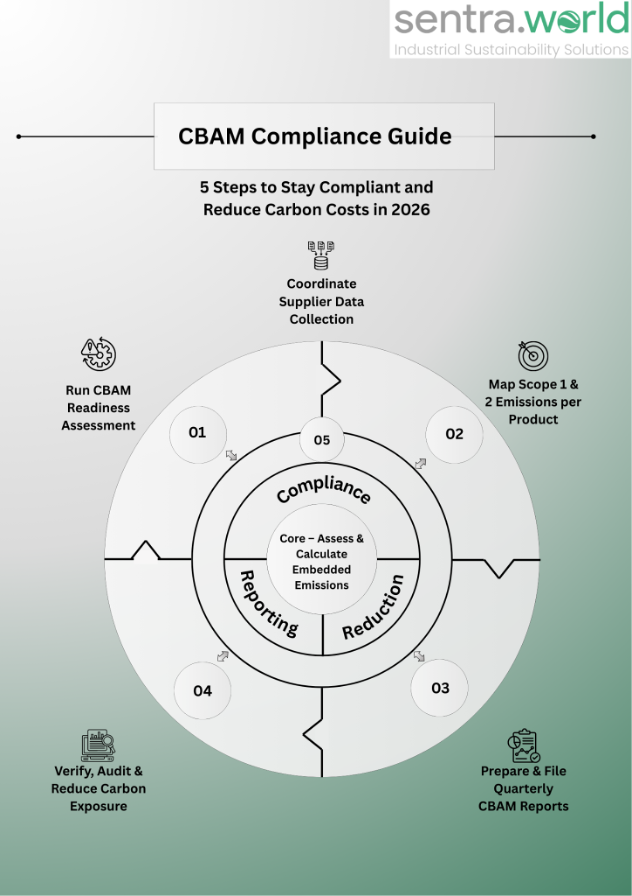
A CBAM consultant is not someone who simply reads regulation documents and forwards summaries to your inbox. The work of a CBAM consultant spans carbon emissions assessment, building a full compliance roadmap, supply chain engagement, carbon tax planning, and internal training for your teams. It is a considerably broader remit than most businesses expect when they first go looking for support. But here is the opportunity: exporters who get this right early are not just avoiding penalties. They are positioning themselves as preferred suppliers to EU buyers who are under their own pressure to clean up their supply chains. In the CBAM era, well-handled compliance becomes a commercial advantage. One of the most financially important things a good consultant does is help you move from EU default emissions values to verified actual data. Relying on default values rather than your own verified production data almost always results in higher CBAM certificate costs. Your actual emissions are typically lower than the conservative benchmarks the EU assigns to countries without verified data, so getting that data right directly reduces costs for your EU buyer and makes you a more attractive supplier. Beyond the numbers, a qualified CBAM Consultant builds a reporting framework your team can actually work with, trains your operations and finance people on what CBAM requires quarter to quarter, and keeps you ahead of regulatory updates so you are not scrambling every time there is a new regulation.
How Do You Know If You Are Choosing the Right One?
This is worth careful thought, because the CBAM advisory market has grown quickly, and not every consultant has the same depth of knowledge.
Start with sector experience. CBAM methodology for steel is not the same as for aluminium or cement. A consultant who knows your specific industry will understand which emissions factors carry the most weight, where auditors focus, and where exporters in your position typically make costly mistakes. Next, ask about verification. The European Commission’s CBAM legislation and guidance page confirms that third-party verification of declared embedded emissions is now required for the definitive phase. If your consultant cannot explain that process clearly, or does not have relationships with accredited verification bodies, that is a flag worth taking seriously. Context also matters. If you are an Indian manufacturer, working with a consultant who understands both Indian industrial realities and EU regulatory expectations gives you a meaningful edge over one who operates entirely from a European perspective.
The Real Cost of Waiting
Penalties for incorrect or missing CBAM reporting can hit hard, particularly for steel. At the projected EUA price of 90 euros per tonne in 2026, importers of high-carbon-intensity steel could face additional costs of 40 to 60 euros per tonne, with upstream products like steel slabs potentially exceeding 20 percent of the import value. For a mid-sized exporter shipping tens of thousands of tonnes to the EU annually, that is a material financial exposure that no CEO wants to discover after the fact. It is also worth noting that Regulation (EU) 2025/2083, adopted by the EU in October 2025, introduced a 50-tonne annual exemption threshold that benefits smaller importers. But if your volumes cross that threshold, full compliance obligations apply with no exceptions.
The manufacturers who invested early in a qualified CBAM Consultant are now discovering something worth paying attention to. Compliance is quietly becoming a competitive advantage. When your emissions data is accurate, verified, and easy for your EU buyer to work with, you reduce their administrative burden and take their compliance risk off the table. That makes you a more attractive supplier than a competitor who cannot say the same. Whether you are just starting to map your CBAM exposure or already fielding urgent data requests from European partners, the right time to bring in proper support was twelve months ago. The next best time is today. Thinking about where to start? The first step is usually a CBAM impact assessment to understand your exposure across your product lines. A qualified CBAM Consultant can complete that assessment and provide you with a clear picture of what compliance looks like for your specific situation, so you can make decisions based on your numbers.