


Aluminium smelting is one of the most power-intensive manufacturing processes in the world. In India, most smelters run on captive coal-fired power plants because grid power is unreliable and industrial-scale renewables are still limited. That decision, made years ago for operational reasons, is now showing up as a carbon liability on every shipment to Europe.
From January 2026, that liability has a price tag. The CEEW estimates that EU-bound Indian aluminium could face an effective carbon cost equal to 12 to 22 percent of its export value, driven almost entirely by coal-based power in smelting. For producers still running on captive coal plants, CBAM levies could add EUR 300 to EUR 400 per tonne to the cost of their metal. In a commodity business where margins are measured in tens of euros per tonne, that is not a compliance issue. It is a contract retention issue.
Why Aluminium Has a Different CBAM Problem Than Steel, and What a CBAM Consultant Does About It
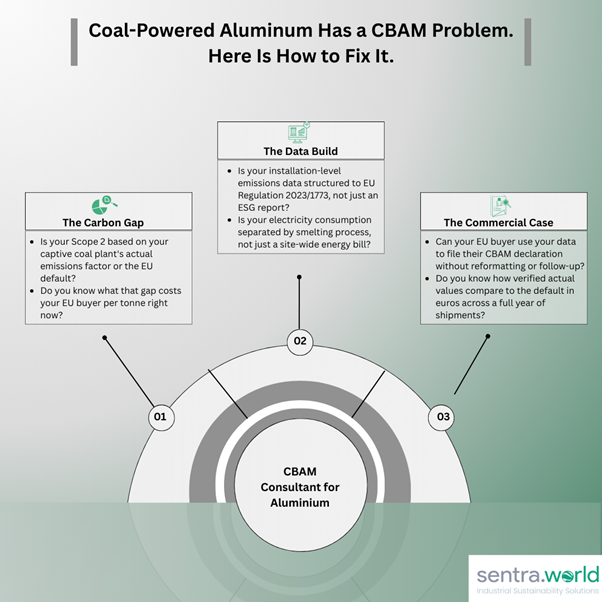
Steel’s CBAM exposure is primarily about the production route, blast furnace versus electric arc furnace. Aluminium’s problem sits elsewhere. The smelting chemistry does not vary much between producers globally. What varies is the electricity source, and that is what CBAM prices. A Norwegian smelter running on hydropower and an Indian smelter running on a captive coal plant can produce chemically identical ingots. Under CBAM, those two ingots carry completely different embedded carbon profiles because the regulation accounts for indirect Scope 2 emissions from electricity consumption as part of the total carbon cost for aluminium. With EU carbon prices at EUR 80 to EUR 85 per tonne of CO2 in early 2026, that electricity gap between a coal-powered Indian smelter and a hydro-powered European competitor translates directly into the CBAM certificate cost the EU importer pays at the border. That importer is not absorbing this quietly. They are repricing supplier relationships to account for it. A CBAM Consultant working with an aluminium exporter focuses first on the actual emissions factor of your captive power plant, how it compares to the EU default, and what the certificate cost difference per tonne looks like between those two figures. That gap is often where the real commercial recovery sits.
What a CBAM Consultant Finds When Aluminium Exporters Have No Verified Data
The EU does not leave emissions calculations blank when an exporter submits nothing. It applies default values, and those defaults are set conservatively high. Default values for CBAM-covered goods run 30 to 80 percent above actual emissions for most Indian producers. For coal-powered aluminium, the gap between a verified actual value and the EU default can be significant enough to change whether a shipment is commercially viable for the EU importer at all. The practical result: your EU buyer’s CBAM certificate cost is higher when they use your default value than when they use your verified actual. To retain EU market access, Indian exporters may need to accept price reductions of 15 to 22 percent to let EU buyers absorb the carbon tax within their margins. For exporters sitting on default values, that starting position is even worse. A CBAM Consultant builds a verified emissions dataset that replaces the default with your actual figure.
How a CBAM Consultant Builds the Emissions Case for a Coal-Powered Smelter
This is technically specific work, and it is why a CBAM Consultant with smelting knowledge matters more than a generalist. The process covers three things:
- Calculating your installation-level Scope 2 emissions using the actual emissions factor of your captive power plant, documented with fuel consumption records and generation data, aligned to EU Implementing Regulation 2023/1773. A generic ESG sustainability report does not meet this standard and will be rejected when the EU importer tries to use it.
- Separating electricity consumed in the smelting process from other site consumption, which requires production-level metering data by process step, not a site-wide energy bill.
- Preparing the CBAM Communication Template for Installations in the exact format the EU importer needs to file, so your data reaches their declaration without follow-up queries or resubmission.
What separates producers holding EU contracts from those being gradually repriced out is whether they have verified data to prove what their actual emissions are, rather than leaving the EU to Liability Calculator and eligibility checker, which lets you run your CN code and power consumption data against current EU carbon prices. Comparing your actual emissions factor to the EU default in that tool shows you, in euros, what verified data is worth over a year’s shipments.
Why a CBAM Consultant for Aluminium Is Not Just a 2026 Fix
The cost of coal-fired smelting under CBAM is not expected to remain at current levels. EU carbon prices are rising from around EUR 75 per tonne today to approximately EUR 130 per tonne by 2030. If the EU extends CBAM to include full indirect electricity emissions, total CBAM costs for aluminium globally could rise from EUR 1 billion to EUR 4.7 billion by 2030. Every producer still tied to a coal grid absorbs that increase automatically, year on year. A CBAM Consultant working with an aluminium exporter is not only managing the 2026 declaration, but they are also mapping the emissions trajectory against rising EU carbon prices through 2028 and 2030, identifying where a renewable power agreement or grid switch changes the commercial picture, and building the data infrastructure that makes those transitions verifiable when the time comes. The coal power decision that made operational sense a decade ago is now a pricing variable your EU buyer tracks by the quarter. Getting ahead of it starts with knowing exactly what it costs you today, and that is where a CBAM Consultant begins the work.