


An Indian manufacturer making gearboxes for European OEMs has not been thinking about CBAM. They export finished components, not raw steel. The regulation, as they understood it, applied to the mills and smelters upstream of them.
That understanding is about to become expensive.
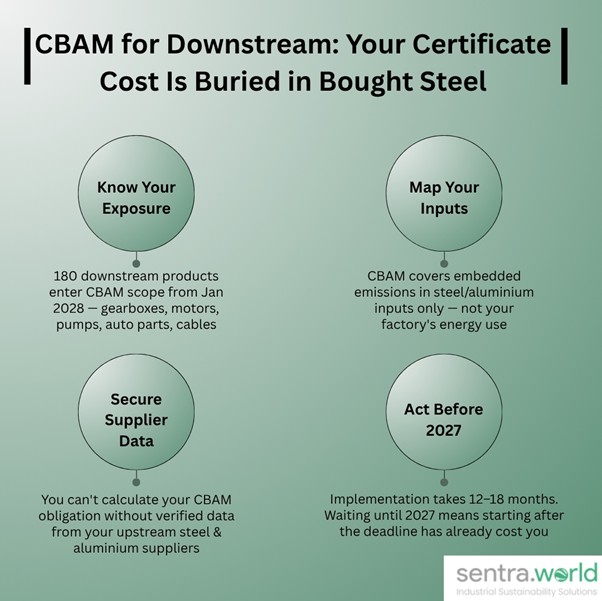
On 17 December 2025, the European Commission published a proposal to extend CBAM to 180 downstream steel and aluminium-intensive products from 1 January 2028. The sectors most exposed include machinery, hardware and fabricated metals, vehicle components, domestic appliances and construction equipment. The expansion is expected to bring approximately 7,500 new importers into CBAM scope[1] overnight. For Indian exporters in these categories, there is no transitional reporting phase, no learning period, no runway. When January 2028 arrives, the financial obligation starts immediately. A CBAM Consultant working with downstream exporters right now is working against a deadline that most of their clients do not yet know exists.
What a CBAM Consultant Maps When Downstream Products Enter CBAM Scope
The first task is product portfolio mapping, and for downstream manufacturers, it is more complex than for steel or aluminium producers because the CN code picture is more fragmented. The 180 additional products proposed for inclusion cover articles of iron and steel, articles of base metals, mechanical and electrical machinery, vehicle parts, domestic appliances and construction [2] equipment. Specific examples include nails, fasteners, pumps, industrial radiators, AC and DC motors, power transformers, cooling towers, gearboxes, cranes, metal furniture and cables made predominantly of stainless steel. A washing machine manufacturer, an auto parts exporter, and an industrial pump supplier all fall within the scope of this proposal, despite being in completely different industries. A CBAM Consultant maps each product in the exporter’s EU portfolio against the proposed CN code list to determine which lines trigger CBAM obligations from January 2028. That mapping is not a straightforward exercise. The additional products were selected based on two criteria: trade intensity and cost-push pressure from steel and aluminium price increases, which means some product categories are included that manufacturers may not intuitively associate with carbon regulation. The CBAM Consultant identifies which of the exporter’s CN codes are on the list before 2028 rather than after.
How a CBAM Consultant Calculates Embedded Emissions for Downstream Goods Differently
This is where the downstream extension has a specific feature that changes the compliance calculation entirely, and where a CBAM Consultant’s understanding of the methodology matters most.
For downstream goods, CBAM attributes emissions only to the precursor materials used, the steel or aluminium content, not to the fabrication or assembly process itself. If an Indian plant stamps car doors from a steel sheet, CBAM covers the embedded emissions in the steel sheet that went into the door, not the energy used in the stamping hall. This is fundamentally different from the calculations steel and aluminium producers make, and it is one that most downstream exporters are completely unprepared to perform. The practical implication is that a downstream exporter needs to know the verified embedded emissions of every steel and aluminium input they consume in production. That means they need their upstream steel and aluminium suppliers to have CBAM-compliant verified data. For Indian automotive component manufacturers sourcing steel from domestic mills, this creates a data dependency that the CBAM Consultant must trace backward through the supply chain before the 2028 deadline. There is one specific benefit for downstream goods worth noting. Default values for downstream products will be applied without the markup that applies to upstream CBAM goods, which increases by 10 percent in 2026, 20 percent in 2027 and 30 percent from 2028. This reduces the penalty for relying on defaults, but it does not eliminate the commercial pressure to provide verified data. EU buyers will still prefer suppliers whose data is verified, because verified actuals will typically be lower than defaults for well-run operations.
A CBAM Consultant structures the compliance build for a downstream exporter in three stages:
- Identifying which steel and aluminium inputs in the production process are covered by CBAM precursors, mapping their CN codes and calculating the steel or aluminium content as a proportion of the finished product’s weight, since this determines the embedded emissions attribution.
- Securing verified emissions data from upstream steel and aluminium suppliers in the format required by EU Implementing Regulation 2023/1773, because the downstream exporter cannot calculate their CBAM obligation without this input data from their supply chain.
- Preparing the CBAM Communication Template for Installations at the downstream product level, combining precursor emissions data with the relevant product benchmarks to produce the per-unit carbon cost the EU importer needs for their declaration.
A CBAM Liability Calculator lets downstream exporters run an initial estimate of their per-tonne carbon cost using CN code and basic steel content data, giving a starting exposure figure before the full CBAM Consultant engagement begins.
Why Downstream Exporters Cannot Wait Until 2027 to Engage a CBAM Consultant
The 2028 deadline sounds distant. It is not. Securing verified emissions data from upstream steel and aluminium suppliers, getting it verified by an ISO 14065-accredited body, and assembling the CBAM Communication Template for every product line in scope is not a process that can be completed in the weeks before January 2028. It takes 12 to 18 months when done properly. The automotive components industry alone exports approximately 27 percent of its total output to the EU and has set a target to triple overall exports to USD 60 billion by 2030. Every year of growth toward that target increases the CBAM certificate liability that arrives with the 2028 extension. A CBAM Consultant engaged in 2026 or early 2027 builds the data infrastructure that protects that growth. One engaged after January 2028 is subject to a penalty that has already begun to accumulate.
The window to prepare is open. It closes faster than most downstream exporters currently appreciate.