


A large integrated steel producer in Odisha ships hot-rolled coil to six EU countries. They have three blast furnaces, two product lines covered under CBAM, and annual EU shipments well above 50,000 tonnes. Their internal sustainability team has run some carbon calculations. Their EU buyers have been asking for data since early 2026. The team is confident they can handle verification internally.
What they have not accounted for is the physical site visit.
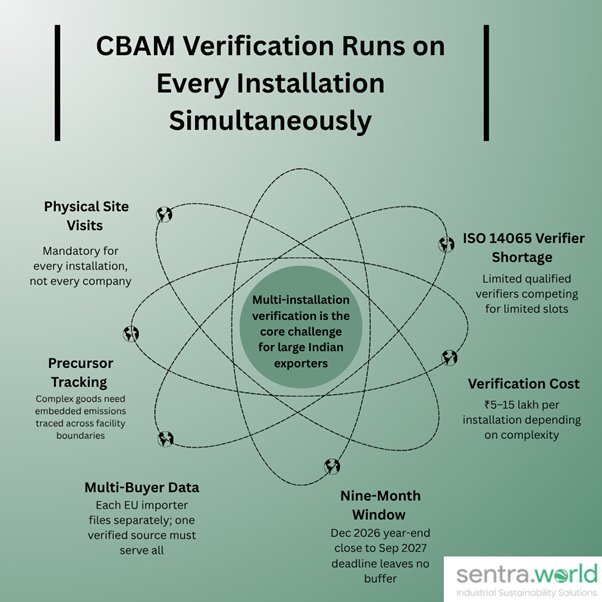
For the first reporting period covering 2026, a physical site visit is mandatory for every installation. Not every company. Every installation. A large Indian exporter with three blast furnaces at two facilities needs verified data from each installation independently. Three site visits, three verification reports, three sets of data that must be reconciled into a single CBAM Communication Template for each EU importer before the September 2027 declaration deadline. For a large exporter, the verification problem is not whether to do it. It is whether there is enough time and enough qualified verifiers to complete it for every installation before the filing window closes. A CBAM Consultant who understands how that bottleneck forms is the one who prevents it.
What a CBAM Consultant Finds When Large Exporters Assume Internal Teams Can Handle Verification
The internal sustainability team at a large Indian exporter is typically well-equipped for ESG reporting, corporate carbon footprinting, and domestic regulatory compliance. What they are not equipped for is the specific requirements of EU CBAM verification, which operates under a completely different standard. CBAM verification requires an ISO 14065-accredited third-party verifier who is independent from the team that produced the emissions data. As of late 2025, many verifiers are still obtaining CBAM-specific accreditation, which means the pool of qualified verifiers available for Indian installations is limited. A large exporter with multiple facilities competing for slots in that limited pool against thousands of other Indian exporters faces a capacity problem that compounds with volume. For a producer with two facilities and three production lines, the question is not just what verification costs. It is whether a slot with an accredited verifier can be secured at all, given that the pool of qualified verifiers for Indian installations is still forming and demand across thousands of exporters is arriving simultaneously. Physical site visits for 2026 data must be booked, conducted, and completed with enough time for the verifier to issue their report before the EU importer needs it for their September 2027 declaration. A CBAM Consultant working with a large exporter starts the verifier engagement in Q1 2026, not Q1 2027.
How a CBAM Consultant Manages Multi-Installation Complexity for Large Indian Exporters
The verification challenge for a large exporter is not just scheduling. It is data architecture across multiple installations that must ultimately feed a single coherent CBAM submission for each EU buyer. Each installation generates its own Scope 1 emissions from its own production processes. Where the same EU buyer sources products from more than one facility, their CBAM declaration requires installation-level data for each source. Where a product uses precursors from one installation that feeds into a second installation’s finished product, the embedded emissions calculation crosses facility boundaries. For complex goods produced across multiple sites, the embedded free allocation is determined as a weighted average across precursor installations, which requires the CBAM data architecture to track input volumes and emissions at the precursor level as well as the finished product level.
A CBAM Consultant structures this for a large exporter in three stages:
- Mapping each production facility and production line to its relevant CN code, determining which installations fall under CBAM scope, which products are simple goods requiring only direct emissions, and which are complex goods requiring precursor-level data from upstream inputs.
- Building an installation-level emissions monitoring framework for each CBAM-covered facility, establishing the process-level metering and documentation that an ISO 14065-accredited verifier needs to conduct the physical site visit and issue a positive verification statement.
- Coordinating verifier engagement across all installations so that site visits are sequenced efficiently, data collection is complete before the verifier arrives, and the resulting verification reports can be assembled into CBAM Communication Templates in the format each EU buyer’s declaration system requires.
Large exporters often supply multiple EU buyers across different member states. Each EU importer files their own declaration. A CBAM Consultant builds a data infrastructure that serves all of them from the same verified source, rather than running parallel and uncoordinated data collection efforts for each customer relationship. Before this work begins, A CBAM Liability Calculator gives large exporters a per-tonne certificate cost estimate across their product range. Running that figure across annual EU shipment volumes produces the total certificate exposure that frames the investment case for building a proper multi-installation compliance infrastructure.
Why Large Exporters Face a Tighter Window Than They Realise
The September 2027 deadline appears to give large exporters sufficient time to complete their verification. In practice, the window is compressed from both ends.
On one side, 2026 data can only be verified after the year ends in December 2026. Verifiers need the full year of production records before they can conduct the site visit and issue their report. On the other side, EU importers need the verified data before they can submit their annual declaration by the 30 September 2027 deadline. That leaves roughly nine months from January 2027 to complete site visits, resolve any queries raised by the verifier, produce the verification reports, and deliver the Communication Templates to every EU buyer. For a large exporter with multiple installations and multiple EU buyers, nine months is not comfortable. [1] Verification of a single installation requires a physical site visit, a data review, resolution of any queries, and issuance of a formal report. With the full year of 2026 production data only available from January 2027 and the September 2027 declaration deadline fixed, a large exporter with multiple installations has a compressed window that narrows further with each installation added to the queue. The volume of a large exporter’s EU business is an advantage in most commercial conversations. In CBAM verification, there is a time constraint. A CBAM Consultant turns that constraint into a managed schedule rather than a missed deadline.