

India’s blast furnace producers are carrying the loudest CBAM headlines. Their carbon intensity is high, their EU exposure is significant, and the compliance challenge is real. But there is a segment of Indian steel that sits in an entirely different position under CBAM, and most of them do not know it yet.Scrap-based electric arc furnace producers in India have the lowest embedded carbon intensity of any steel production route. The EU’s finalised CBAM benchmark for scrap-based EAF steel is 0.072 tonnes of CO2 per tonne of steel, compared to 1.370 tonnes for blast furnace production. That gap is not marginal. It is the difference between a shipment that costs an EU buyer almost nothing in CBAM certificates and one that costs them significantly more per tonne than the steel itself is worth in margin. The problem is that this advantage is invisible without verified data. A scrap-based EAF producer without a CBAM Consultant in place is sitting on a competitive edge their EU buyers cannot see, cannot use, and will not pay a premium for.
What a CBAM Consultant Does First for Scrap-Based EAF Producers
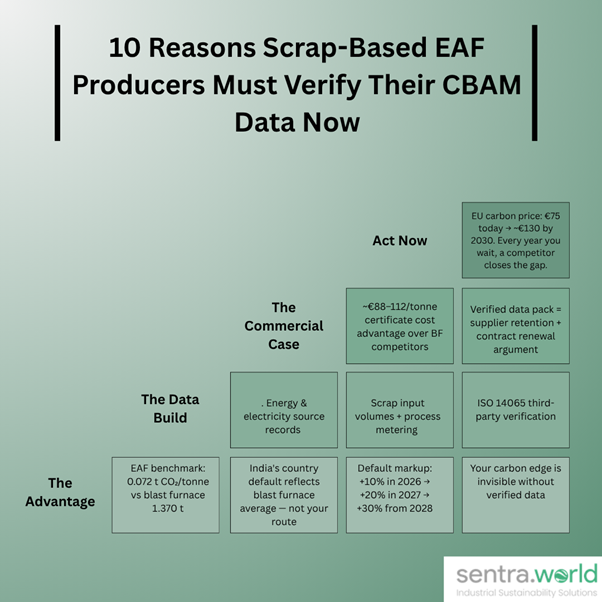
The starting point for a CBAM Consultant working with a scrap-based producer is not remediation. It is documentation. Secondary steel production through EAF routes contributes around 55 percent of India’s steel output, yet EAF technology rep[1] resents only 13 percent of India’s steel production capacity compared to the global average of 29 percent. Many of these producers are running operations that are structurally clean by CBAM standards but have never been required to generate the installation-level, process-specific emissions data that EU Implementing Regulation 2023/1773 requires. The verification challenge for scrap-based producers is different from blast furnace operations in one specific way. The emissions profile is low, which is an advantage. But the data infrastructure to prove that a low number of EU-accredited verifiers does not exist at most scrap-based facilities. Energy consumption records, scrap input documentation, electricity source records, and process-step metering all need to be in place before the verified figure can be produced. A CBAM Consultant builds that infrastructure and maps it to the EU methodology, so the verified number reflects the actual production route rather than a default value set far above it. What happens when a scrap-based producer submits no verified data? Default values are set at the average emission intensity of each exporting country, increased by a markup of 10 percent in 2026, rising to 20 percent in 2027, and 30 percent from 2028 onwards. India’s country-level default for steel reflects the average of its blast furnace-dominated production. A scrap-based EAF producer assigned that default is carrying a certificate burden that has nothing to do with how they actually make steel. A CBAM Consultant fixes that by replacing the default with a verified actual that reflects the real production route.
How a CBAM Consultant Turns Verified Emissions Into a Commercial Argument
This is where the scrap-based producer’s position becomes genuinely different from every other Indian steel exporter in an EU pricing conversation.India’s average steel emission intensity is approximately 2.5 tonnes of CO2 per tonne, while scrap-based systems can produce steel at 1.3 to 1.5 tonnes of CO2 per tonne. At an EU carbon price of EUR 80 per tonne, the difference in CBAM certificate cost between a blast furnace shipment and a verified scrap-EAF shipment from the same Indian exporter is roughly EUR 88 to EUR 112 per tonne. For an EU buyer choosing between two Indian suppliers quoting similar prices, that certificate cost difference is a direct margin impact. The scrap-based producer with verified data is cheaper in total landed cost terms even before the unit price negotiation starts. A CBAM Consultant structures the verified data pack specifically to make that commercial argument visible. The deliverable is not just a compliance document. It is the numbers that show an EU buyer exactly what a verified scrap-EAF shipment costs them in certificates versus what a blast furnace shipment from a competing Indian supplier costs them. That comparison is a supplier retention tool, a contract renewal argument, and in some cases a reason for an EU buyer to switch sourcing toward the scrap-based producer rather than away from them.
A CBAM Consultant builds that case in three steps:
- Establishing verified installation-level Scope 1 emissions for the EAF process, documented against actual electricity consumption, scrap input volumes, and auxiliary energy use, aligned to EU Implementing Regulation 2023/1773 and ready for third-party verification by an ISO 14065 accredited body.[2]
- Producing the CBAM Communication Template for Installations in the format the EU importer’s declaration system accepts, so the verified figure feeds directly into their annual CBAM filing without reformatting or follow-up.
- Framing the per-tonne certificate cost comparison between the scrap-EAF-verified figure and the Indian country-level default, giving the EU buyer a concrete number to plug into their procurement cost model.
Before commissioning that work, A CBAM Liability Calculator lets a scrap-based producer run their CN code against their actual production route to see exactly what their certificate cost looks like versus the country default. That gap in euros per tonne is the opening number for a CBAM Consultant engagement and the commercial case for quickly getting verified data in place.
Why Scrap-Based Producers Cannot Afford to Wait on a CBAM Consultant Engagement
The competitive advantage of a scrap-based EAF route compounds every year that EU carbon prices rise. EU carbon prices are projected to increase from around EUR 75 per tonne today to approximately EUR 130 per tonne by 2030. Every euro of increase widens the cost gap between a verified scrap-EAF shipment and a blast-furnace default. The producers who build their verified data now are the ones whose commercial advantage is already visible to EU buyers when that pricing pressure arrives. Those who wait are handing that advantage to whichever competitor gets there first. A CBAM Consultant is the mechanism that converts a production decision made years ago into a pricing argument that works in EU contract negotiations today.