

Indian steel and aluminium exports to the EU dropped 24 % in FY 25 before CBAM even became a financial obligation. The compliance pressure alone was enough to push buyers toward suppliers who could answer carbon questions cleanly. Now that CBAM is fully live from January 2026, that pressure has only grown. And the exporters feeling it hardest are not the ones with the worst products. They have the widest carbon data gap.
So what exactly is this gap, and why does a CBAM Consultant matter so much in closing it?
Why Steel Exporters Have a Bigger CBAM Consultant Problem Than They Realize
The carbon data gap is simple to explain. Your EU buyer needs verified, plant-level emissions data from your production facility to complete their CBAM declaration. If you cannot provide it, they are forced to use EU default emission values set by the European Commission. For Indian steel producers operating blast furnaces, the default values are particularly punishing. A typical Indian integrated steel producer emits around 2.1 tonnes of CO2 per tonne of crude steel, compared to an EU average closer to 1.8 tonnes. That gap already creates CBAM exposure. Add the conservative default markup on top, and your EU buyer is paying significantly more in CBAM certificates than they would if your actual verified data were available.
That extra cost does not sit quietly on your buyer’s books. It comes back to you as a price renegotiation, a tougher contract, or a switch to a different supplier. The carbon data gap is a commercial problem, not just a compliance one. And fixing it is exactly what a CBAM Consultant is built to do.
What a CBAM Consultant Does to Close the Carbon Data Gap
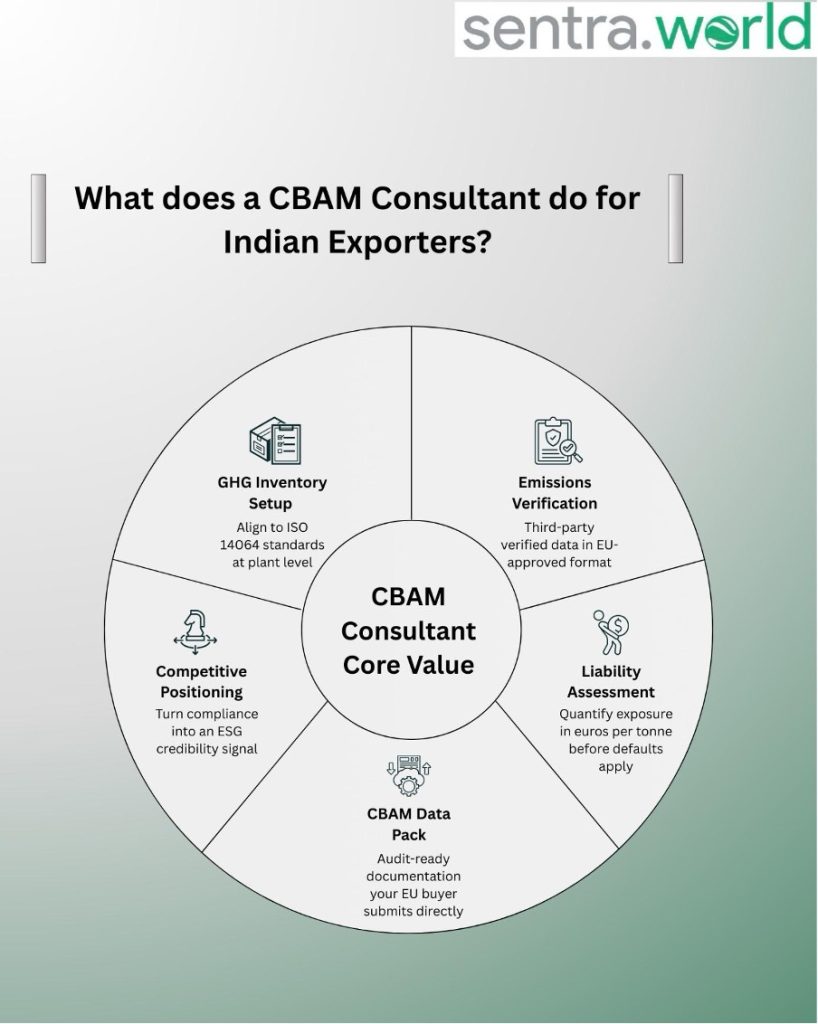
A CBAM Consultant starts where most exporters are weakest: at the data collection stage. Most Indian manufacturers do not have a GHG inventory system that tracks emissions at the process and plant levels in the format required by the EU. They may have ESG reports, sustainability disclosures, or ISO certifications. CBAM does not recognize ESG disclosures. It demands plant-level emissions data verified by EU-approved auditors.
A CBAM Consultant builds that system from scratch if needed. They define the operational boundaries of your production process, identify all inputs and outputs that generate embedded emissions, set up data collection aligned with ISO 14064 standards, and prepare your facility for third-party verification by an ISO 14065-accredited auditor. The output is a verified emissions figure your EU buyer can use directly in their CBAM declaration without needing anything more from you.
Before starting that process, it helps to know your current financial exposure. sentra.world’s CBAM Liability Calculator lets you enter your product CN code and basic emissions data to get an instant estimate of your CBAM liability in euros per tonne. That number becomes the baseline your CBAM Consultant works to bring down through verified actual data.
How a CBAM Consultant Helps Steel Exporters Stay Competitive in EU Contracts
Carbon data is no longer just a compliance requirement. It is a supplier selection criterion. EU buyers are actively ranking suppliers based on their ability to provide clean, audit-ready emissions data. Those who can do it without creating extra work for the buyer’s compliance team keep and grow their contracts. A CBAM Consultant prepares you for that ranking by building what is now being called a standardized CBAM data pack: a documented, independently verified package of your emissions data formatted exactly as your EU buyer needs it. This is the deliverable that turns your CBAM compliance from a friction point into a relationship strength. There is also a pricing angle here that most exporters are not yet fully leveraging. Some suppliers are already offering dual pricing to EU buyers, one base price and a separate CBAM-adjusted price based on verified emissions. This approach makes the carbon cost transparent and gives buyers confidence that they are not absorbing hidden exposure. A CBAM Consultant can help you build and communicate this pricing model to your EU customers, positioning you as a more sophisticated and trustworthy supplier than competitors still working from assumptions.
CBAM Consultant Advantage: Lower Emissions Can Mean Better Business
Here is the shift in thinking that changes the CBAM story for steel exporters. Producers with lower carbon intensity can become cheaper after carbon costs are applied than high-emission competitors, even if their base price is similar. When carbon is factored into the total cost of procurement, the supplier who produces cleaner steel wins on the landed price, not just the invoice price. A CBAM Consultant helps you understand where your production sits on that spectrum, where emissions reductions are achievable, and how to communicate your carbon performance to EU buyers in a way that creates commercial value. It is a shift from managing a compliance burden to building a competitive advantage, and it is available to every Indian steel exporter willing to do the work. The carbon data gap is real, but it is also fixable. And every month that passes without addressing it is another month your EU buyers are evaluating alternatives. A qualified CBAM Consultant can assess your carbon data gap, build the verification framework your EU buyers need, and help you use your emissions data as a commercial tool rather than a compliance liability.