


Here is something that catches most Indian exporters off guard. CBAM compliance is not only about measuring what happens inside your factory. It requires you to account for the emissions embedded in every significant input that goes into your product. The coal your upstream supplier uses to produce the iron ore you process. The electricity intensity of the aluminium billet you buy and roll. If those upstream emissions are not tracked, calculated, and documented correctly, they show up as a gap in your CBAM data. And when verified supplier data is unavailable, your EU buyer has no choice but to fall back on default values, which push costs up for both of you. Managing this supplier data problem is one of the most practically demanding parts of CBAM compliance. It is also where a CBAM Consultant earns their value most visibly.
Why Supplier Emissions Data Is the Hardest CBAM Problem a CBAM Consultant Solves
Most Indian exporters have reasonable visibility into their own plant-level emissions. Where the gap consistently appears is upstream. Large producers often do not share plant-level emissions data with the MSMEs and manufacturers that source from them. A rolling mill sourcing steel billets from a large integrated plant may have no idea what the actual embedded emissions of that input are. Without that number, the rolling mill cannot produce a complete CBAM data set, no matter how clean their own operations are. This is a structural problem across Indian export supply chains, not a failure of any individual business. But CBAM does not make allowances for structural problems. What CBAM needs is granular, installation-level emissions data with a clear methodology, verified by an accredited third party. General ESG disclosures, sustainability reports, and industry averages do not qualify. The data must be specific, traceable, and formatted in accordance with EU calculation standards. The gap between what most Indian suppliers currently produce and what CBAM actually requires is where a CBAM Consultant steps in.
What a CBAM Consultant Does to Fix Your Supplier Data Chain
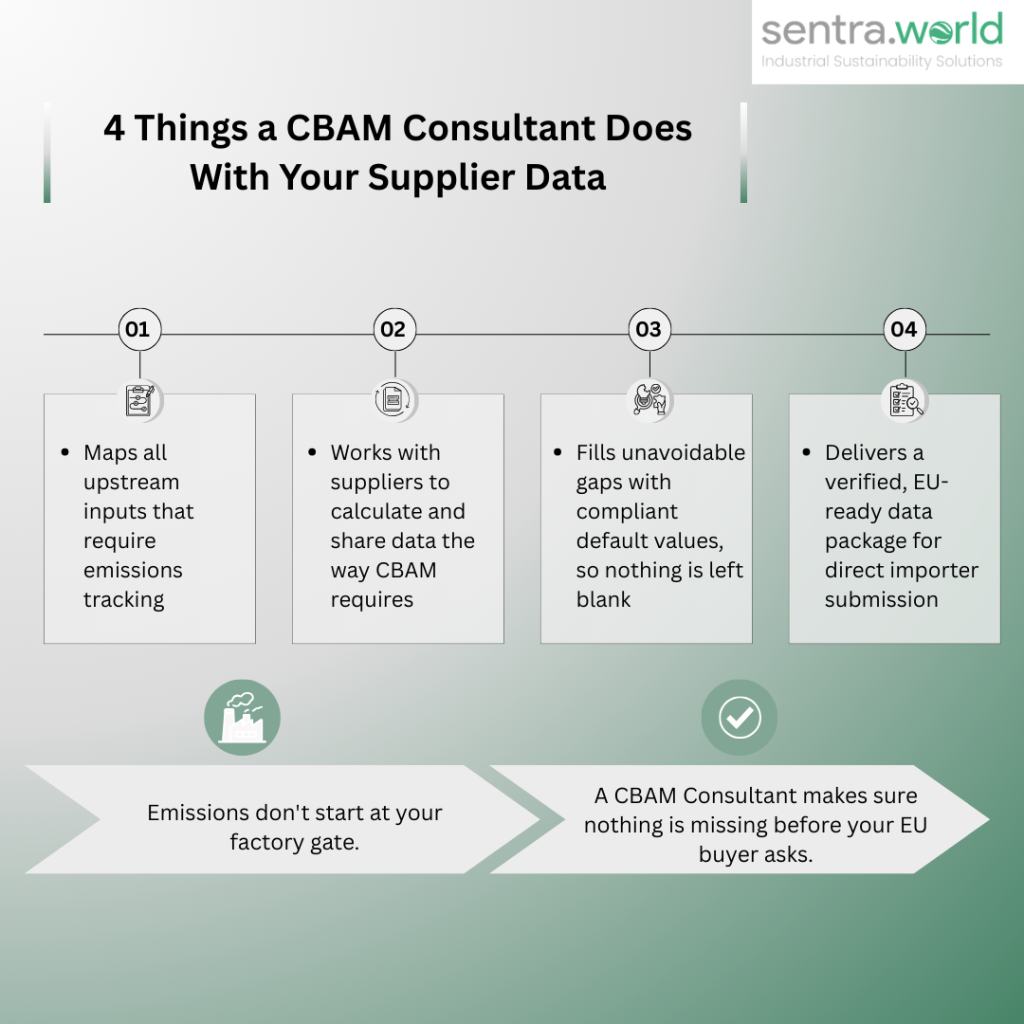
Closing the supplier emissions data gap is not a single conversation. It is a structured engagement process that a CBAM Consultant manages on your behalf across multiple levels of your supply chain. The typical approach involves:
- Mapping every significant input into your CBAM-covered product and identifying which ones require upstream emissions data
- Reaching out to each supplier with a clear data request framed in language they can act on, not EU regulatory language, most suppliers cannot interpret
- Providing suppliers with templates and methodology guidance so their data is calculated consistently and in a format your EU buyer can use
- Following up systematically because supplier data collection is rarely a one-round exercise
- Flagging where actual supplier data is not obtainable and advising on whether a defensible default value or precursor emissions estimate can be used within the limits CBAM permits
Suppliers who have zero idea about emissions reporting, conflicting calculation methods across product lines, and missing documentation are the norm, not the exception, in Indian supply chains right now. A CBAM Consultant manages that friction so you are not chasing data from three directions while also trying to run your export operations.
How a CBAM Consultant Structures Supplier Data for EU Importer Submission
Collecting supplier emissions data is only half the problem. The other half is organizing it correctly for your EU importer to use in their CBAM declaration. The European Commission provides a CBAM Communication Template for Installations specifically designed to help EU importers gather consistent, compliant emissions data from their non-EU suppliers. Your data must fit that template cleanly for your importer to use it.
A CBAM Consultant structures your supplier data collection and your own plant-level data so that the final output is a complete, EU-ready emissions data package. That package typically includes:
- Direct emissions broken down by production process and energy source
- Indirect emissions from purchased electricity, calculated using the correct country-specific emission factor
- Upstream precursor emissions for qualifying inputs, documented with methodology
- A clear declaration of calculation methodology aligned with CBAM’s Annex IV requirements
- Verification status of each data component and a record of sources
Before building this data structure, it’s helpful to understand the financial stakes. Sentra’s CBAM Liability Calculator gives you an instant estimate of your carbon cost exposure in euros per tonne using your product CN code and basic emissions inputs. That number clarifies exactly how much is riding on getting the supplier data right.
The CBAM Consultant Advantage: Reliable Data That Protects Every Shipment
Indian exporters face serious challenges in providing accurate product-level emissions data that meet EU CBAM obligations. The consequence of failing is straightforward. Default values get applied. Costs go up. Contract terms get tighter. And over time, EU buyers start looking for suppliers who make their compliance life easier. The exporter who has a clean, complete, consistently delivered supplier emissions data package is the one who builds trust at the commercial level, not just the compliance level. That consistency is what a CBAM Consultant builds for you, across your supply chain, in a format that works for your EU importer and holds up under regulatory scrutiny.
Does your current data tell the full emissions story of your product, from input to shipment? If there are gaps upstream, a CBAM Consultant is the fastest way to close them before they close the deal for you.