

The market for CBAM compliance services in India has grown fast. Since January 2026, when the EU moved CBAM into its definitive phase, the number of consultants, platforms, and advisory services claiming to handle CBAM has multiplied just as quickly as the pressure on exporters to comply. That creates a real problem. An Indian exporter looking for a CBAM Consultant today is navigating a crowded market where almost everyone sounds credible, and very few have been tested under actual EU scrutiny. The wrong choice is not a minor inconvenience. If your CBAM data is incorrect, incomplete, or calculated using the wrong methodology, your EU buyer faces higher certificate costs, tighter contract terms, and the option to find a supplier who gets it right. Choosing a CBAM Consultant is one of the most commercially significant decisions an exporter will make in 2026. Here is how to make it well.
The First Thing a Good CBAM Consultant Should Demonstrate Is EU Methodology Fluency
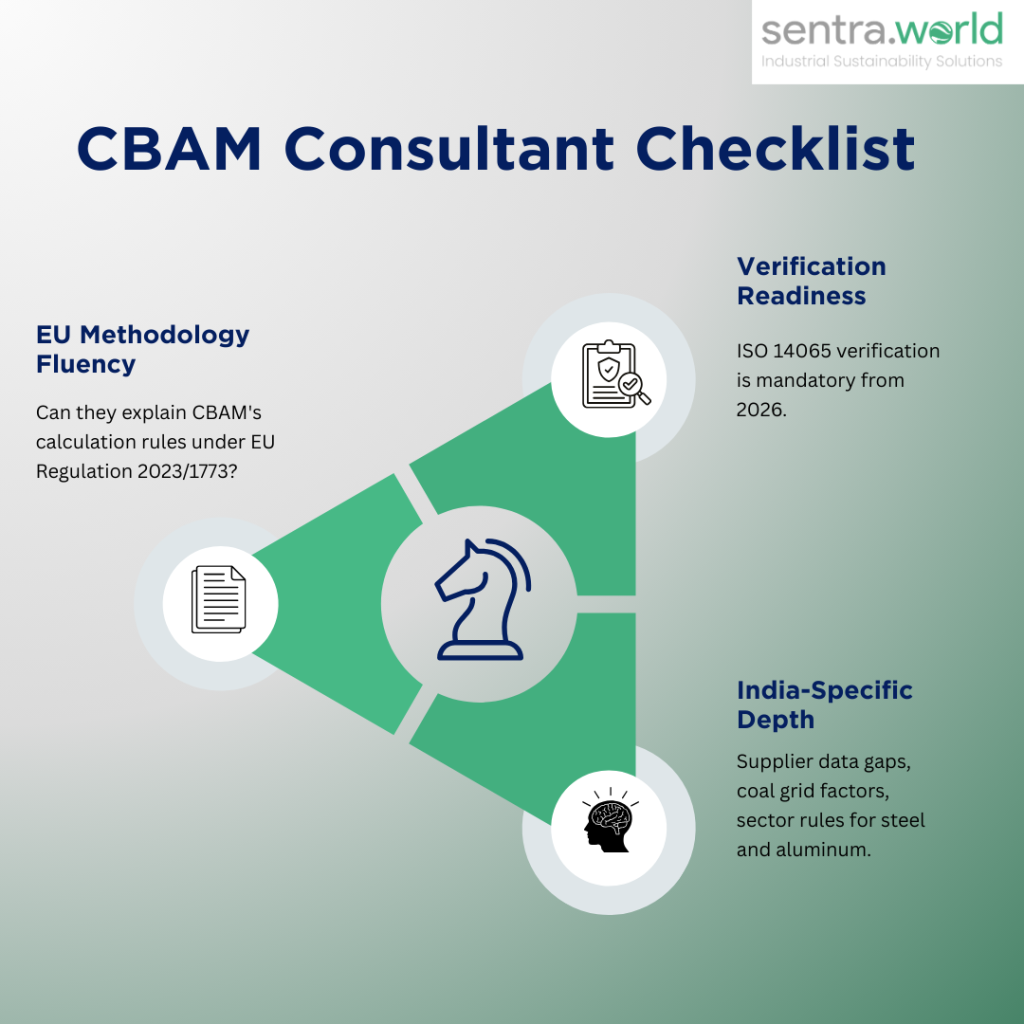
CBAM does not follow the GHG Protocol. It does not follow ISO 14064-1 the way most sustainability consultants understand it. It has its own prescribed calculation methodology under EU Implementing Regulation 2023/1773, with specific rules for system boundaries, activity data, emission factors, and the treatment of precursor inputs. A consultant who cannot explain those rules in concrete terms, or who relies on general GHG accounting frameworks and calls it CBAM compliance, is not a CBAM Consultant. They are a carbon accountant applying the wrong standard to your export business. Ask any prospective consultant directly: what is the difference between how CBAM calculates embedded emissions and how the GHG Protocol does it? The answer should be immediate and specific. If it is vague, keep looking.
What a Qualified CBAM Consultant Knows About Verification That Most Do Not
One of the clearest ways to assess a CBAM Consultant is to ask how they handle verification. From 2026, third-party verification by an ISO 14065 accredited auditor is mandatory for any exporter using actual emissions data rather than defaults. Verification involves a physical site inspection, a review of your monitoring methodology, and an assessment of your documentation against EU standards.
But a qualified CBAM Consultant should be able to:
- Prepare your facility and data systems for the site visit before the accredited verifier arrives
- Identify gaps in your documentation that a verifier will flag as non-conformities
- Review the draft verification report and advise on any findings before they become compliance issues
If your consultant cannot explain the verification process clearly, or has no relationships with accredited verification bodies, that is a flag worth taking seriously. The verification step is where poorly prepared data either holds up or falls apart, and your consultant needs to be ready for it long before the auditor walks in.
The Questions Every Indian Exporter Should Ask a CBAM Consultant Before Signing
Beyond methodology and verification knowledge, there are several practical questions that reveal whether a CBAM Consultant has genuinely worked in the Indian export context or is adapting a European compliance playbook to a market they do not fully understand.
Ask these before you commit:
- Have you worked with exporters in my specific sector, steel, aluminium, cement, or fertilisers, and can you show me examples of completed CBAM data packs?
- How do you handle supplier emissions data collection when upstream suppliers do not track plant-level emissions?
- What happens if my verified data is not ready before my EU buyer’s reporting deadline?
- Do you understand the India-specific coal grid emission factor and how it affects my Scope 2 calculation under EU methodology?
- What does your deliverable actually look like, and can it go directly into my EU importer’s CBAM declaration?
A CBAM Consultant working at the right level of depth should answer all of these without hesitation. The supplier data question in particular is revealing. Most data gaps in Indian export compliance sit upstream, not in the exporter’s own facility, and a consultant who does not have a structured approach to supplier engagement is leaving the hardest part of your compliance problem unsolved.
How a CBAM Consultant Should Help You Understand What Is at Stake Financially
Before any consultant begins substantive work, you should have a clear picture of your actual carbon cost exposure in euros per tonne. A CBAM Liability Calculator lets you estimate that instantly using your CN code and basic emissions data, giving you the number your EU buyer is already calculating on their end. A CBAM Consultant should use a figure like this as the starting point for a compliance conversation, not a closing one. If a consultant cannot anchor their recommendation to a real financial exposure figure early in the process, they are selling compliance services without connecting them to the commercial reality your business is navigating.
What to Ask Your CBAM Consultant Before the Contract Is Signed
Here is something worth doing before you sign with anyone. Ask them to show you a CBAM communication template they have actually completed for an Indian exporter. Something they built, for a real client, in your sector. If they have done this work before, they will have one. If they hesitate, or offer you a proposal instead, or start explaining why they cannot share client documents, you have your answer. Understanding CBAM and having delivered CBAM are two very different things, and right now the market is full of people who are very good at the first one. Your EU contracts are not the right place for someone to get their first experience.