

Somewhere in your inbox right now, or arriving soon, is an email from your EU buyer asking for verified carbon emissions data for your shipments. They need plant-level figures, Scope 1 and Scope 2, calculated using EU methodology, with third-party verification if possible. They mention a CBAM declaration deadline. They say it is urgent. Most Indian exporters forward this to their accounts team or sustainability manager, get something put together, and send it back. Their buyer’s compliance team looks at it and quietly notes that the data does not match CBAM requirements. The buyer adds a carbon-linked clause to the next contract. The price negotiation gets harder. Eventually, a supplier who sends the right data without being asked twice takes that slot. That is how CBAM is reshaping EU supplier relationships in 2026. Not with a single dramatic penalty, but through quiet contract-by-contract attrition.
What Your EU Buyer Is Actually Doing When They Ask for a CBAM Consultant Report
Your EU buyer is not just collecting data. They are solving a financial problem they have no other way to solve. EU importers are legally responsible for submitting CBAM declarations and purchasing certificates to cover the embedded emissions in every shipment. They cannot measure your plant’s emissions themselves. They depend entirely on what you send them. When your data is missing or unverified, their only option is to apply EU default emission values for your country and product. Those defaults are set 30 to 80 percent above actual emissions because the EU uses the highest observed emission intensity as the benchmark. At an EU carbon price of around EUR 80 per tonne, a default-value penalty of even 0.5 tonnes CO2 per tonne of product on a 10,000-tonne shipment adds EUR 400,000 in unnecessary certificate costs to your buyer’s books. That cost comes straight back to you as a price cut demand or a lost renewal. A CBAM Consultant report is what prevents that from happening. It gives your buyer actual, verified data they can use instead of the default, and it cuts their compliance burden to near zero. That combination is what makes you a supplier worth keeping.
Why Most Indian Exporters Cannot Answer That Request Without a CBAM Consultant
The instinct is to pull together whatever carbon data exists internally and send it across. The problem is that CBAM does not acce₹₹₹₹₹₹₹pt ESG disclosures, sustainability reports, or GHG Protocol-based calculations as valid evidence. EU Implementing Regulation 2023/1773 has its own prescribed methodology with specific system boundaries, emission factors, and activity data requirements. A document that looks thorough by Indian reporting standards will be missing the exact fields a EU importer’s declaration system requires. This is the gap a CBAM Consultant closes. They understand what the EU importer’s system needs at the field level, how to structure your data to fit the CBAM Communication Template for Installations, and what verification standard makes the data usable rather than just present. Without that knowledge, the data you send creates more work for your buyer, not less. And buyers under their own compliance pressure do not reward suppliers who create extra work.
What a CBAM Consultant Report Actually Delivers to Your EU Buyer
A proper CBAM Consultant report is a structured data package your buyer’s compliance team can submit directly without reformatting anything. Here is what it contains:
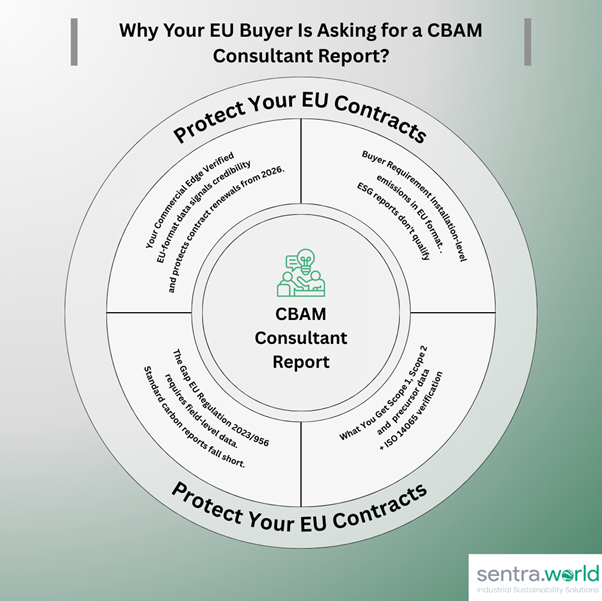
- Specific embedded emissions per tonne of product calculated at the installation level using EU methodology, not company averages or regional estimates, which CBAM explicitly does not accept.
- Scope 1 direct emissions broken down by production process and fuel source, with activity data and emission factors documented clearly so the verifier and your buyer can both trace the calculation.
- Scope 2 indirect emissions from purchased electricity using India’s grid emission factor under the correct EU calculation approach, which differs from how most Indian manufacturers currently report electricity emissions.
- Upstream precursor emissions for significant inputs such as iron ore or aluminium billets, with methodology declared in line with CBAM’s Annex IV requirements.
- A third-party verification statement from an ISO 14065-accredited auditor, without which your buyer cannot use actual values and must revert to defaults regardless of what else you send.
Before a CBAM Consultant starts building this package, understanding your financial baseline matters. sentra.world’s CBAM Liability Calculator and eligibility checker lets you enter your CN code and basic emissions data to get your estimated exposure in euros per tonne instantly. That number tells you exactly how much the gap between your actual emissions and the EU default is costing your buyer right now, and gives your consultant a concrete target to work from.
The CBAM Consultant Advantage: What the Right Report Does to Your Supplier Position
From January 2026, CBAM is embedded in every price negotiation, reshaping contracts and supplier rankings. EU buyers a[1] re now comparing suppliers not just on price and delivery but on how cleanly and quickly they respond to carbon data requests. Exporters who demonstrate year-on-year emissions improvement are better positioned in supplier reviews and contract renewals than those who submit the same unverified numbers every quarter. The exporter who responds to the CBAM data request within days with a complete, verified, EU-formatted package and CBAM Certificates is not just being compliant. They are telling their buyer something important about how they run their business. That signal matters more than most exporters realise when renewal conversations begin.
Has your EU buyer sent that request yet? If they have, a CBAM Consultant is the fastest way to send back the right answer.