

A forging unit in Ludhiana supplies tractor parts to a large Indian manufacturer. That manufacturer ships finished tractors to dealers in Germany. The forging unit has never exported anything to the EU directly. No EU buyer has ever sent them a contract. No customs filing has ever mentioned CBAM. And yet, in 2026, that forging unit’s carbon data is at the center of a CBAM compliance problem their customer cannot solve without them. This is the reality for tens of thousands of Indian manufacturers who think CBAM does not apply to them because they are not exporters. It does apply to them. Just indirectly, and without the paperwork that would normally make it obvious.
Why Indirect Exporters Are Inside the CBAM Problem Whether They Know It or Not
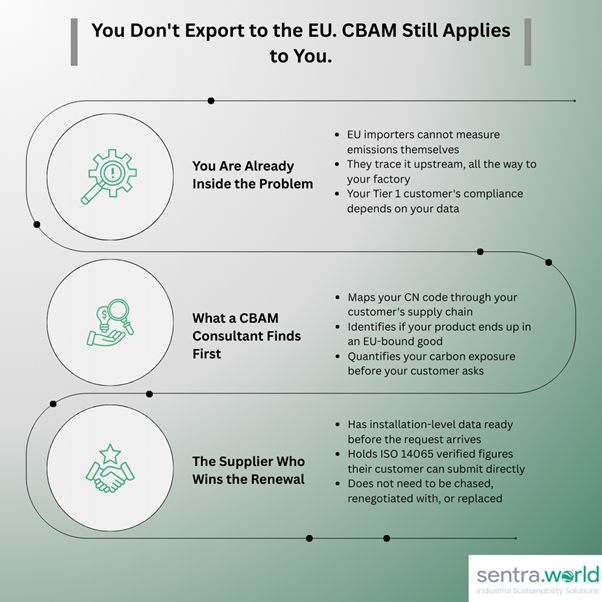
CBAM’s legal obligation sits with the EU importer. But the emissions on which that obligation is based originate in factories across India, including those that have never shipped a single tonne directly to Europe. EU importers cannot measure the embedded emissions in imported goods themselves. They depend on their suppliers, who depend on their suppliers, all the way down the chain. When a Tier 1 exporter cannot provide verified emissions data to their EU buyer, they look upstream first. They need plant-level carbon figures from every significant input in their production process, including the steel billets, aluminium sheets, or forged components they sourced from you. When Tier 1 suppliers commit to carbon accountability, that pressure trickles down to every link in the chain. Tier 2 and Tier 3 manufacturers must provide data or risk being replaced by a supplier who can. This is not a future scenario. It is happening in procurement conversations across Indian industrial clusters right now.
What a CBAM Consultant Identifies for Indirect Exporters That They Cannot See Themselves
Most indirect exporters do not know which of their products feed into EU-bound supply chains. They supply to a mix of domestic and export-oriented customers and have no visibility into where the finished goods ultimately go. This is exactly where a CBAM Consultant starts.
The first job is supply chain mapping. A CBAM Consultant traces your product’s CN code through your customer’s production process to determine whether it ends up in a CBAM-covered good exported to the EU. If it does, your embedded emissions are part of your customer’s compliance obligation, and your customer’s EU buyer is eventually going to ask for them. The second job is exposure assessment. The European Commission’s downstream extension proposal, put forward in December 2025, would bring an additional USD 1.1 billion worth of Indian exports under CBAM scope from January 2028. The sectors most affected include automotive components, mechanical machinery, and furniture fittings. The automotive components industry alone exports approximately 27 percent of its total output to the EU. A forging unit, a precision parts manufacturer, or a sheet metal processor supplying into that sector is carrying CBAM exposure today, even though they are not yet required to report anything. Critically, unlike the original CBAM goods, there is no transition period proposed for downstream products. When the extension takes effect, EU importers will face immediate financial obligations with no preparatory runway. The indirect exporter who has not built their emissions data infrastructure before that date will lose their slot in the supply chain to one who has.
How a CBAM Consultant Builds the Data Your Tier 1 Customer Will Come Asking For
When your direct customer eventually receives a CBAM data request from their EU buyer, their first call is to you. At that point, you have two options. You can scramble, delay, and send something that does not meet EU methodology standards. Or you can send a complete, verified data package that your customer can use immediately.
A CBAM Consultant builds the second option before the call ever comes. For an indirect exporter, the work typically covers:
- Calculating your product’s embedded emissions at the installation level using EU Implementing Regulation 2023/1773 methodology, because general GHG reports or ISO 14064 summaries prepared for other purposes do not meet CBAM’s granularity requirements and will be rejected at the point of use.
- Setting up a monitoring system for Scope 1 and Scope 2 emissions at the process level, so your data is traceable and defensible when your customer’s EU buyer or their verifier asks how the numbers were calculated.
- Preparing your facility for third-party verification by an ISO [1] 14065-accredited auditor, which your Tier 1 customer will eventually require before they can use your data in their own CBAM declaration.
Before this work begins, understanding your financial starting point helps. sentra.world’s[2] CBAM Liability Calculator lets you estimate the embedded carbon cost in euros per tonne for your product using your CN code and basic emissions inputs. That number tells you and your CBAM Consultant exactly how much your data gap is costing your customer’s EU buyer right now, and frames the commercial case for getting it right.
The CBAM Consultant Advantage: Being the Supplier Your Customer Does Not Have to Worry About
Major EU buyers are already requesting embedded emissions data from suppliers through their procurement scoring, even for products not yet formally covered under CBAM. The supply chain pressure is moving faster than the regulatory timeline. Indian manufacturers across cities who supply into EU-linked value chains are already fielding data requests they do not know how to answer. The indirect exporter who invests in a CBAM Consultant now becomes the supplier that their Tier 1 customer does not have to chase, renegotiate with, or eventually replace. That position is worth far more than the cost of the compliance work. And the window to build it ahead of the downstream extension deadline is narrowing. Does your product end up in a supply chain that touches the EU? If you are not certain, that question alone is worth answering with a CBAM Consultant before your customer answers it for you.