

ESG Reporting & Sustainability Disclosure
Turn complex ESG data into audit-ready sustainability reports with ESG compliance software built for industrial manufacturers
What is ESG Reporting?
ESG reporting is the process through which companies disclose their performance across Environmental, Social, and Governance factors. It helps businesses communicate how they manage sustainability risks, resource use, workforce practices, ethical conduct, compliance, and long-term business resilience.
For industrial manufacturers, ESG reporting goes beyond preparing a yearly sustainability report. It requires reliable data from plants, energy systems, suppliers, HR, EHS, procurement, finance, and governance teams.
By making ESG data measurable and transparent, companies can meet regulatory requirements, respond to investor and buyer expectations, improve operational accountability, and build trust with stakeholders.
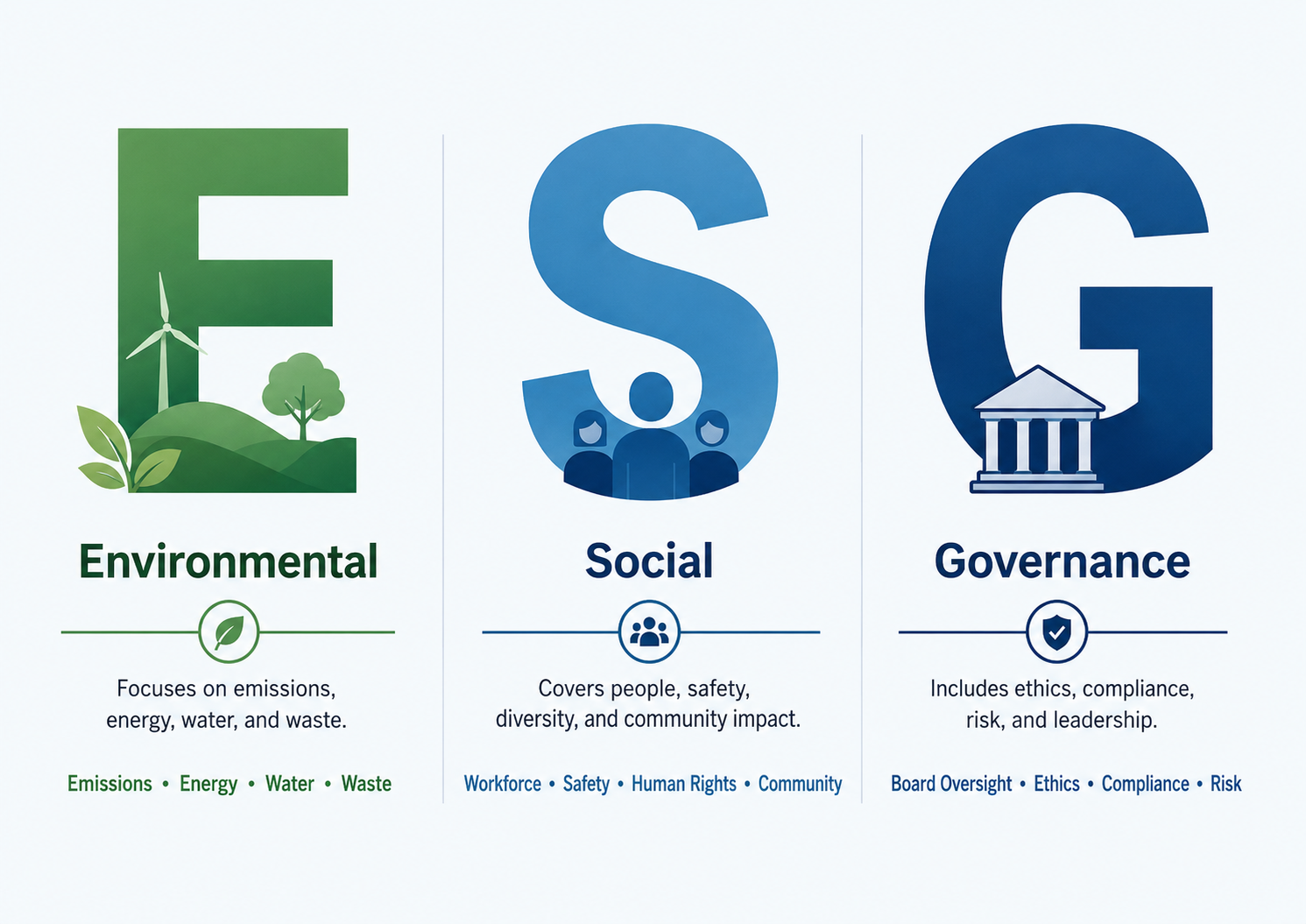
Pillars of ESG Reporting
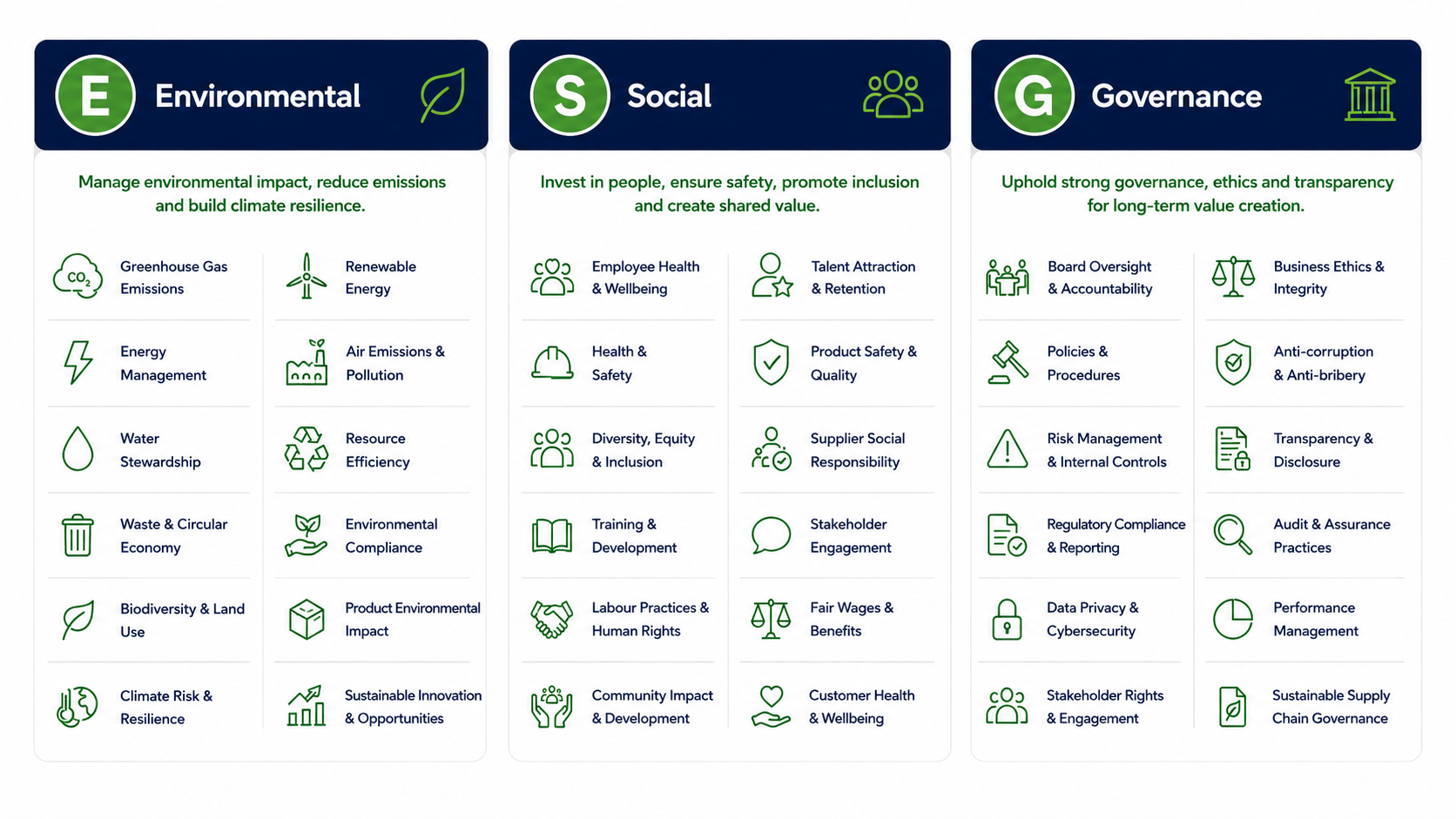
The three Pillars of ESG Reporting help companies organise sustainability data into clear environmental, social, and governance categories. For manufacturers, these pillars must be supported by reliable plant-level and business-level data.
For manufacturers, these pillars need reliable operational data from plants, departments, and suppliers. A strong ESG reporting framework connects environmental, social and governance metrics into one ESG data management platform, making sustainability disclosures more accurate, consistent and audit-ready across different ESG reporting standards.
What changes in 2026?

Verified Supplier Data Becomes Essential
Actual emissions data must be verified by an accredited third-party auditor. Without verification, importers must rely on default emission values, which are typically higher.

New EU Benchmark Values
The EU has introduced product-specific benchmark emissions values based on CN codes and production routes. If supplier data is unavailable, country-level default benchmarks apply, increasing CBAM exposure.

CBAM Costs Begin
From 1 January 2026, importers must purchase CBAM certificates covering emissions above benchmark levels.
Certificate prices are linked to the EU ETS carbon market.

CBAM Registry Becomes the Compliance Hub
The EU CBAM Registry will manage emissions of reporting and certificate purchases. While declarations become annual, companies will still track emissions quarterly for cost forecasting.
Calculate your CBAM costs
Calculate your CBAM costs
What Each Part of the Formula Means:
Embedded Emissions– The direct greenhouse gas emissions generated during the production of the exported product. These emissions are calculated according to EU CBAM methodology
SEFA (Specific Embedded Free Allocation)– SEFA adjusts emissions using the EU benchmark and phase-in factor, reflecting the gradual removal of free EU ETS allowances between 2026 and 2034.
SEFA is calculated using:
- Specific mass of precursor materials
- EU benchmark emissions
- CBAM phase-in factor
- Cross-sectoral correction factor
CBAM Certificate Price – The CBAM certificate price is linked to the EU Emissions Trading System (EU ETS) and reflects the carbon market price in the EU.
Importers must purchase certificates equivalent to the emissions subject to CBAM.
Carbon Price Already Paid – If a carbon price has already been paid in the exporting country (for example under national carbon pricing systems like India’s CCTS), it can be deducted to avoid double carbon pricing.
The result determines the CBAM cost per tonne of imported goods, which EU importers must pay through CBAM certificates.

ESG Reporting Frameworks and Standards
An ESG reporting framework which is strong helps companies decide what to disclose, how to calculate different metrics , which data points are to be included and how the disclosures should be reviewed.
The real challenge for industrial manufacturers is not only to understand each framework but also building one reliable ESG foundation that can then be mapped across multiple ESG standards. ESG reporting varies by different regions, around 20+ frameworks are recognised globally. It follows two frameworks i.e. Mandatory and Voluntary reporting.
Mandatory ESG Reporting Framework
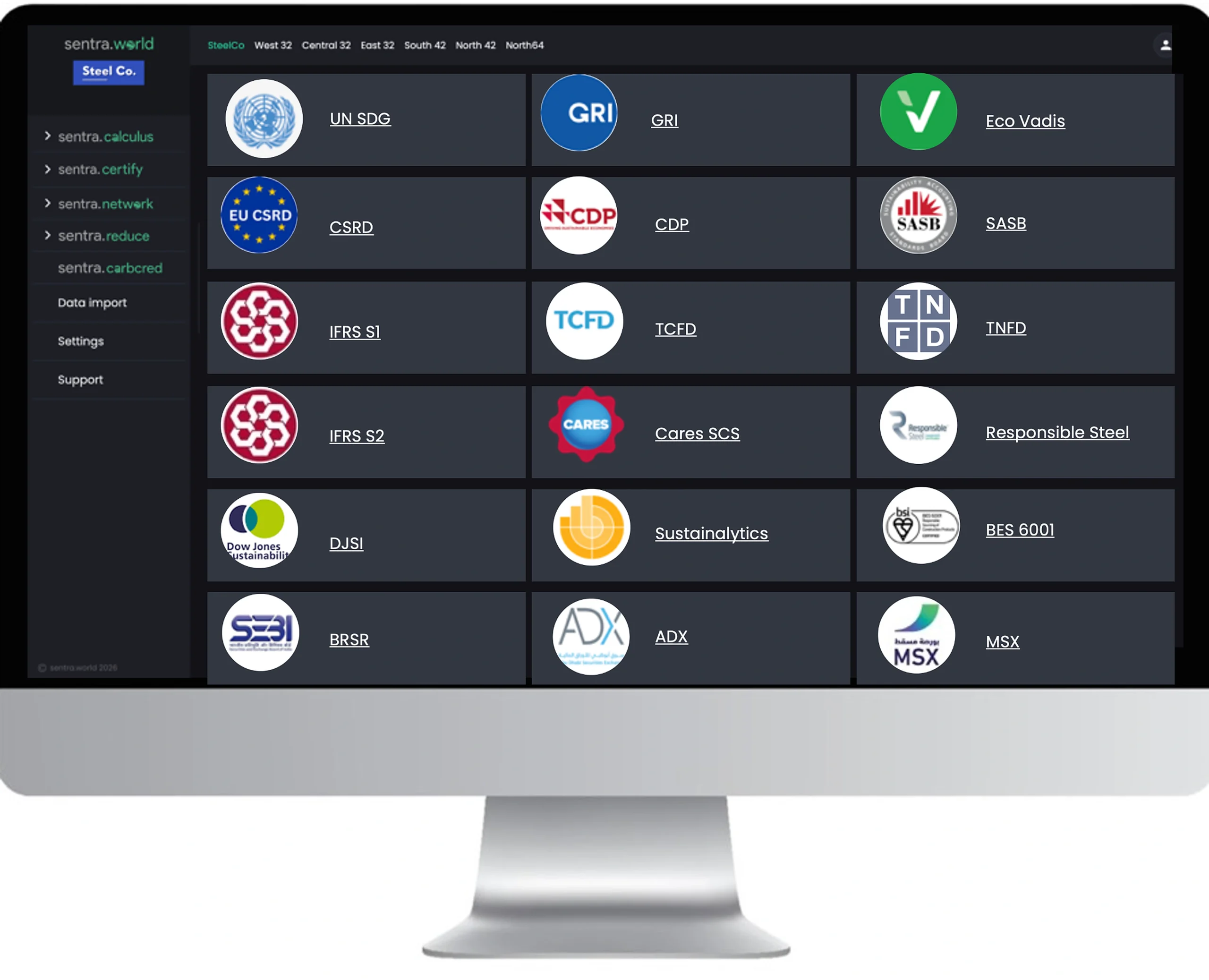
Mandatory ESG reporting applies when a regulator, stock exchange, or law requires eligible companies to disclose sustainability information. The examples for mandatory reporting frameworks are BRSR (India), MSX(Oman), ADX(UAE) and CSRD (EU).
Voluntary ESG Reporting Framework
Voluntary ESG reporting frameworks help companies improve comparability, stakeholder communication, and international credibility even when reporting is not legally mandatory. Ex: GRI, ISSB/ IFRS S1,IFRS S2, SASB, TCFD etc.
ESG Data Management Across Your Operations
In ESG reporting, there are multiple data inputs that are to be considered across Environmental, Social and Governance metrics. sentra.world helps companies collect, validate, calculate and then report ESG data across these metrics. Using ESG data management tools for reporting, manufacturers can move from fragmented manual inputs to a structured ESG data management platform that supports dashboards, disclosures, audits and sustainability reports.
GHG Emissions
Scope 1, Scope 2, Scope 3 emissions intensity, product-level emissions, and value-chain emissions.
Energy
Electricity, fuel, renewable energy, energy intensity, energy savings, and plant-level performance.
Water
Water withdrawal, consumption, discharge, recycling, reuse, and water intensity.
Waste
Hazardous waste, non-hazardous waste, recycling, reuse, disposal, and circularity indicators.
Workforce and Safety
Employee data, worker data, diversity, training, injuries, fatalities, LTIFR, and safety systems.
Governance and Compliance
Board oversight, policies, ethics, anti-corruption, risk management, whistleblower mechanisms, and controls.
Supply Chain
Supplier ESG data, responsible procurement, supplier assessments, value-chain emissions, and customer ESG requirements.
Product Sustainability
Product Carbon Footprint, Corporate Carbon Footprint, LCA, EPD, carbon intensity, and product-level sustainability data.
ESG Reporting Requirements by Region
ESG principles are global, but ESG reporting requirements differ across ESG in India, ESG in UAE, ESG in Oman, and other markets. A manufacturer operating across multiple regions may need to report similar data in different formats.

India: BRSR and BRSR Core
India’s ESG disclosure landscape is led by BRSR and BRSR Core for 1000 eligible listed companies. The Core framework requires structured ESG data for emissions tracking along with the metrics mapped correctly.

UAE: SCA, ADX and DFM
ESG reporting in UAE is guided and shaped by exchanges and regulator level expectations which includes ADX, SCA, DFM along with other voluntary frameworks like GRI, SASB etc.

Oman: MSX and OSI
Oman’s ESG reporting landscape is led by MSX disclosure requirements for listed public companies, along with OSI to evaluate the performance of companies across ESG and aligning to the global standards.
ESG Reporting and Preparation Journey
ESG reporting becomes difficult when data is collected manually across departments, plants, suppliers, and business units. sentra.world helps companies build a structured ESG reporting and preparation workflow from source data to final disclosure.
- 1. Define ESG Boundary
Identify the entire value-chain coverage covering plants, subsidiaries and also define operational boundaries, reporting periods.
- 2. Identify ESG Reporting Requirements
Identify and map applicable ESG reporting requirements across 20+ frameworks and standards such as BRSR, GRI, ADX, MSX, DFM, CSRD, customer questionnaires and internal ESG scorecards or dashboards.
- 3. Collect Source Data
Capture all the required data points from the existing systems set up that can include ERP systems, excel files, meters, invoices, utility bills, EHS systems, procurement data, HR records and more.
- 4. Calculate & Validate Metrics
Perform all the necessary calculations including emissions factors, formulas, unit conversions, intensity calculations, which further require quality checks and approval workflows.
- 5. Generate Sustainability Reports
Create ESG reporting dashboards, audit ready reports, along with audit trail management, evidence packs and generate final sustainability reports.
How sentra.world helps in Sustainability Reporting?
sentra.world provides ESG compliance software for manufacturing companies to manage complex sustainability data, carbon accounting, framework mapping and audit-ready disclosures.
Unlike generic ESG tools, sentra.world is built for industrial data complexity. As an automated ESG data collection platform, it connects plant-level activity data, carbon accounting, operational evidence, supplier inputs and reporting workflows into one ESG data management platform.
Automated ESG Data Collection
Collect ESG data from plants, ERP systems, meters, invoices, Excel files, EHS records, HR systems, procurement teams, and suppliers.
ESG Data Management Platform
Centralise ESG data across facilities, departments, suppliers, business units, and reporting periods.
Framework and Standards Mapping
Map one ESG dataset to BRSR, BRSR Core, GRI, ISSB, ADX, DFM, MSX, CSRD, ESRS, customer questionnaires, and internal ESG dashboards.
Carbon Accounting Integration
Connect ESG reporting with Scope 1, Scope 2, Scope 3, PCF, CCF, LCA, EPD, CBAM, CCTS, and product-level carbon disclosures.
Audit-Ready Evidence Management
Maintain source documents, assumptions, calculation logic, emission factors, data owners, approvals, and version history.
Expert-Led Implementation
Work with sustainability, carbon accounting, regulatory, and industrial manufacturing specialists.
How an ESG Data platform helps in Sustainability Reporting?
Excel spreadsheets may work for basic ESG data collection, but they are not enough for complete ESG reporting requirements. Manufacturing companies need controlled and scalable systems that can support carbon accounting, evidence management, audit trails and multi-framework reporting.
Manual ESG reporting creates a higher risk of formula errors, missing audit evidence, supplier data gaps, unclear ownership and delayed reporting cycles. ESG data management tools for reporting, such as sentra.world, help companies reduce these risks by creating a structured workflow from source data to final disclosure.
Manual Spreadsheets | ESG Data Platform |
High error risk | Controlled data workflows |
Weak audit trail | Full evidence trail |
Version control issues | Centralised records |
Manual framework mapping | Automated disclosure mapping |
Delayed reporting | Real-time dashboards |
Ready to Simplify ESG Reporting?
sentra.world helps industrial manufacturers meet ESG reporting requirements with a structured ESG data management platform.
Leading ESG Consultancy for Industrial Manufacturers
Trusted by across India, the Middle East, and Southeast Asia for ESG Reporting, Carbon Accounting, EPD Consulting, and CBAM Consultancy.

















































Frequently asked questions about ESG Reporting and Sustainability Disclosure

ESG stands for Environmental, Social, and Governance. It is a way to measure how a company manages its impact on the environment, people, business ethics, risk, compliance, and transparency.
ESG reporting helps companies improve transparency, meet investor and buyer expectations, reduce compliance risks, track sustainability performance, and prepare audit-ready disclosures. For manufacturers, it also helps identify inefficiencies in energy, emissions, water, waste, and supply-chain data.
ESG reporting standards are frameworks that guide what companies should disclose and how they should report sustainability data. Common ESG reporting standards include GRI, ISSB / IFRS S1 and S2, SASB, TCFD, BRSR, CSRD, ESRS, ADX, DFM, and MSX.
Most companies prepare ESG reports annually, but ESG data should be tracked throughout the year. Regular monitoring helps companies avoid last-minute data gaps, improve accuracy, maintain evidence, and stay ready for audits, investor requests, customer questionnaires, and changing ESG reporting requirements.
ESG reporting can be mandatory or voluntary depending on the country, regulator, stock exchange, company size, and business type. For example, frameworks such as BRSR in India, CSRD in the EU, ADX/DFM in the UAE, and MSX in Oman apply to eligible companies, while standards like GRI, ISSB, SASB, and TCFD are often used for voluntary or investor-led reporting.
Manufacturers need ESG reporting tools because ESG data is often spread across plants, meters, ERP systems, invoices, EHS teams, HR teams, procurement teams, and suppliers. A structured ESG data management platform helps collect, validate, calculate, and report this data accurately.
An ESG data management platform is a digital system that helps companies manage ESG data across departments, plants, suppliers, and reporting frameworks. It supports data collection, calculations, evidence management, approvals, dashboards, and audit-ready sustainability reporting.
Companies can start by identifying applicable ESG reporting requirements, defining reporting boundaries, assigning data owners, collecting source data, validating metrics, maintaining evidence, and mapping disclosures to the required ESG reporting framework.
It’s the process of turning a factory’s raw environmental and social numbers, emissions, energy use, water, waste, worker safety, into a structured disclosure that regulators, investors or customers can actually verify.
Good ESG compliance software pulls data from plants and ERP systems, maps one dataset to 20+ frameworks like BRSR, GRI, ISSB and CSRD, tracks Scope 1-3 emissions, and keeps an evidence trail auditors can actually check.
Latest Blogs
The initial phase of the Carbon Border Adjustment Mechanism (CBAM) was more flexible. Reports could be filed with default values, estimates had fewer

CBAM for engineering exporters is not a future issue, it is an active compliance obligation with consequences already accumulating. Many exporters assume the
For industrial companies navigating compliance requirements in 2025, confusing a sustainability report with an ESG disclosure isn’t just a semantic mistake – it
Just enter your CN Code to check.
