
India’s export clusters are not one problem. There are hundreds of separate problems sharing the same postcode. A pump manufacturer in Rajkot, a precision casting unit in Coimbatore, and a tractor component maker in Ludhiana may all export steel-intensive goods to the EU. But their production routes, their raw material sources, their energy setups, and their position in the EU supply chain are completely different. CBAM treats each installation individually. The compliance gap in each cluster is shaped by its specific product mix, its upstream suppliers, and how its units sit relative to the 50-tonne threshold. Small suppliers across India’s industrial belts are already seeing a surge in compliance requirements since January 2026, with requirements increasing sharply and small suppliers losing orders because they do not have the infrastructure. A CBAM Consultant working with cluster manufacturers cannot apply a single template across all three. The work is cluster-specific, and that specificity is exactly what determines whether the approach succeeds.
Why CBAM Consultant Work in Export Clusters Is Different From Working With Large Integrated Mills
Large steel producers like JSW or Hindalco have MRV teams, sustainability units, and in-house carbon accounting infrastructure. They have the budget to run third-party verifications and the data systems to generate installation-level emissions records. A CBAM Consultant working with them is refining an existing framework. MSMEs produce around 40 percent of Indian steel but do not have MRV teams, sustainability units or cheap capital. Small units in Rajkot, Ludhiana and Coimbatore are running foundries and rolling mills on investments of a few crores, with no dedicated sustainability function and no energy metering at the process level. A CBAM Consultant working in these clusters is not refining anything. They are building from scratch, often across dozens of units simultaneously, in an environment where the basic infrastructure for emissions measurement does not yet exist. The precursor data problem is acute in clusters specifically because of how they source raw material. A cluster unit in Rajkot processing billets from a regional re-roller, or a Coimbatore casting unit sourcing aluminium from a secondary smelter, needs installation-level emissions data from that supplier to complete their own CBAM calculation. India’s best green steel still emits 1.7 to 1.9 tonnes of CO2 per tonne of output against the EU’s tax-free benchmark of 1.34 tonnes[1] , which means even well-run cluster units carry a carbon gap that verified data needs to quantify accurately, not leave to EU default assumptions.
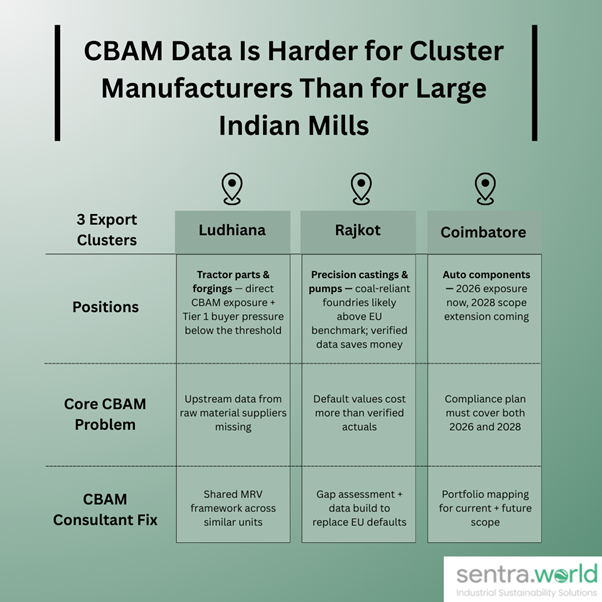
What a CBAM Consultant Identifies Across Small Cluster Units
The three clusters face overlapping but distinct CBAM challenges depending on their product mix and EU exposure:
- Ludhiana’s forging and casting belt, which supplies tractor components, automotive parts and agricultural machinery to EU buyers, sits at the intersection of direct export exposure and Tier 2 supplier pressure. Units above the 50-tonne threshold face direct CBAM obligations. Those below it face buyer pressure from the Tier 1 manufacturers consolidating their orders, who need upstream data regardless of the threshold exemption.
- Rajkot’s engineering goods cluster, which includes precision parts, pump components and castings,[2] means their actual emissions are likely higher than the EU benchmark. A CBAM Consultant doing a gap assessment here typically finds that default values would cost significantly more than verified actuals, making the data build a financially justified investment even for small units.
- Coimbatore’s auto components and engineering parts manufacturers face the combined pressure of direct CBAM exposure today and potential downstream scope extension from January 2028, which would bring steel and aluminium-intensive finished goods formally into the CBAM scope. A CBAM Consultant working here is not just solving 2026 but mapping what the 2028 extension means for each unit’s product portfolio.
A cluster-level approach matters because the economics of individual-unit compliance are often unworkable on their own. When small firms pool resources into one shared MRV facility, they can reduce individual compliance costs by approximately 40 percent. A CBAM Consultant who understands cluster dynamics can structure that shared infrastructure, identifying which units can use a common monitoring framework and which need individual installation-level data because their production routes differ.
How a CBAM Consultant Builds a Cluster-Level Compliance Plan That Individual Units Cannot Build Alone
The fundamental problem for cluster manufacturers is that basic carbon-reporting tools and staff training can cost several years of profit for many small foundries. Individual compliance at that cost, replicated across 50 units in a cluster, is not viable. A shared approach structured by a CBAM Consultant changes that arithmetic.
The work a CBAM Consultant does at the cluster level covers three areas:
- Mapping the EU exposure across the cluster’s full product portfolio, identifying which units are above the 50-tonne threshold directly, which are below it but inside a Tier 1 supplier’s consolidated CBAM obligation, and which face buyer-driven data requests regardless of regulatory thresholds.
- Building a shared emissions monitoring framework for units with similar production processes, so that a single methodology covers multiple foundries or rolling mills and the verification cost is spread across the cluster rather than borne by each unit individually.
- Establishing a data supply relationship with the large mills providing raw material inputs to cluster units, so that precursor emissions are captured in the calculation rather than left as a gap that forces the EU importer back to default values.
Before this work begins, A CBAM Liability Calculator gives cluster units a per-tonne carbon cost estimate based on CN code and basic production data. That number frames the business case for a CBAM Consultant engagement in terms the unit owner understands: not regulatory compliance, but margin protection on every tonne that ships to Europe. The clusters that build this infrastructure first are the ones whose EU buyers renew contracts rather than replace them. That window is open now. It will not stay open indefinitely.