


Most Indian exporters think of CBAM as a 2026 problem. The regulation went live in January. The compliance pressure started immediately. That framing is not wrong, but it misses where the consequences actually land. The first annual CBAM declaration covering all 2026 imports is due 30 September 2027. That is the moment when every shipment an EU buyer imported from India during 2026 gets accounted for in a single verified filing. Every tonne of steel, every consignment of aluminium, every instance of missing or unverified emissions data gets crystallised into a certificate obligation and a potential penalty on the same date. The EU importer carries that obligation legally. But the data that determines whether they meet it, or how expensive it is to meet it , comes entirely from the Indian exporter. A CBAM Consultant working with Indian exporters in 2026 is building the dataset that determines how that September 2027 filing looks for every EU buyer they supply.
What a CBAM Consultant Finds When Indian Exporters Have Not Tracked 2026 Shipments Correctly
The September 2027 declaration is not a snapshot of one shipment. It covers the full calendar year of 2026 imports. Every shipment that cleared EU customs between January and December 2026 is included. For an Indian exporter supplying a European buyer across multiple consignments throughout the year, that means twelve months of emissions data must be traceable, consistent, and verifiable by a single deadline.Default values will increase by 10 percent in 2026, 20 percent in 2027, and 30 percent from 2028 onwards. Every shipment that lands on a default value rather than a verified actual compounds this exposure. An exporter who shipped four consignments to an EU buyer in 2026 without providing verified data is not carrying one data gap into September 2027. They are carrying four, each priced at an inflated default. A CBAM Consultant starts by auditing every 2026 shipment against the emissions data provided for each one. That audit typically reveals three categories of exposure: shipments where verified data was provided and accepted, shipments where data was provided but does not meet EU Implementing Regulation 2023/1773 methodology standards, and shipments where no data was provided and the EU importer is holding a default value. The September 2027 filing is built from whatever is in that third pile. A CBAM Consultant works to move as many shipments as possible out of it before the deadline arrives.
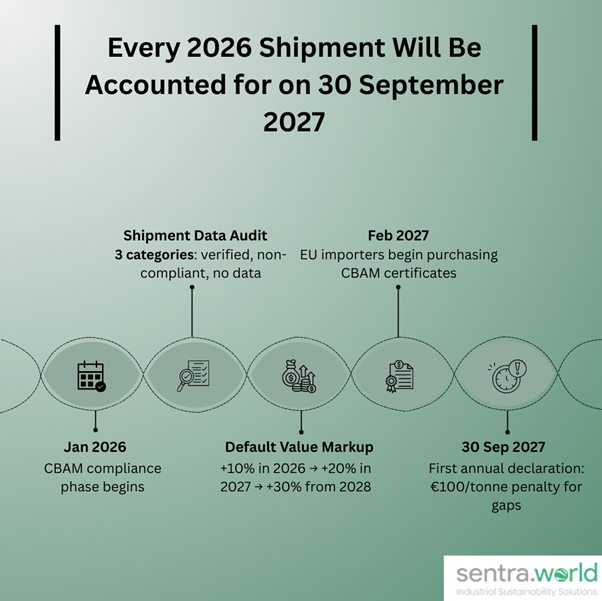
How the Default Value Markup Makes September 2027 More Expensive Every Month It Is Left Unaddressed
This is the dynamic most Indian exporters do not see until a CBAM Consultant shows them the numbers. The penalty for failing to surrender sufficient CBAM certificates is EUR 100 per excess tonne of CO2, with no upper cap. That penalty applies to the EU importer. But every EUR of penalty risk the EU importer is carrying translates directly into price pressure, contract clause changes, or sourcing decisions that land on the Indian exporter. The connection between unverified data in 2026 and financial exposure in September 2027 is direct. Certificate sales through the EU’s central platform begin in February 2027, covering emissions from 2026 imports. EU buyers will be purchasing certificates from February 2027 to cover the full year’s imports. Where verified data is available, they buy certificates based on actual emissions. Where it is not, they buy based on default values that are priced higher. The difference in certificate cost between verified actuals and inflated defaults on a full year of shipments can be significant enough to restructure a supply relationship entirely. A CBAM Consultant running this calculation for an Indian exporter in mid-2026 produces a concrete euro figure: this is what your EU buyer’s certificate cost will be in September 2027 on current data, and this is what it would be if verified data was in place for every shipment from here forward. That number is the commercial case for completing the compliance work before the year ends. Before that calculation begins, A CBAM Liability Calculator gives exporters a per-tonne estimate using their CN code and basic production data, which frames the scale of the September 2027 exposure against current carbon pricing before the detailed audit starts.
How a CBAM Consultant Structures the Next Period Between Now and September 2027
The window between January 2026 and September 2027 is not as long as it looks. Third-party verification of 2026 emissions data must be completed before the declaration is filed. The transition from default values to verified emissions data requires 12 to 18 months for robust implementation. For an Indian exporter who has not yet started, that timeline runs directly to the declaration deadline with no buffer.
A CBAM Consultant structures the preparation in three phases:
- Building and verifying the emissions dataset for 2026 shipments using EU Implementing Regulation 2023/1773 methodology, so that verified actuals replace default values in the EU importer’s system before the declaration is filed. This includes engaging the ISO 14065 accredited verifier and completing the physical site visit that the first verification period requires.
- Delivering the CBAM Communication Template for Installations to the EU importer in the format their declaration system requires, so the data is usable without reformatting or follow-up that eats into the filing window.
- Setting up the ongoing monitoring framework so that 2027 shipment data is captured correctly from the start of the year, avoiding the retrospective data reconstruction problem that makes 2026 compliance so expensive for exporters who did not prepare in time.
The September 2027 deadline will expose every Indian exporter who treated 2026 as a year to watch rather than a year to act. A CBAM Consultant builds the data that determines which side of that exposure your EU buyer’s filing puts you on.