

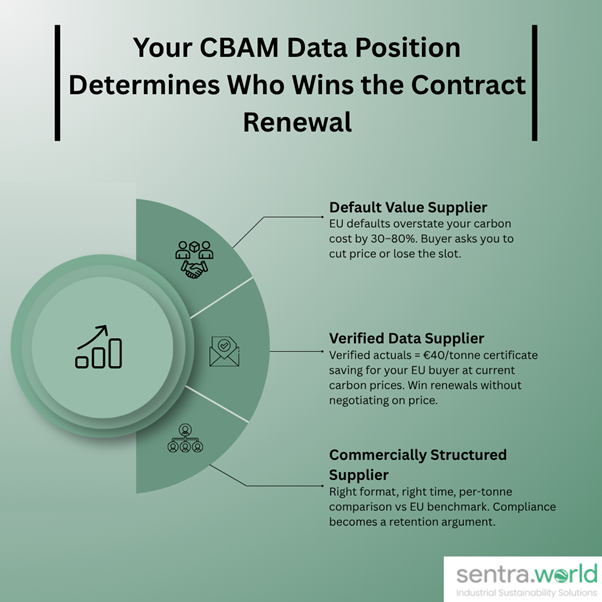
Picture the conversation your EU buyer’s procurement team is having right now. They have two Indian steel suppliers quoting within EUR 5 per tonne of each other. Both have been reliable in terms of quality and delivery. The procurement team runs its CBAM cost model. One supplier has submitted verified emissions data. The other is sitting on an EU default value. The difference in CBAM certificate cost between those two suppliers is not EUR 5 per tonne. It is closer to EUR 40 to EUR 60 per tonne at current carbon prices, depending on the production route. The verified supplier wins the renewal without negotiating on price. The other supplier gets a call asking them to reduce their price by enough to offset the certificate gap, or loses the slot to the one who does not create that problem. That is the contract renewal conversation happening across European steel and aluminium procurement right now. A CBAM Consultant builds the position that wins it.
What a CBAM Consultant Produces That Turns Compliance Into a Commercial Asset
Most Indian exporters think of their CBAM data submission as a compliance task. They prepare it because their EU buyer asked for it, send it across, and move on. A CBAM Consultant reframes that entirely.
The CBAM data submission is the only document your EU buyer’s procurement team has that quantifies your carbon cost in euros per tonne alongside every other supplier in their portfolio. When two suppliers quote similar prices, the one with a lower verified carbon footprint wins market access and buyer preference. That preference is not abstract. It shows up directly in the certificate cost line on the EU importer’s cost model, and it is visible to every procurement manager who runs that model.
A CBAM Consultant builds a verified data pack that is not just technically accurate but commercially structured. That means:
- Producing verified installation-level emissions data using EU Implementing Regulation 2023/1773 methodology, confirmed by an ISO 14065 accredited verifier, so the figure that lands in the EU buyer’s cost model is a verified actual and not a country-level default that overstates your carbon cost by 30 to 80 percent.[1]
- Delivering the CBAM Communication Template for Installations in the exact format the EU importer’s system accepts, so the data populates their annual declaration without manual processing, follow-up emails, or reformatting.
- Documenting the methodology clearly enough that the EU importer’s verifier can review it without raising queries, which eliminates the back-and-forth that delays a supplier’s data from being accepted and forces the importer to fall back on defaults.
A supplier who delivers this package every year, on time, in the right format, with a verified figure that is lower than the default, is solving a real operational problem for the EU buyer’s compliance team. That is a contract retention argument that has nothing to do with unit price.
How a CBAM Consultant Structures the Data Specifically for the Supplier Comparison Moment
This is where the CBAM Consultant’s work goes beyond verification. The EU buyer is comparing suppliers. The comparison moment is the contract renewal review. A CBAM Consultant who understands how that review works can structure the data submission to maximise the supplier’s visible advantage. The key figure the EU buyer’s procurement team uses is the certificate cost per tonne, calculated as embedded emissions multiplied by the EU ETS price. At an EU carbon price of EUR 80 per tonne, a difference of 0.5 tonnes of CO2 per tonne of steel between two suppliers translates to EUR 40 in certificate cost per tonne sourced. On a 10,000-tonne annual contract, that is EUR 400,000 in certificate cost difference. A procurement team managing their CBAM budget has a very direct reason to prefer the lower-emission supplier at the same unit price. A CBAM Consultant builds the submission to make that comparison land clearly. That means presenting the verified per-tonne emissions figure alongside the EU benchmark for the relevant production route, so the EU buyer can immediately see how far below the default the supplier sits. It means structuring the data by CN code in a way that matches how the EU importer’s declaration system reads it, so there is no ambiguity about which product category the figure applies to. And it means providing the supporting documentation the importer’s verifier needs without being asked for it separately. Before the contract renewal conversation, A CBAM Liability Calculator lets an exporter run their verified emissions figure against the EU default for their product, producing the exact euro-per-tonne difference that the EU buyer’s procurement team will see in their cost model. That number is the opening argument in the renewal discussion.
Why the CBAM Consultant’s Role Does Not End After the First Submission
Contract renewals are annual. So is the CBAM declaration cycle. An Indian exporter who submits verified data once and then lets their monitoring lapse is not building a durable commercial position. They are creating a one-year advantage that disappears the moment the next renewal comes around with stale or unverified data. A CBAM Consultant builds an ongoing monitoring framework that keeps the data current, the verification process on schedule, and the Communication Template updated for any changes in production route or input materials during the year. That continuity is what converts a single compliance win into a sustained supplier preference that holds through multiple renewal cycles. India is projected to bear 18 percent of total global CBAM costs, nearly double its share of EU import value. The Indian exporters who use that structural pressure as a reason to build better data infrastructure are the ones whose EU buyers renew contracts. The ones who treat it as someone else’s problem are the ones who get the call asking them to reduce their price.