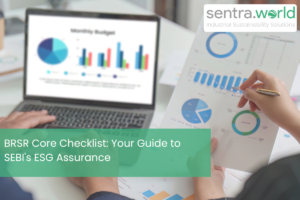

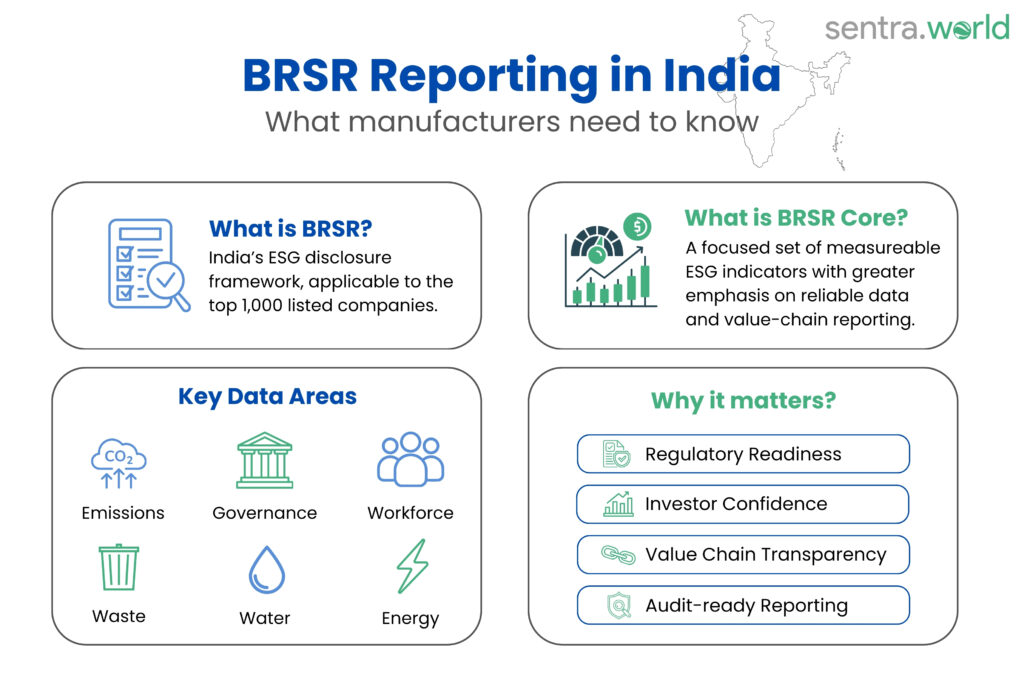
India’s corporate sustainability landscape has evolved dramatically. BRSR (Business Responsibility and Sustainability Reporting) has shifted from a voluntary exercise to a critical standard for Indian manufacturers aiming to compete globally.
Introduced by SEBI (Securities and Exchange Board of India), BRSR replaced the former Business Responsibility Report framework with a more demanding disclosure system. The previous “comply or explain” approach is now obsolete.
Audit-ready ESG data is now essential for entry into global supply chains.
The phased mandate reveals the larger picture:
📋 Mandatory Phased Assurance Timeline
- FY 2023-24: Top 150 listed companies -mandatory BRSR reporting solutions
- FY 2026-27: Expanded to the top 1,000 listed companies
This swift expansion mandates that thousands of manufacturers develop audit-ready sustainability data infrastructure immediately. Investing in strong BRSR reporting solutions for corporate sustainability disclosure, including reliable BRSR Reporting software (such as sentra.world and more), is becoming an operational necessity rather than a competitive edge.
The deeper aspect of this framework -BRSR Core, is where true accountability starts.
Decoding BRSR Core: The 9 High-Materiality Attributes
Not all ESG reporting requirements are equal, and BRSR Core highlights this distinction. While standard BRSR reporting companies to broadly disclose across environmental, social, and governance dimensions, BRSR Core focuses on 9 high-materiality attributes identified by the SEBI Expert Committee as crucial for investors and stakeholders. These attributes require ‘reasonable assurance’, contrasting with the softer ‘limited assurance’ for general disclosures, signifying the difference between a superficial review and a thorough audit.
| Attribute | Key Metric | Why It Matters for Manufacturers |
| GHG Emissions (Scope 1 & 2) | tCO₂e per unit of output | Directly tied to carbon border taxes and export eligibility |
| Water Consumption | Intensity per revenue/production unit | Critical for water-stressed manufacturing regions |
| Waste Management | Hazardous vs. non-hazardous disposal rates | Regulatory risk and circular economy positioning |
| Energy Consumption | Renewable vs. total energy ratio | Signals decarbonization trajectory to global buyers |
| Employee Well-being | Benefits coverage, safety incident rates | Increasingly screened by multinational procurement teams |
The Glide Path: Mandatory Assurance on a Timeline
SEBI has implemented a phased ‘Glide Path’ to gradually tighten BRSR reporting in India for listed companies. Initially, the top 150 listed entities faced mandatory BRSR Core disclosure, with plans to extend this requirement to the top 250 companies – a strategic escalation to build assurance capacity across the ecosystem.
This Glide Path is significant, signaling that reasonable assurance is not a distant possibility but an impending obligation. Companies treating this as a mere compliance checkbox today risk being unprepared when independent third-party verification becomes mandatory. A practical approach is to start building verified data pipelines now, before auditors arrive.
Manufacturers cannot meet these standards alone. The complexity extends beyond factory walls into the supply chain.
Why Your Suppliers Are Now Your Responsibility
For those keeping up with the BRSR Core rollout, the reporting bar has risen sharply. However, the most significant shift for manufacturers is not what they report about their operations, but what they must now disclose about their suppliers.
Starting FY 2024-25, SEBI requires the top 250 listed companies to disclose ESG data for value chain partners that account for 2% or more of total purchases or sales. This 2% rule pulls numerous upstream and downstream partners into the compliance fold.
Manufacturers need to understand:
- Scope expands rapidly. A mid-size industrial firm with 40+ active suppliers can easily have 10–15 partners exceeding the 2% threshold, each requiring verified ESG disclosures.
- MSMEs are crucial. Many Indian manufacturers rely on unlisted MSME suppliers, who often lack ESG frameworks, making Scope 3 emissions reporting challenging.
- Manufacturing is the focus. The mandate targets complex, multi-tier production supply chains. If your business involves raw materials or contract processing, this regulation applies to you.
- Data infrastructure is vital. Manually collecting and organizing partner-level ESG data is unsustainable, making ESG data management tools for reporting essential.
Scope 3 emissions -those generated across a company’s value chain rather than within its own facilities -often represent 70% or more of a manufacturer’s total carbon footprint, making supplier data the single most consequential gap in any BRSR disclosure.
Understanding the brsr full form -Business Responsibility and Sustainability Reporting is straightforward. Building supplier relationships and data pipelines for value chain ESG disclosures is the real challenge.
For sectors with carbon-intensive supply chains, this challenge intensifies -as discussed in the next section.
Sector Spotlight: The High Stakes for Indian Steel and Industrial Firms for BRSR Reporting
Steel exemplifies the urgency of structured ESG disclosure. No sector highlights the importance of ESG compliance like Indian steel manufacturing.
Carbon Intensity: A Ticking Clock for Export Markets
According to iFOREST, India’s steel sector emitted nearly 240 million tonnes of CO₂ in 2023, representing around 12% of the country’s total greenhouse gas emissions. The sector’s emissions intensity is also higher than the global average, at 2.54 tCO₂ per tonne of crude steel compared to 1.91 tCO₂ globally. This is a significant liability. The European Union’s Carbon Border Adjustment Mechanism (CBAM) already imposes premiums on carbon-intensive imports, meaning Indian steel exporters without credible emissions data face financial penalties in lucrative markets. BRSR Core’s mandatory carbon accounting framework provides firms with the verified disclosure infrastructure needed to compete and negotiate.
Water Consumption: Closing the Global Gap
The challenge extends beyond carbon, as suggested by a report from Springer – Even efficient Indian steel plants consume around 3.3 m³ of water per tonne of steel, more than three times the global best-practice benchmark of 1.0 m³ per tonne-a gap that institutional investors and foreign buyers are increasingly unwilling to overlook. Robust water metrics, disclosed under SEBI ESG reporting guidelines, unlock access to green finance instruments like sustainability-linked loans and green bonds.
Firms investing in ESG reporting tools and services for enterprises can transform raw data into standardized disclosures required by lenders and global buyers. The challenge isn’t whether to close this gap – it’s whether MSMEs in the supply chain can keep pace with leading firms.
The MSME Gap: Solving the ESG Adoption Crisis in the Supply Chain
While DBS and Bloomberg Media Studios found that 92% of Indian SMEs consider ESG a high priority, while only a few currently follow such practices, highlighting a wide gap between ESG intent and implementation.
As established earlier, BRSR Core pushes reporting obligations upstream. For India’s industrial giants, this means compliance scores increasingly depend on their smallest, least-resourced partners. MSMEs are the weak link, not due to lack of intent, but lack of infrastructure.
Most small manufacturers operate on thin margins with lean teams. Asking them to track Scope 3 emissions or water intensity without support sets them up for failure.
ESG compliance is crucial for MSMEs seeking global opportunities. International buyers audit supplier chains, and a non-compliant tier-2 vendor can cost a large firm for a critical contract.
The solution lies in ESG data management platforms tailored for smaller enterprises -tools that simplify data collection without needing dedicated sustainability teams.
Pro-Tip for MSME Owners: Begin with three metrics your main buyer tracks – usually energy, water, and waste. Document these monthly in a simple spreadsheet before investing in a platform. Building data habits is more important than the tool itself.
Selecting the right technology partner requires careful consideration -which the next section explores.
Choosing the Right BRSR Reporting Solution for Manufacturing
With the MSME capability gap in mind, the next question is practical: what should manufacturers look for when selecting ESG compliance software for manufacturing? Not every platform suit Indian industrial firms, and the wrong choice can increase compliance burden.
The right ESG reporting tool should not just collect data; it should provide actionable insights to mitigate environmental impact effectively.This distinction between passive data collection and active intelligence -separates capable platforms from basic tools.
Consider this checklist when evaluating options:
- Automated data ingestion from existing ERP systems and IoT sensors to eliminate manual entry errors
- Native support for both BRSR and BRSR Core formats to streamline reporting without switching platforms
- Value Chain Modules allowing suppliers to input data directly without technical expertise
- SEBI XBRL-aligned outputs for generating audit-ready reports from the start
- Supplier performance dashboards to identify data gaps before they become compliance issues
- Multiple data entry support for diverse supplier workforces
In practice, manufacturers who view platform selection as strategic build more resilient disclosure pipelines. The right tool evolves with compliance obligations.
How sentra.world Helps You with Your BRSR Reporting
Navigating BRSR Reporting Core requirements, value chain disclosures, and assurance readiness without the right tools is challenging. sentra.world is designed for manufacturers needing to move beyond spreadsheets and fragmented data collection. The platform centralizes ESG data across facilities and supplier tiers, simplifying metric tracking for global buyers and auditors. Rather than scrambling at reporting time, manufacturers can monitor performance continuously, making compliance a living process.
Benefits manufacturers gain with sentra.world:
- Structured data collection aligned to BRSR Core indicators
- Supplier onboarding workflows for easier value chain disclosures
- Audit-ready documentation supporting third-party assurance requirements
- Real-time dashboards linking ESG performance to business decisions
The manufacturers securing long-term supply chain partnerships are those demonstrating verified, consistent ESG performance -not just submitting reports. Compliance alone won’t win contracts; credibility will.
The opportunity to build that credibility is now. Regulatory timelines are tightening, and global buyers are already shortlisting suppliers based on ESG readiness. Don’t wait for a mandate, accelerate your BRSR reporting today.
For more information on BRSR reporting: https://sentra.world/esg-reporting/