
The wait is over. The Carbon Border Adjustment Mechanism (CBAM) has established its price at €75.36 per metric ton of CO₂ equivalent along with EU CBAM certificate price for Q2 of 2026 published on 6th July 2026 as €75.28 per metric ton of CO₂ equivalent . This is no longer merely a concept; it’s a financial reality. For those importing steel, aluminum, cement, fertilizers, or electricity, the clock is ticking. As noted by the European Commission, CBAM will initially impact about 3% of total EU imports, yet these sectors contribute to over 50% of industrial emissions in the EU ETS.
Previously, managing CBAM was as easy as filling out forms: report emissions, submit data, and you’re done. But that’s history. With the Q1 2026 CBAM certificate price set at €75.36/tCO₂e, we’re entering the definitive regime. Carbon costs are now integral to your cost of goods sold (COGS).
Here’s the kicker: this shift is monumental. What was once a formality now significantly influences your margins, pricing strategies, and negotiations with suppliers. Engaging a CBAM consultant can help navigate these changes.
The Q1 2026 price is your key reference for 2027 planning. It’s your starting point for aligning CBAM costs with the EU CBAM compliance timeline 2027. Let’s explore what this means for your 2027 responsibilities.
CBAM Certificate Timeline: Purchase to Surrender
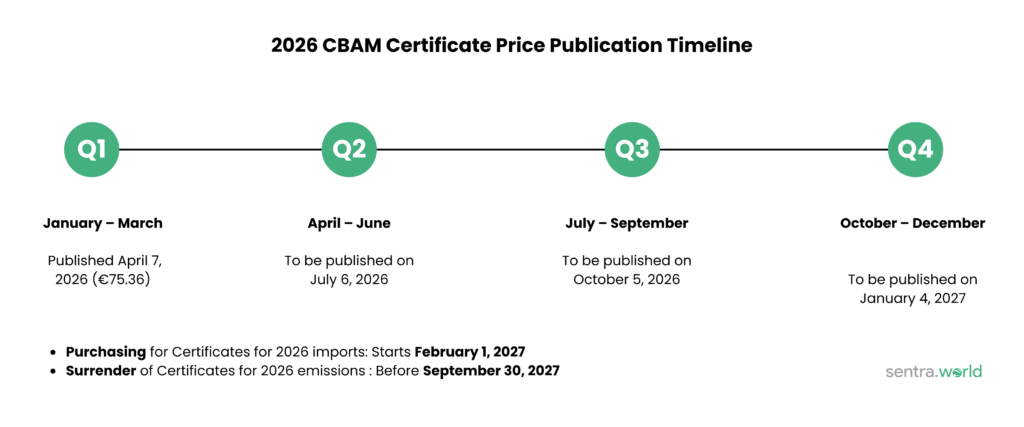
Knowing the price is just one piece of the puzzle. Many importers are surprised by the sequence of obligations and the narrow margin for error once the definitive phase begins. The first CBAM certificate price for Q1 2026 was announced on April 7, 2026, at 75.36 euros. The timeline below highlights important dates for the publication of CBAM certificate prices.
Stay ahead of CBAM pricing changes and reporting timelines with expert guidance from a CBAM consultant for all your exporting needs.
February 2027: The CBAM Certificate Purchase Window Opens
February 2027 marks the start. The CBAM certificate purchase window opens, enabling authorized declarants to acquire certificates through the EU registry. This is the real deal. From this point, importers of steel, aluminum, cement, fertilizers, electricity, and hydrogen must secure enough certificates for their imports’ embedded emissions. Prices fluctuate based on the average auction price of EU Emissions Trading System (EU ETS) allowances from the previous week, making costs variable. The European Commission’s CBAM certificate pricing framework ensures this is a moving target, not a fixed budget item.
A certificate in February might be cheaper, or more expensive, than one in August. Effective treasury management is crucial here, not just compliance. CBAM Solutions and consultancy can provide guidance on these fluctuating costs.
September 30, 2027: The Hard Stop
Don’t overlook this date. By September 30, 2027, authorized declarants must submit their annual CBAM declaration and surrender the correct number of certificates for goods imported in 2026. Missing this deadline could lead to penalties greater than the certificate costs, including fines and potential authorization suspension.
Here’s a practical tip: CBAM scrap classification decisions during import affect the number of certificates you need to surrender. Getting this right is essential, especially as regulators tighten verification. A CBAM consultant can ensure compliance with CBAM certificates along with these classifications.
Tighter Checks: The New Reality of Emissions Reporting
The EU Parliament released a draft report on April 10, 2026, introducing various new provisions to the current CBAM rules. The compliance calendar isn’t just about dates; it’s about what the EU requires you to prove. When the CBAM certificate price Q1 2026 was set at €75.36, rules tightened regarding what qualifies as a valid emission. Importers in steel and aluminum need to reconsider assumptions from the transitional phase.
Pre-Consumer Scrap Is No Longer a Zero-Emission Input
This is significant. Scrap metal rules have evolved. Previously, pre-consumer scrap was considered carbon-free. Not anymore. The EU now classifies it as a precursor material, necessitating emissions tracking and CBAM reporting.
Why is this important? A steel product with substantial scrap content could still have high carbon emissions if the energy source isn’t clean. Assuming scrap is clean is not only incorrect, it’s now a compliance risk.
Targeting Scrap-Based Resource Shuffling
This reclassification is deliberate. Scrap-based resource shuffling, where supply chains reroute high-scrap products through CBAM-covered borders while dirtier production remains outside, is precisely what the mechanism aims to stop. The European Commission’s framework seeks to close these loopholes.
Actual Data Over Default Values
Equally crucial is moving away from default emission values. These were acceptable during the transitional phase, but using them now could lead to overestimating or underestimating your liability. Real data from production facilities is now the standard.
So, is your supplier data ready for an audit? Mandatory physical site visits are part of verification, meaning your CBAM certification must reflect actual conditions, not estimates.
Getting your data right isn’t just a reporting task; it affects the euros you’ll owe. The link between data quality and financial exposure is vital. Utilizing CBAM consultancy services can enhance your reporting accuracy.
Calculating the Financial Impact: From Carbon Tons to Euros
To understand your CBAM liability, don’t just focus on the €75.36/tCO₂e price. The real figure depends on a formula connected to your commodity’s CN code, the product’s embedded emissions, and any carbon price already paid in the origin country.
Calculate your CBAM liability for free: https://sentra.world/cbam-liability-calculator/
Each CN code has different default emission factors, and the certificate price changes quarterly based on the EU ETS weekly auction average. Your liability can fluctuate from order to certificate surrender. Price volatility tied to the EU ETS is a budgeting issue, not just background noise.
Why Default Values Are Expensive
First-time CBAM declarants often rely on default emission values from the European Commission. These defaults are high, reflecting worst-case scenarios, not actual supplier performance. Without verified emissions data, EU authorities may assign default values that are 30–80% higher than actual emissions, significantly inflating CBAM certificate costs.
Cross-Border Carbon Price Alignment
Aligning carbon pricing systems globally adds complexity. If a supplier has paid a domestic carbon price, that cost can reduce your CBAM liability. But verifying this deduction requires data most importers don’t have structured processes for.
That’s where sentra.world comes in, bridging the data gap and enhancing CBAM compliance.
How sentra.world Solves the CBAM Data Gap With Faster and Accurate Reporting
Figuring out your CBAM liability is one thing; proving it to EU regulators is another. Spreadsheets and emails aren’t up to the task for the detailed emissions data required. This gap widens as the CBAM certificate surrender deadline September 2027 approaches.
sentra.world, #1 CBAM Consultancy for exporters, bridges this gap by offering comprehensive solutions for CBAM:
- Detailed emissions calculation per CN code: Accurately assess emissions for each commodity.
- Quarterly reports with platform analytics: Stay updated with the latest data insights.
- Coverage of all applicable CN codes: Ensure comprehensive compliance across your imports.
- Adherence to the latest and official CBAM methodology: Follow the most current standards.
- Utilization of the latest default and benchmark values from CBAM: Use updated values for accurate reporting.
2. Official document and audit preparation in line with EU regulations: Be prepared for regulatory scrutiny.
- Summary communication & Annexure IV: Provide clear and concise documentation.
- Support for O3CI portal upload: Simplify the submission process.
- Document preparation for third-party audit: Ensure readiness for external audits.
3. Carbon tax and certificate-related support: Navigate financial implications with ease.
- Carbon tax estimation as per EU ETS carbon price: Accurately forecast tax liabilities and with the latest CBAM certificate prices.
- Year-on-year forecasts from 2026 to 2034: Plan ahead with long-term projections.
- Guidance on commercial discussions with customers: Strategize effectively with clients.
Key Takeaways for CBAM Certificate
- €75.36 per metric ton of CO₂ equivalent
- The Q1 2026 price is the essential benchmark for all 2027 financial planning.
- CBAM certificate purchase begins in February 2027
- Average auction price of EU Emissions Trading System (EU ETS) allowances
- A certificate bought in February may cost significantly less-or more-than one purchased in August.