

Your EU buyer just shortlisted three alternative suppliers. The product quality is comparable, the pricing is close, and the lead times are similar. But two of those suppliers sent over independently verified carbon emissions data without being asked. You are still trying to figure out what that data even looks like. This is the new reality for Indian exporters to Europe, and it arrived faster than almost anyone anticipated. You have no idea what to send them. This is not a hypothetical. It is the exact situation thousands of Indian exporters found themselves in when CBAM moved from a reporting exercise into a full payment obligation in January 2026. Steel, aluminium, cement, fertilizers, electricity, and hydrogen: if any of these are in your export portfolio, this regulation is already inside your business, whether you have engaged with it or not. The exporters who are protecting their margins and holding onto their EU contracts right now are the ones who brought in a CBAM Consultant before that email arrived.
Why Indian Exporters Need a CBAM Consultant More Than Most
Not every exporting nation is equally exposed to CBAM. India is one of the hardest hit, and the reasons are structural rather than accidental. India is projected to bear 18 percent of total global CBAM costs, nearly double its share of EU import value. Indian steel production leans heavily on blast furnaces, and a large portion of aluminium manufacturing runs on coal-fired power. Both routes carry significantly higher embedded carbon than the EU benchmark, and that gap directly translates into higher CBAM certificate costs for every EU buyer importing your goods.The numbers are specific. Indian aluminium exporters face additional costs of $1,500 to $1,600 per tonne exported to the EU due to coal-heavy power dependency. Indian cement producers are expecting profit margins to decline by $65 to $160 per metric ton through to 2036. On top of that, many steel and aluminium exporters may need to cut prices by 15 to 22 percent just to let EU buyers absorb the carbon tax within their own margins.These are not worst-case projections. They are the starting position for any Indian exporter who has not yet engaged a CBAM Consultant to assess and reduce their exposure
What a CBAM Consultant Does That Your Finance Team Cannot
Most businesses assume CBAM is a compliance task they can hand to their accounts or sustainability team. It is not, and finding out the hard way is expensive. The core problem is straightforward. When your EU importer lacks verified emissions data from your production facility, they are required to apply EU default emission values for your product and country. These defaults are set at the highest observed emission intensity, which means they almost always overstate your actual emissions. Every tonne of that difference is an extra CBAM certificate cost that your buyer pays, and that cost comes back to you as price pressure or lost contracts.
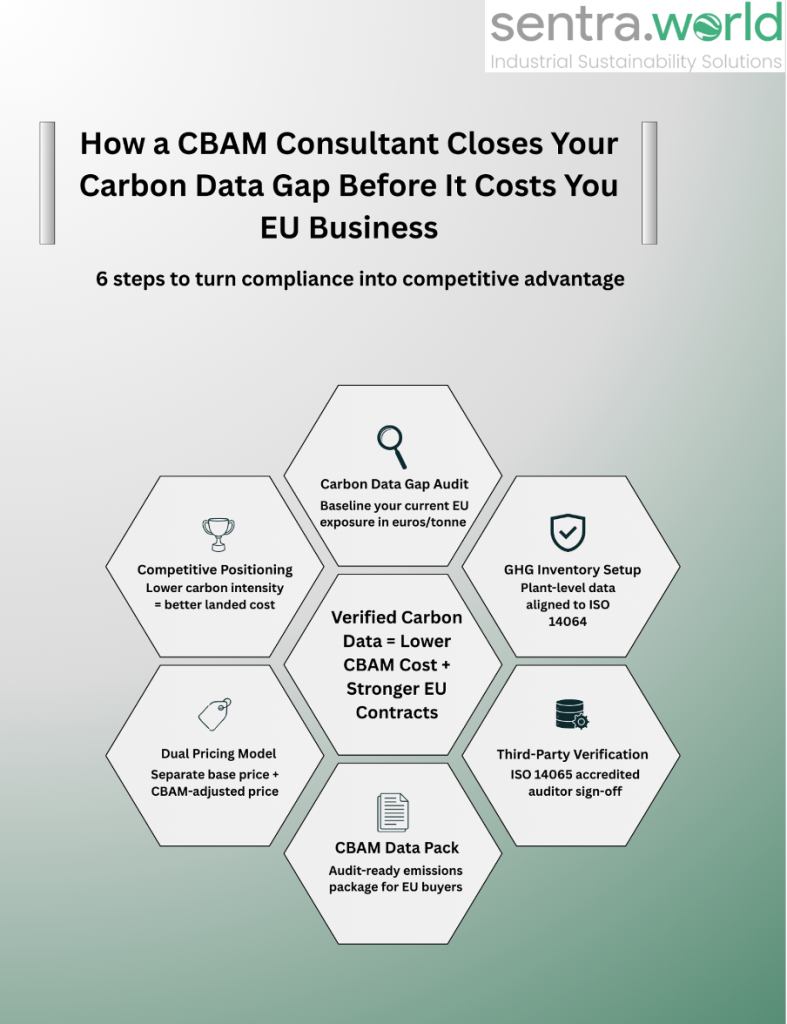
A CBAM Consultant closes that gap. They set up a GHG inventory system aligned to ISO 14064, calculate your embedded emissions at the plant level using EU-approved methodology, arrange third-party verification, and deliver everything in the exact format your EU buyer needs for their annual declaration. Before that process begins, tools like CBAM Liability Calculator give you and your consultant an instant estimate of your current exposure in euros per tonne, so you are walking into the engagement with real numbers rather than assumptions.
The difference between what you owe using default values versus verified actual data is not marginal. For Indian manufacturers, it is often the difference between being priced out of the EU market and staying competitive within it.
How a CBAM Consultant Protects Your EU Contracts
The financial exposure is serious. But the contract risk is what keeps export managers awake at night. EU importers are now prioritizing suppliers who provide clean, audit-ready emissions data over those who cannot. Carbon data quality sits right alongside price and lead time as a supplier selection criterion. A CBAM Consultant builds what is now being called a standardized CBAM data pack, a fully documented, independently verified package of your production-level emissions that your EU buyer can submit directly without needing anything more from you. That kind of frictionless experience is what strengthens supplier relationships in 2026. Is your business currently providing this to your EU customers? If the answer is no, that is exactly where a CBAM Consultant starts.
The CBAM Consultant Edge: When Compliance Becomes Your Competitive Advantage
CBAM compliance does not just protect your existing business. It opens new doors. Indian manufacturers who invest in verified, low-emission data are finding that it becomes a credibility signal with European buyers who are themselves under ESG scrutiny. When your carbon data is clean, verified, and consistently delivered, you are not just compliant – you are the kind of supplier a European company wants to be associated with as they navigate their own sustainability commitments. Indian exporters who start early are turning CBAM from a cost into a competitive differentiator. The CBAM Consultant makes this possible by sitting at the intersection of regulatory knowledge, carbon accounting, and trade strategy. That combination is exactly what every serious Indian exporter to the EU needs right now. The question is not whether CBAM will affect your business, but it is whether you are managing that impact or absorbing it.