
The Carbon Border Adjustment Mechanism, or CBAM, is the European Union’s carbon border policy. It puts a carbon cost on selected imported goods so that products entering the EU face a similar carbon price as products made inside the EU under the EU Emissions Trading System.
CBAM for ferro alloys is becoming an important compliance and cost issue for Indian manufacturers exporting to the European Union.
CBAM has been introduced to reduce carbon leakage. Carbon leakage happens when production moves from countries with strict carbon rules to countries with lower or no carbon cost. By applying a carbon cost to imports, CBAM aims to create fairer competition for EU industries and encourage lower-carbon production globally.
For ferro alloy producers, especially manufacturers of ferro manganese, ferro chrome, and ferro nickel, CBAM is no longer only about submitting emissions data. From 2026 onwards, carbon costs become relevant for EU-bound exports. This means verified emissions data can directly affect customer conversations, pricing, margins, and competitiveness in EU markets.
The European Commission states that CBAM’s definitive regime starts from 2026, after the transitional phase from 2023 to 2025. EU importers, or their indirect customs representatives, importing more than the 50-tonne threshold of CBAM goods into the EU need to apply for authorised CBAM declarant status.
Who Pays CBAM: Exporter or Importer?
A common question for Indian ferro alloy companies is: who actually pays CBAM?
Under CBAM, the EU importer is responsible for the formal compliance obligation. The importer must apply for CBAM authorisation, submit CBAM declarations, purchase CBAM certificates, and surrender certificates for the embedded emissions in imported goods.
The non-EU exporter or producer does not directly pay CBAM certificates to the EU. However, the exporter plays a critical role because the EU importer depends on the producer’s emissions data to calculate the CBAM liability.
| Non-EU Producer / Exporter | EU Importer |
|---|---|
| Calculates product-level CO₂ emissions | Requires CBAM authorisation |
| Gets emissions data audited or verification-ready | Submits annual CBAM declaration |
| Shares data on the O3CI portal or through summary communication | Buys and surrenders CBAM certificates |
| Provides supporting documents and production data | Faces customs and compliance checks |
The simple way to understand it is this:
The importer pays for CBAM certificates, but the exporter’s emissions data decides how the cost is calculated.
For ferro alloy exporters, this is why accurate, verified product-level emissions data is important. If reliable data is not available, EU customers may have to rely on default values, which can increase their CBAM cost exposure and weaken the exporter’s position in price negotiations.
Which Ferro Alloys Are Covered Under CBAM?
Before calculating emissions or preparing CBAM reports, ferro alloy exporters need to check whether their products are covered under CBAM.
The key ferro alloys currently relevant for CBAM are:
| Product | Common Name |
| Ferro Manganese | FeMn |
| Ferro Chrome | FeCr |
| Ferro Nickel | FeNi |
However, exporters should not rely only on product names. CBAM applicability depends on the CN code of the product. A product may look similar to a covered product but may fall under a different classification.
For exporters, the first step is to check:
- Which ferro alloy products are exported to the EU
- Which CN codes apply
- Whether the product falls under CBAM-covered categories
- How much volume is exported to EU customers
- Whether EU buyers will need verified emissions data
- Whether default values or actual values will be used
This is important because a wrong product classification can lead to wrong reporting, wrong cost estimation, and confusion with EU customers.
What Has Changed in 2026?
The shift from the transition phase to the definitive phase is the biggest change in CBAM.
During the transition phase from 2023 to 2025, importers mainly had to report embedded emissions. From 2026 onwards, CBAM starts becoming a real cost for EU-bound imports. Reuters has also described this as a move from reporting-only compliance to full implementation from January 2026, where importers will need to surrender CBAM certificates linked to embedded emissions in imported goods.
Key changes from 2026 include:
- CBAM has entered the definitive phase.
The transition phase focused on reporting. The definitive phase brings carbon costs and financial obligations for covered EU imports.
- EU importers will need to surrender CBAM certificates.
Importers will need to purchase and surrender certificates corresponding to embedded emissions in covered imported goods.
- Verified emissions data becomes more important.
Exporters that provide accurate and verified product-level emissions data can help EU customers avoid relying only on default values.
- Default values may increase cost exposure.
If actual verified emissions data is not available, importers may have to use default values. These may not reflect the real performance of an efficient producer.
- CBAM certificate prices are linked to the EU carbon market.
CBAM certificate prices are connected to EU ETS carbon prices, which means carbon cost exposure can change over time.
- Importers need to plan for certificate purchase and surrender.
Reuters reported that companies have until September 2027 to buy CBAM certificates covering 2026 emissions and submit them to the EU.
For Indian ferro alloy exporters, the message is clear: CBAM is now moving from compliance paperwork to commercial impact.
Calculating CBAM Cost for Ferro Alloys
The CBAM cost depends on how much carbon is embedded in the product and how that compares with the EU benchmark.
A simplified way to understand the formula is:
Carbon tax per tonne of product =
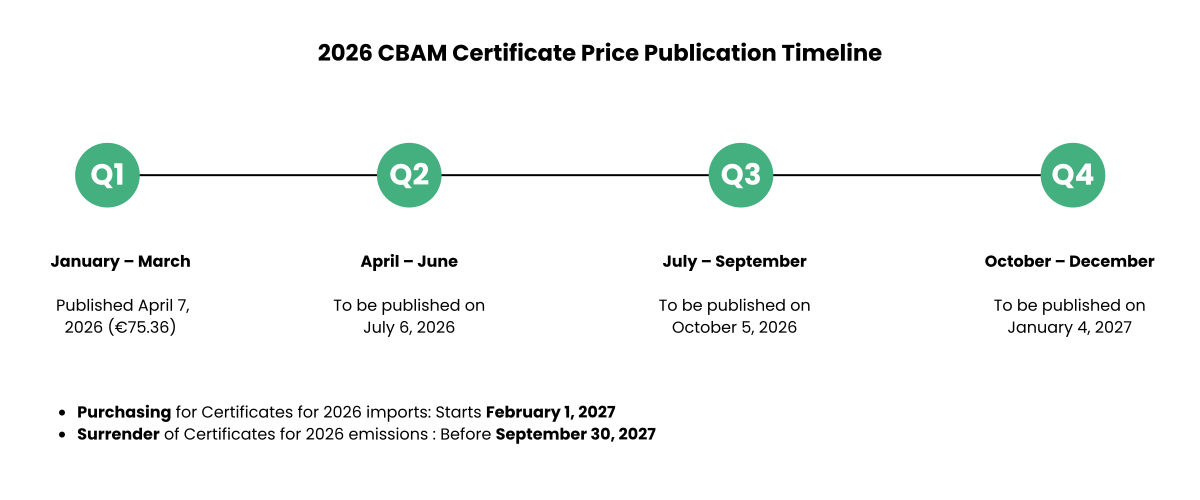
(Embedded direct emissions – Benchmark × CBAM factor) × CBAM certificate price (€75.36)
What Each Part Means
Embedded direct emissions
These are the direct emissions generated during production. For ferro alloys, this may include emissions from furnace operations, reductants, fuels, and process-related emissions.
Benchmark
The benchmark works like a reference emissions value. It helps determine how much of the product’s embedded emissions will be exposed to CBAM cost.
CBAM factor
The CBAM factor adjusts the benchmark during the phase-in period as free allowances under the EU ETS are gradually reduced.
CBAM certificate price
This is linked to the EU ETS carbon market. Since the certificate price changes with the carbon market, exporters and importers need to keep updating their cost estimates.
Example: CBAM Cost for Ferro Manganese
Let’s take a simple example.
Assume an Indian exporter sends 1,000 tonnes of ferro manganese to the EU.
| Input | Value |
| Export volume | 1,000 tonnes |
| Verified embedded direct emissions | 3.5 tCO₂e/t |
| FeMn benchmark for 2026–27 | 1.361 tCO₂e/t |
| Assumed 2026 CBAM factor | 97.5% |
| CBAM certificate price | €75.36/tCO₂e |
Step 1: Calculate adjusted benchmark
1.361 × 97.5% = 1.327 tCO₂e/t
Step 2: Calculate chargeable emissions per tonne
3.5 – 1.327 = 2.173 tCO₂e/t
Step 3: Calculate total chargeable emissions
2.173 × 1,000 = 2,173 tCO₂e
Step 4: Calculate estimated CBAM cost
2,173 × €75.36 = €163,757 approx.
This example shows why accurate emissions data matters. If the producer can reduce emissions intensity or prove that actual emissions are lower than default values, the estimated CBAM cost can change significantly.
EU CBAM Timeline
The EU CBAM is being introduced in stages. The transition phase focused on emissions reporting, while the definitive phase brings actual carbon cost exposure for covered EU imports. Reuters has reported that the levy applies from January 2026, with companies having until September 2027 to buy and submit CBAM certificates covering 2026 emissions.
| Period | What Happens |
| Q4 2023 – Dec 2025 | Transition phase. Importers submit emissions reports, but no CBAM certificate payments are required. |
| 1 Jan 2026 | Definitive phase begins. CBAM starts including financial obligations for covered imports. |
| 2026 | Importers continue asking exporters for emissions data to estimate future liability. |
| 2027 | Importers begin settling obligations for 2026 imports through CBAM certificates. |
| 30 Sept 2027 | First annual surrender deadline for certificates covering 2026 emissions. |
| 2034 onwards | CBAM is expected to be fully phased in as free allocation under the EU ETS is phased out. |
This timeline is important because exporters cannot wait until the final payment date. EU importers are already asking suppliers for emissions data so they can estimate future CBAM costs correctly.
Benchmark Values and Default Values for Ferro Alloys
Before looking at the numbers, it is important to understand what benchmark values and default values mean.
What are benchmark values?
Benchmark values are reference emissions values used in CBAM cost calculation. They work like an allowable emissions threshold. The benchmark helps determine how much of the product’s embedded emissions will be subject to CBAM cost.
What are default values?
Default values are used when actual verified emissions data is not available. If an exporter cannot provide reliable emissions data, the EU importer may have to rely on default values.
For exporters, this can be risky. Default values may not reflect the real performance of a specific plant. A producer with better-than-default emissions performance can lose that advantage if actual data is not measured, verified, and shared.
Reuters has reported that the EU uses default values where producers fail to disclose real emissions data, and industry sources have described these default values as intentionally strict to encourage companies to provide their own emissions data.
Benchmark Values for Key Ferro Alloys
Based on the working CBAM calculation table, the benchmark values are:
| Product | 2026–27 Benchmark | 2028 Onwards Benchmark |
| FeMn | 1.361 tCO₂e/t | 1.277 tCO₂e/t |
| FeCr | 1.142 tCO₂e/t | 1.106 tCO₂e/t |
| FeNi | 2.390 tCO₂e/t | 2.295 tCO₂e/t |
Default Values for Ferro Alloys
The default values for 2025 are:
| Product | Default Value |
| FeMn, carbon content greater than 2% | 1.69 tCO₂e/t |
| FeMn, carbon content less than or equal to 2% | 5.59 tCO₂e/t |
| FeCr, carbon content greater than 4% | 2.350 tCO₂e/t |
| FeCr, carbon content less than or equal to 4% | NA |
| FeNi | 3.480 tCO₂e/t |
For 2026, default values are increased by 10%. The default values for 2026 based on goods produced in and exported from India are:
| Product | Default Value |
| FeMn, carbon content greater than 2% | 1.859 tCO₂e/t |
| FeMn, carbon content less than or equal to 2% | 6.149 tCO₂e/t |
| FeCr, carbon content greater than 4% | 2.585 tCO₂e/t |
| FeCr, carbon content less than or equal to 4% | NA |
| FeNi | 3.828 tCO₂e/t |
Why Benchmark and Default Values Matter
Benchmark and default values matter because they directly influence CBAM cost.
For ferro alloy exporters, this creates four practical risks.
1. Direct impact on margins
If the CBAM cost for a product is high, EU customers may ask exporters to reduce prices or share the cost burden.
2. Pricing pressure in EU markets
EU buyers may compare suppliers based not only on product price and quality, but also on embedded emissions and future CBAM exposure.
3. Advantage for lower-carbon producers
Exporters with accurate, verified, and lower emissions data can position themselves better than suppliers relying on default values.
4. Need for reliable emissions data
Without accurate product-level emissions data, exporters may lose control over how their carbon performance is represented to EU buyers.
This is why CBAM should be treated as a business issue, not just a compliance requirement.
The 50% Rule Every Importer Must Know
CBAM compliance is not only a year-end activity. From 2027, importers also need to plan their CBAM certificate position during the year.
Under Regulation (EU) 2023/956, authorised CBAM declarants are required to hold enough CBAM certificates in their CBAM registry account during the year. At the end of each quarter, the number of certificates held should correspond to at least 50% of the embedded emissions in all CBAM goods imported since the beginning of that calendar year.
This matters because CBAM creates an ongoing carbon-cost exposure for EU importers, not just a one-time annual payment.
By 30 September each year, and for the first time in 2027 for imports made in 2026, the authorised CBAM declarant must surrender CBAM certificates corresponding to the verified embedded emissions declared for the previous calendar year. Reuters has also reported that companies have until September 2027 to submit CBAM certificates covering 2026 emissions.
For ferro alloy exporters, this means EU customers will not wait until the end of the year to think about CBAM costs. They will need reliable emissions data during the year to estimate how many certificates they may need to hold and surrender.
Penalty Warning
If an authorised CBAM declarant fails to surrender the required CBAM certificates, penalties may apply for each certificate not surrendered.
The CBAM Regulation links this penalty mechanism to the EU ETS excess emissions penalty under Article 16(3) of Directive 2003/87/EC. This penalty is commonly referred to as €100 for each tonne of CO₂e not covered, and paying the penalty does not remove the obligation to surrender the outstanding certificates.
For example, if a shipment of 10,000 tonnes has embedded emissions of 3 tCO₂e per tonne, the total exposure is:
10,000 × 3 = 30,000 tCO₂e
At a penalty exposure of €100 per tCO₂e, the potential penalty could be:
30,000 × €100 = €3,000,000
This would be in addition to the obligation to surrender the required CBAM certificates.
The simple point for exporters is this: the importer pays for certificates, but the exporter’s emissions data affects the importer’s cost and compliance risk.
CBAM: Threat or Opportunity for Indian Ferro Alloy Exporters?
For Indian ferro alloy exporters, CBAM can become either a risk or an advantage.
It becomes a risk when companies do not know whether their products are covered, do not have reliable emissions data, or cannot support EU customers with verified information.
It becomes an opportunity when exporters can show accurate product-level carbon data, identify reduction opportunities, and help buyers reduce uncertainty around CBAM costs.
Ferro alloy manufacturers should start by answering these questions:
- Are my products covered under CBAM?
- Which CN codes apply to my exports?
- How much of my business is linked to EU customers?
- What is my product-level emissions intensity?
- Can I provide verified emissions data?
- How will CBAM affect customer pricing discussions?
The exporters that prepare early will have stronger conversations with EU buyers.
How Ferro Alloy Producers Should Prepare for CBAM
Indian ferro alloy producers can prepare for CBAM by focusing on five practical actions.
1. Identify EU exposure
Confirm whether your products are exported directly or indirectly to the EU. Also check whether the product falls under CBAM-covered sectors and CN codes.
2. Define production routes
Map the installations, furnaces, processes, and production routes used to manufacture CBAM-covered goods.
3. Track product-level emissions
Collect activity data and emission factors across the production chain, including fuel, electricity, reductants, raw materials, and precursor materials.
4. Estimate future CBAM cost
Model how emissions intensity, EU benchmarks, and CBAM certificate prices may affect product costs from 2026 onwards.
5. Verify and share emissions data
Prepare for third-party verification and share verified emissions data with EU customers for CBAM reporting.
How Ferro-Manganese Producers Can Reduce CBAM Exposure
Ferro manganese producers can reduce CBAM exposure by lowering emissions intensity and improving data quality.
Some practical options include:
Submerged Arc Furnace optimisation : Better furnace automation and control can improve energy efficiency. This includes better control of temperature, current, voltage, electrode use, and raw material feeding.
Waste heat recovery : Submerged Arc Furnaces generate significant heat. Waste heat recovery systems can reuse this heat for preheating raw materials, generating steam, or producing electricity.
Pre-reduction of manganese ores : Pre-reducing manganese ore before the main furnace can reduce the energy required during smelting.
Alternative reductants : Replacing part of coal or coke with lower-carbon alternatives such as biomass or biochar can reduce direct emissions, depending on technical feasibility and availability.
Renewable electricity : Ferro alloy production is electricity-intensive. Using renewable electricity through captive solar, open access, or power purchase agreements can reduce Scope 2 emissions and improve the overall carbon profile.
Hydrogen-based reduction is also being explored, but it is still at an early stage for ferro manganese production and should be treated as a longer-term option.
How sentra.world Helps with CBAM for Ferro Alloys
CBAM compliance cannot be managed properly through scattered spreadsheets and manual reporting. Exporters need accurate emissions data, correct methodology, audit-ready documentation, and clear cost visibility.
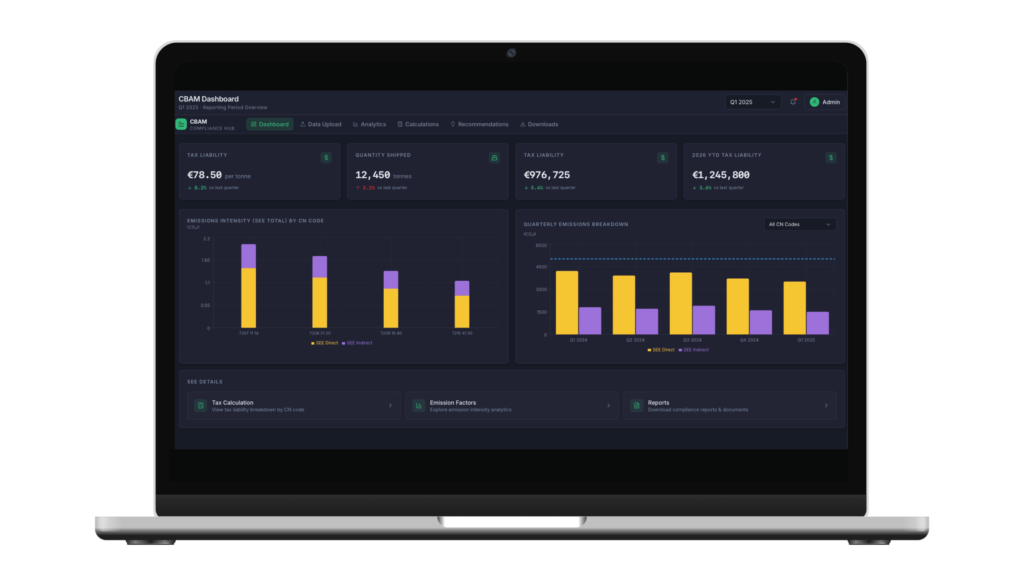
sentra.world helps ferro alloy exporters prepare for CBAM through a digital carbon accounting and CBAM reporting platform designed for industrial manufacturing.
- Comprehensive emissions calculation
sentra.world helps calculate product-level emissions aligned with EU CBAM methodology across applicable CN codes.
- EU-ready CBAM reporting
The platform supports quarterly CBAM reports with analytics and exporter-ready documentation.
- CN code and product coverage support
sentra.world helps exporters assess whether their products fall under CBAM and how reporting should be handled.
- Pre-audit and compliance support
sentra.world supports pre-audit preparation, compliance documentation, and audit readiness. The platform also supports partnerships with leading verifiers for a smoother third-party audit process.
- O3CI portal and summary communication support
sentra.world helps exporters prepare data for the O3CI portal or provide summary communication documents directly to EU customers.
- CBAM cost and carbon tax forecasting
The platform helps estimate CBAM liability based on EU ETS-linked certificate prices, benchmark values, and product-level emissions.
- Official CBAM consultant support
sentra.world is recognised as an official CBAM consultant by EEPC India under the Ministry of Commerce and supports exporters with structured, EU-aligned CBAM compliance and automated reporting.
Final Takeaway
CBAM for ferro alloys is no longer a distant policy issue. It is now a commercial issue for exporters selling to the EU.
From 2026 onwards, ferro alloy exporters need to understand product coverage, calculate embedded emissions, compare performance against benchmark and default values, and support EU customers with accurate data.
The companies that prepare early will be better placed to manage carbon cost exposure, protect customer relationships, and compete in EU markets.
For Indian ferro alloy producers, the next step is clear: build reliable emissions data, prepare for verification, and start modelling CBAM cost before customers ask for it.
Sources
- European Commission — Carbon Border Adjustment Mechanism
https://taxation-customs.ec.europa.eu/carbon-border-adjustment-mechanism_en
- Regulation (EU) 2023/956 establishing the Carbon Border Adjustment Mechanism
- European Commission — CBAM certificate price updates
https://taxation-customs.ec.europa.eu/carbon-border-adjustment-mechanism_en
- Reuters — EU CBAM transition and September 2027 certificate timeline
https://www.reuters.com/sustainability/climate-energy/eu-aluminium-cement-imports-face-higher-emissions-costs-draft-shows-2025-12-12