

CBAM Compliance: What EU Buyers Now Expect From Indian Exporters

CBAM Compliance is not coming as a shock announcement. It is already showing up in day-to-day trade work. EU buyers are starting to treat emissions data like any other supply requirement. Not as a “nice to have.” As something they need to collect, check, and close every quarter. If you searched CBAM full form, here […]
From PAT to CCTS: India’s Transformative Shift Toward a Carbon Market Future
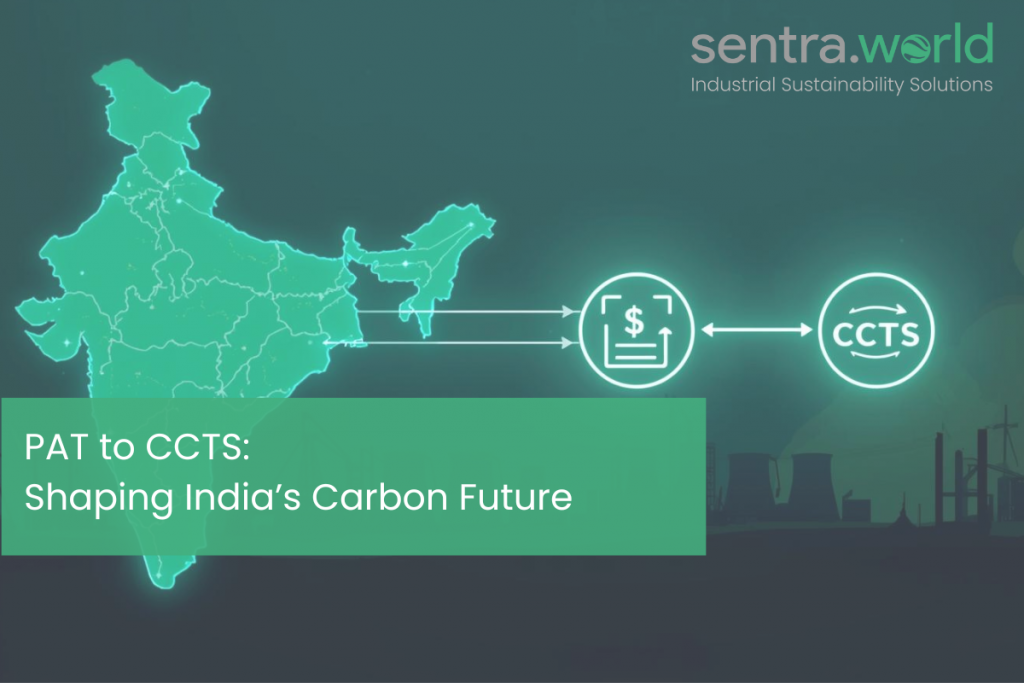
As India plans to reach its 2070 net-zero goal; there are many policies which are coming up evolving from energy efficiency to carbon accountability, progressing in the direction of that future. The foundational groundwork was laid by the PAT scheme (Perform, Achieve and Trade) and the shift towards being accountable for your emissions is taken […]
CBAM 2026 Simplified: Key Updates and Exporter Implications
What’s New at a Glance? The European Union has recently confirmed that Carbon Border Adjustment Mechanism (CBAM) benchmarks for exporters in other countries for CBAM calculation of import related carbon costs in energy heavy industries like steel, aluminum, cement, fertilizers will be out in the market in the coming few weeks and finalized until Q1 […]
India’s CCTS: Complete Guide to 9 Sectors Under Carbon Credit Trading Scheme
India’s Carbon Credit Trading Scheme (CCTS) introduced by the BEE (Bureau of Energy Efficiency) marks a foundational step in India’s decarbonisation journey. Under this scheme, extensive energy sectors are notified to reduce their emission intensities through assigning them baseline targets along with the reduction targets monitored through reporting. These sectors form the bulk of all […]
Latest CBAM Updates: What Exporters Need to Know in 2025
The European Union’s Carbon Border Adjustment Mechanism (CBAM) continues to evolve as the EU works to reduce carbon leakage by ensuring that high-carbon products imported from outside the EU face a carbon price similar to that of EU-produced goods. With the Omnibus package introduced by the European Commission, the process of complying with CBAM has […]
Global Carbon Markets & Trading Explained
Over the past six months, the world has witnessed a rapid expansion of carbon markets. Countries such as India, Saudi Arabia, Pakistan, UAE, and Vietnam have introduced their own carbon credit trading schemes, signalling a collective shift towards market-based mechanisms to tackle climate change. Additionally, the United Nations (UN) launched its global carbon market under […]
What are Carbon Credits and How Do They Work?
The recently concluded COP29 in Baku marked a significant milestone in the global fight against climate change, with the acceptance of a new global carbon market framework. This agreement aims to enhance international cooperation in reducing greenhouse gas emissions and facilitating carbon trading across borders. As nations grapple with the urgent need to address climate […]
Carbon Credit Trading Scheme (CCTS) Calculation in India
Continuing from our previous discussion on the Indian Carbon Credit Trading Scheme (CCTS), this blog delves into the calculation methodology integral to the scheme. It encompasses the scope boundaries, notional emissions, targets, and compliance cycles, as well as the methods for raw material and fuel data collection and reporting. Grasping these elements is essential for […]
Decoding Green Steel Taxonomy for India
The emergence of the Green Steel Taxonomy for India marks a pivotal moment in the global steel industry, particularly as nations strive to meet ambitious climate goals. Launched by India on December 12, 2024, this groundbreaking initiative aims to decarbonise the steel sector, supported through the Ministry of Steel Green Steel Policy, which is a […]
Unveiling India’s Carbon Credit Trading Scheme

As the world grapples with the urgent need to address climate change, countries are searching for innovative solutions to reduce carbon emissions and transition to a greener future. Recently, in a landmark moment for global climate governance, COP29 delivered on a decade-long promise by launching the world’s first unified global carbon market under the Article […]
