

EPD Reporting - Environmental Product Declartions
Transform product carbon and lifecycle data into credible environmental declarations for better product transparency.
What is EPD Reporting?
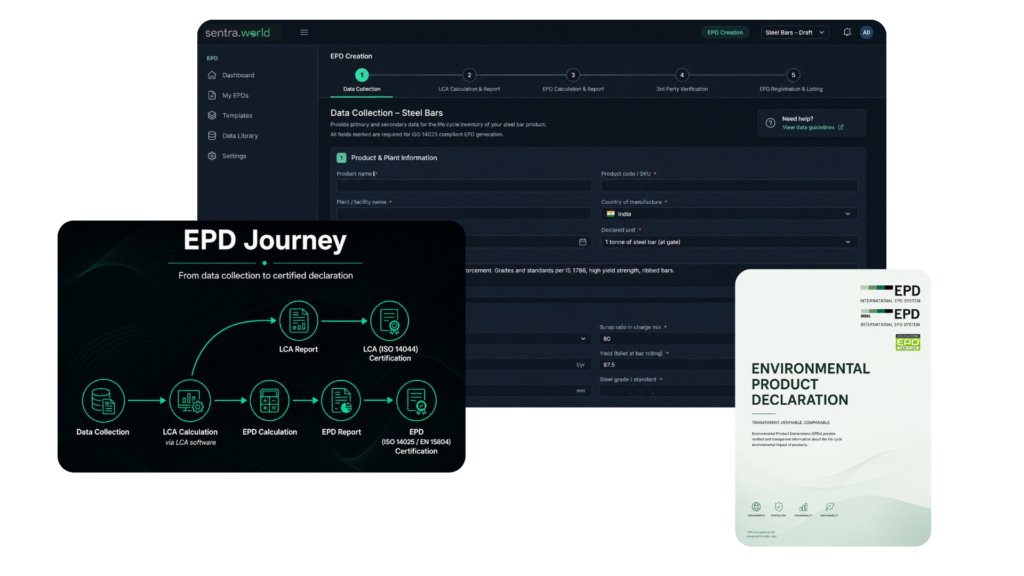
An Environmental Product Declaration, or EPD, is a verified document that communicates the environmental performance of a product in a standardised and transparent format. EPD reporting is usually based on Life Cycle Assessment methodology under ISO 14040 and ISO 14044, and follows ISO 14025 for Type III environmental declarations.
For manufacturers, EPD reporting helps convert detailed product-level data into credible information that customers, architects, developers, procurement teams and sustainability teams can use to compare products. The EPD process also follows applicable Product Category Rules, and for construction products, standards such as EN 15804 and ISO 21930 are commonly used.
An EPD focuses on the environmental impact of a specific product or product group. This makes it especially useful for steel, aluminium, cement, glass, pipes, tubes, foundries, building materials and other industrial products where customers increasingly ask for verified product-level environmental data.
Why EPDs Matter Now?
Manufacturers are facing a clear shift in how products are evaluated. Buyers are no longer looking only at price, quality and delivery; they are also asking for verified environmental performance, product carbon data and credible sustainability documentation.
EPD reporting helps manufacturers respond to this shift by providing product-level environmental information in a recognised, structured and comparable format. With the right EPD documentation for sustainable products, companies can support customer disclosures, green procurement, export readiness and low-carbon product positioning.
How can EPD Consultancy help you?
Green Procurement
Large buyers and infrastructure projects increasingly prefer materials with verified environmental data.
Green Building Requirements
EPDs are commonly used in construction and building material procurement where product impact needs to be documented.
Export and Customer Requirements
International customers may ask suppliers to provide verified product carbon and environmental information.
Product Differentiation
An EPD helps manufacturers show credible sustainability performance instead of relying on broad claims.
EPD Reporting vs LCA Reporting
LCA and EPD are closely connected, but they serve different purposes in product sustainability reporting. LCA is the technical assessment used to calculate lifecycle environmental impacts, while EPD reporting converts those results into verified and standardised EPD documentation for sustainable products. For manufacturers, understanding the difference is important before starting the EPD preparation journey, selecting an EPD consulting service, or using an automated EPD reporting platform.
| Basis | LCA | EPD |
|---|---|---|
| Full Form | Life Cycle Assesment | Environment Product Declaration |
| Purpose | Measures the environmental impact of a product across lifecycle stages | Communicates verified product environmental performance in a standardised format |
| Output | LCA study or LCA report | Verified EPD document |
| Based on | Lifecycle data, system boundaries, assumptions and impact assessment methodology | LCA results, Product Category Rules and third-party verification requirements |
| Use | Internal analysis, impact assessment, hotspot identification and reduction planning | Customer disclosure, green procurement, market-facing sustainability claims and product comparison |
Leading EPD Consultancy for Industrial Manufacturers
Trusted across India, the Middle East, and Southeast Asia for ESG Reporting, Carbon Accounting, EPD Consulting, and CBAM Consultancy.

















































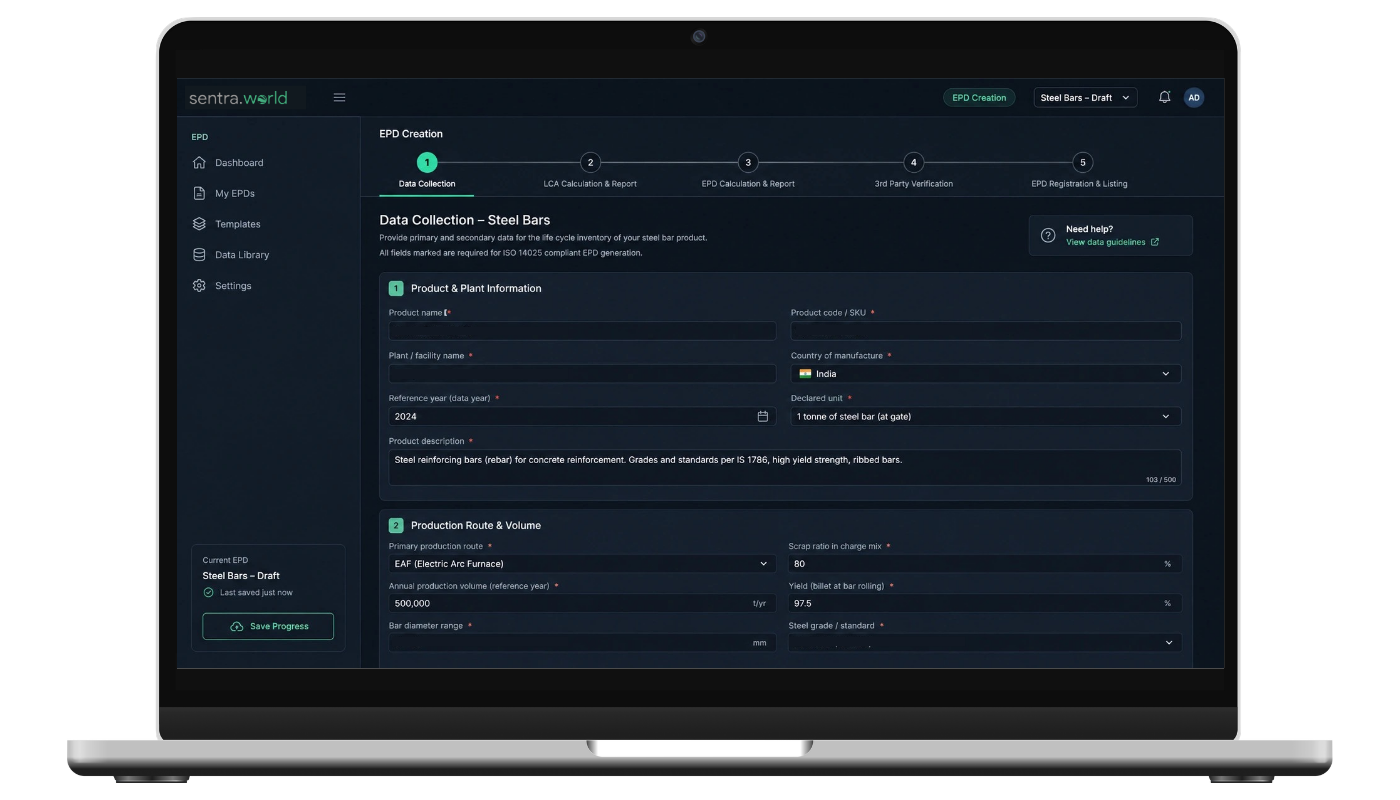
EPD Preparation Journey
EPD preparation becomes difficult when product-level data is collected manually across plants, ERP systems, meters, invoices, production records, logistics teams and suppliers. A structured EPD preparation journey helps manufacturers move from scattered data to organised LCA inputs, verification-ready evidence and accurate EPD documentation for sustainable products.
- 1. Select the Product
Choose the product or product family for which the EPD is required.
- 2. Define Scope and Boundary
Define the plant, declared unit, reporting period, product route and lifecycle boundary.
- 3. Identify Product Category Rules
Select the applicable PCR that defines how the EPD should be prepared.
- 4. Collect Product-Level Data
Collect material, energy, process, transport, waste and supplier data.
- 5. Conduct LCA and PCF Calculations
Calculate environmental impacts and product carbon footprint using structured activity data and emission factors.
- 6. Prepare Documentation
Prepare the EPD document, LCA report, methodology notes and supporting evidence.
- 7. Verification and Publication
Submit the EPD for third-party review and publish it through the selected EPD programme operator.
What Data is Needed for EPD Reporting?
EPD preparation depends on reliable product-level data that shows how a product is manufactured and where its environmental impacts come from. For industrial manufacturers, this data is often spread across plants, ERP systems, Excel files, meters, invoices, production records, logistics teams and suppliers, making EPD reporting difficult to manage manually.
This is where sentra.world helps. The platform collects data through integrations with ERP systems, Excel sheets and other source records, then structures and centralises information on raw materials, energy use, fuel consumption, production volumes, transport, packaging and waste. This makes EPD documentation for sustainable products more traceable, consistent and verification-ready.
Product
Product name, product category, technical specifications, declared unit, manufacturing site and production route.
Raw Material
Input materials, quantities, grades, recycled content, supplier data and upstream emission factors.
Energy and Fuel
Electricity, fuel, heat, steam, renewable energy use and plant-level energy records.
Process and Production
Production volume, yield, scrap, process losses, batch-level information and product family mapping.
Transport and Packaging
Inbound transport, outbound transport, packaging materials, distances and transport modes.
Waste and End-of-Life
Manufacturing waste, recycling, disposal, reuse potential and end-of-life assumptions.
How sentra.world supports in EPD Reporting?
sentra.world helps manufacturers move from scattered product data to structured, traceable and EPD-ready information. Our EPD consultancy support covers product scoping, PCR alignment, LCA readiness, EPD documentation, evidence management and verification preparation.
For manufacturers preparing product sustainability disclosures, LCA consulting is an important first step before EPD reporting. It helps define the product scope, lifecycle boundary, data requirements and calculation approach needed to create reliable and verification-ready EPD documentation.
Automated Data Collection
Collect product, material, energy, fuel, process, logistics and supplier data from ERP systems, Excel files, invoices, meters and operational data sources.
Product Carbon Accounting
Calculate product-level emissions using activity data, emission factors, process routes and batch or product-family information.
LCA Data Structuring
Organise lifecycle data across raw materials, manufacturing, transport, use phase and end-of-life assumptions.
EPD Documentation
Prepare structured outputs and evidence packs required for EPD development and third-party verification.
Evidence and Audit Trails
Maintain source documents, assumptions, calculation logic, approvals, version history and emission factors in one digital platform.
Industrial Manufacturing Focus
sentra.world is built for industrial sectors where product sustainability data is complex, technical and plant-driven.
EPD Consultancy and Reporting Support for Manufacturers
sentra.world supports EPD reporting and product sustainability workflows for industrial manufacturers by helping them structure product-level data, prepare EPD documentation for sustainable products, manage evidence, and build verification-ready reporting processes.
With an automated EPD reporting platform and expert-led EPD consulting service, companies can move from scattered manufacturing records to clear, traceable and audit-ready product sustainability disclosures across different industrial sectors.

Metals
Supports EPD reporting for high-impact metal value chains where product-level emissions, raw material inputs and process data are critical.

Industrial Products
Enables product-level environmental documentation for engineered components used across manufacturing, infrastructure and global supply chains.

Construction Materials
Helps manufacturers prepare verified product sustainability data for materials used in green buildings, infrastructure and procurement decisions.
Ready to prepare an EPD for your product?
We help you collect, calculate, document and prepare product sustainability data for EPD development and verification.
Frequently Asked Questions

The full form of EPD is Environmental Product Declaration. It is a verified document that communicates the environmental performance of a product in a standardised format, usually based on Life Cycle Assessment data and applicable Product Category Rules.
To prepare an EPD, manufacturers need to define the product scope, identify the applicable Product Category Rules, collect product-level data, complete the LCA study, prepare the EPD document and complete third-party verification. EPD reporting becomes easier when product data, evidence and calculations are managed in a structured system.
EPD reporting usually requires product composition, raw material inputs, energy and fuel use, production data, transport, packaging, waste data, supplier inputs and supporting evidence. This data is used to prepare LCA calculations and EPD documentation for sustainable products.
Product Category Rules, or PCRs, define how the environmental impact of a specific product category should be calculated and reported. They help ensure that EPDs for similar products follow a consistent methodology and can be compared more reliably.
The average timeline for creating an EPD report typically is 3 months but can take longer. The timeline depends on product complexity, data availability, PCR requirements, LCA readiness and verification review. For manufacturers with scattered data, the process may take longer because product-level data, evidence and assumptions need to be collected and validated first.
Yes, EPDs are generally verified by an independent third party before publication. Verification checks whether the LCA data, methodology, assumptions and EPD documentation follow the relevant programme operator and PCR requirements.
Businesses need EPD certification to provide credible, verified and comparable product-level environmental data to customers, procurement teams, architects, developers and global buyers. It helps support green procurement, product sustainability claims, export readiness and low-carbon product positioning in competitive markets.
One EPD may cover multiple similar products if they fall under the same product scope and are allowed under the applicable Product Category Rules. However, the products must be technically comparable, and the data and assumptions must be clearly documented.
LCA consulting supports EPD reporting by helping companies calculate lifecycle environmental impacts, define system boundaries, organise activity data and prepare the technical foundation required for a verified Environmental Product Declaration.
Yes, sentra.world provides EPD consulting service support for product scoping, data gap assessment, PCR alignment, LCA readiness, evidence management, EPD documentation and verification preparation with automated EPD reporting platform.
EPD consultancy helps manufacturers understand the complete EPD preparation process, from product scoping and PCR selection to LCA data preparation, EPD documentation and verification readiness. It ensures that product-level data is collected correctly, assumptions are documented, and the final Environmental Product Declaration is structured in line with applicable standards and buyer expectations.
Latest Blogs
The initial phase of the Carbon Border Adjustment Mechanism (CBAM) was more flexible. Reports could be filed with default values, estimates had fewer
CBAM for engineering exporters is not a future issue, it is an active compliance obligation with consequences already accumulating. Many exporters assume the
For industrial companies navigating compliance requirements in 2025, confusing a sustainability report with an ESG disclosure isn’t just a semantic mistake – it
Just enter your CN Code to check.
