
The regulatory environment for companies listed on the Muscat Stock Exchange (MSX) now requires reporting on Environmental, Social and Governance (ESG) pillars. ESG reporting requirements in Oman have shifted from being recommended to becoming a compulsory mandate. MSX first encouraged the listed companies to voluntarily report their 2023 ESG report in 2024 and then in 2025 – it became mandatory for 2024 activities to submit their ESG disclosures on MSX platform by 31st March 2025.
From 2025, MSX-listed companies were required to disclose their performance across 30 specific ESG metrics for the 2024 fiscal year, marking Oman’s transition from voluntary to mandatory sustainability reporting. By late 2025, MSX reported that companies listed on Main Market and Parallel Market achieved 100% compliance with the ESG disclosure standards.
This change is now in effect. Oman has already enforced ESG reporting on the Muscat Stock Exchange with penalties for non-compliance. Industrial firms and manufacturers face increased scrutiny due to their environmental impact. Missing deadlines or submitting incomplete data can result in reputational harm, regulatory fines, and reduced access to institutional investments and that’s why the need of modern ESG KPI dashboards is rising which will allow companies to track compliance across metrics across departments and plants efficiently.
The rationale for this mandate is aligned with Oman’s Vision 2040 economic diversification agenda and its commitment to achieving Net Zero emissions by 2050, establishing both political will and policy frameworks for genuine accountability.
Understanding the specifics of required reporting and aligning with international frameworks presents considerable complexity.
Decoding ESG Reporting Requirements in Oman: MSX, GRI and Global Reporting Alignment
With the mandate for ESG reporting firmly in place, the crucial question is: what does compliance entail? The answer is structured and more demanding than many industrial leaders might expect.
The 30 Metrics in Focus
The Muscat Stock Exchange ESG Guidelines require listed companies to report on 30 specific ESG metrics, categorized into three pillars:
- Environmental: Energy consumption, greenhouse gas emissions, water usage, waste generation, and environmental fines
- Social: Employee headcount, gender diversity, training hours, workplace injuries, and community investment
- Governance: Board composition, audit independence, anti-corruption policies, and shareholder rights disclosures
For industrial firms, the environmental pillar bears considerable operational significance. Detailed data on energy intensity, water withdrawal, and waste diversion rates serve as a longitudinal performance record, scrutinized by investors and regulators annually.
MSX, GRI and Global Reporting Alignment
The framework’s credibility is bolstered by its alignment with international standards. The MSX ESG framework is designed to support reporting in line with global sustainability practices and standards. Companies may also align disclosures with alignments with the Global Reporting Initiative (GRI) Standards for reporting and ISSB/IFRS S1 and S2 for investor focused disclosure.
This alignment is strategically vital. Companies structuring their disclosures around GRI and TCFD not only meet local regulations but also build the credibility needed for international capital markets.
Consistent, GRI-aligned ESG data is a highly underutilized competitive advantage for Omani industrial companies seeking international partnerships.
Environmental metrics – energy, water, waste – present significant data-quality challenges for most industrial operations. This challenge becomes critical when cross-border trade is involved, as companies exporting to Europe are already experiencing.
The Industrial Imperative: ESG Reporting Requirements in Oman and the Steel Sector’s Data Challenge
Understanding what to disclose is just half the battle. For Oman’s steel manufacturers and heavy industrial operators, the pressing challenge is building the operational infrastructure to capture, verify, and report data accurately – with implications extending beyond the MSX.
The EU’s Carbon Border Adjustment Mechanism changes the landscape for Omani exporters. Under CBAM regulations, Omani steel manufacturers exporting to the European Union must report the embedded carbon emissions of their products. Carbon content effectively becomes a trade variable. Companies unable to provide credible, auditable emissions data risk losing market access or facing substantial carbon tariffs -consequences far more severe than local compliance fines.
This is where Scope 1, 2, and 3 emissions tracking becomes a genuine competitive differentiator. Scope 1 covers direct emissions from owned facilities, Scope 2 accounts for purchased energy, and Scope 3 – the most complex – includes emissions from the entire value chain, from raw material sourcing to product transportation. For a steel facility managing multiple production lines, numerous suppliers, and cross-border logistics, compiling these numbers is not straightforward.
Typically, industrial teams rely on siloed spreadsheets across departments, leading to inconsistent methodologies, version-control errors, and data gaps that become apparent only during audits. Fragmented data collection isn’t just inefficient – it’s a liability when regulators or EU trading partners demand third-party verification.
Purpose-built ESG data management tools for reporting offer a structural advantage over manual processes. However, understanding why spreadsheets fail at this scale – and what a centralized platform delivers -requires deeper exploration.
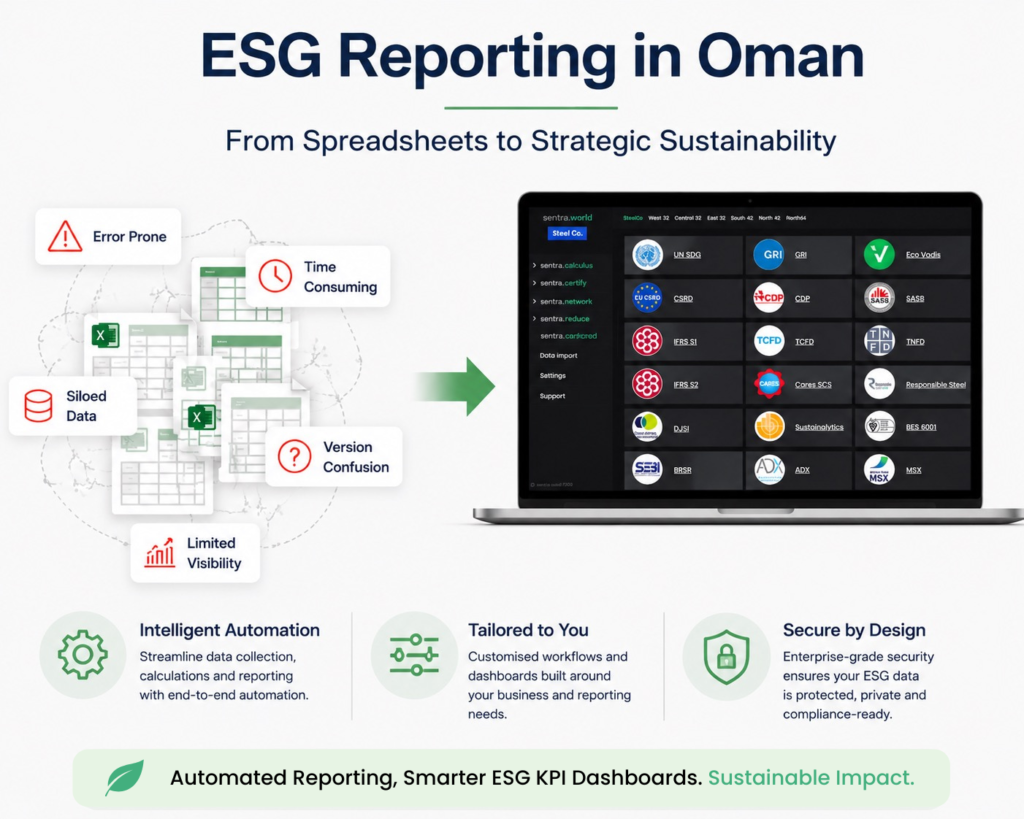
Why Manual ESG Reporting isn’t enough?
Given the complexity of CBAM-driven data requirements for industrial operators, a critical operational question arises: how do you capture, verify, and report all of this at scale? For many enterprises, the honest answer remains “with spreadsheets” – a significant liability.
Manual ESG data entry introduces risks at every stage. A single formula error or misclassified emission factor can cascade across an annual report, creating audit vulnerabilities that are hard to trace and costly to fix. For industrial manufacturing firms, the MSX Sustainability Reporting Guide demands granular data on energy consumption, water usage, and waste management – the kind of multi-variable tracking spreadsheets can’t reliably handle.
Manual data processes also create a structural blind spot: they’re inherently backward-looking. Year-end reporting becomes a scramble rather than a strategic exercise, leaving no room for adjustments during the reporting period.
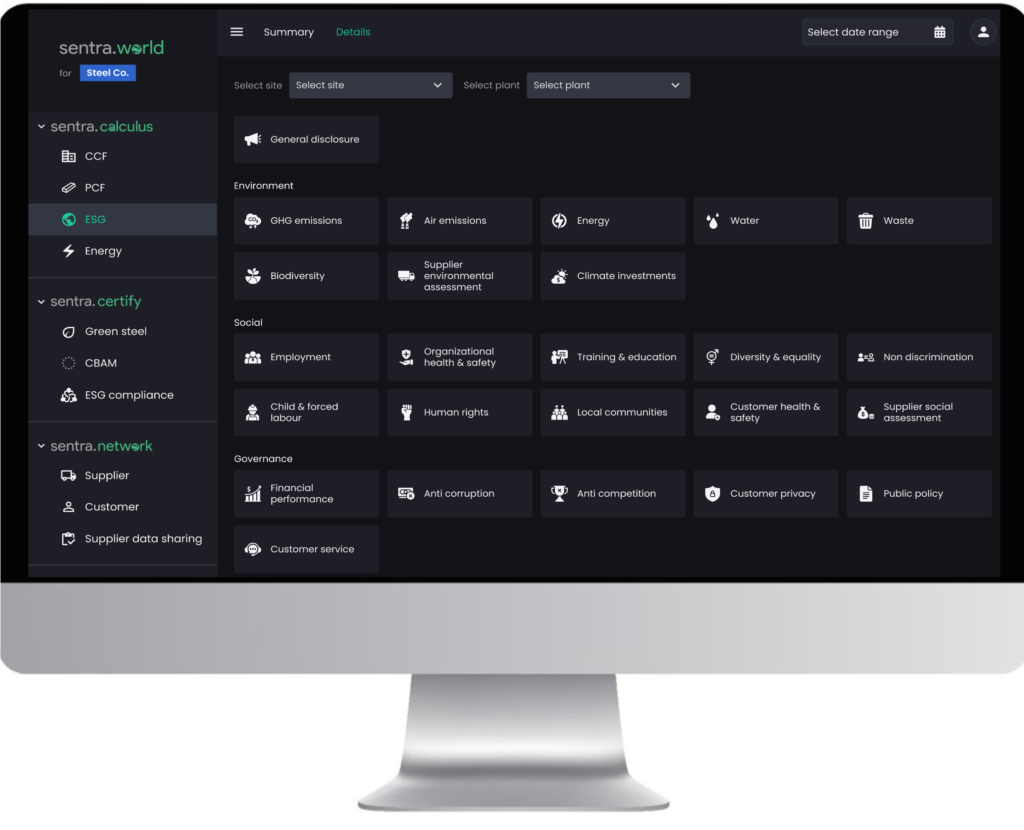
An ESG data management platform fundamentally changes this dynamic. For multi-site industrial operations – such as steel plants across multiple regions – centralized platforms aggregate real-time inputs from each facility, automatically flag anomalies, and maintain a defensible audit trail. This last point is crucial when regulators or institutional investors require evidence. Using ESG KPI dashboards can help companies automate data collection and validation along with easier reporting for Environmental, Social and Governance metrics.
The transition from reactive to proactive sustainability management is more than just an efficiency gain – it’s a competitive advantage. Selecting the right platform to achieve this capability requires understanding which features are crucial for Oman’s industrial context.
Selecting the Best ESG Reporting Tools for Omani Enterprises
With the complexity of CBAM requirements and the limitations of manual data management established, the next question is: what should industrial leaders look for when evaluating ESG compliance software for manufacturing operations?
Not all platforms are created equal – and for Omani steel producers and heavy industrials, generic tools designed for other industries won’t suffice.
5 Essential Features for Omani ESG Software
1. Pre-Built GRI and MSX Templates Your platform should come ready to support the MSX’s specific disclosure framework, not require extensive customization. Look for native GRI Standards mapping alongside templates that align with Muscat Stock Exchange requirements.
2. Robust Scope 3 Tracking This is essential. As the European Commission’s CBAM Regulation dictates, failing to provide verified Scope 1, 2, and 3 data can result in significant penalties, making automated Scope 3management and compliance certification vital. Your software must automate supplier-level data collection across your value chain.
3. Audit Trail Capabilities Regulators and third-party verifiers need a clear, timestamped record of how every data point was sourced and calculated. Platforms lacking defensible audit trails pose serious verification risks.
4. Carbon Accounting Modules for Heavy Industry Generic ESG tools rarely account for the unique emission profiles of steel manufacturing – blast furnace outputs, coking coal combustion, and process emissions require sector-specific calculation methodologies. Purpose-built industrial carbon accounting is a critical differentiator.
5. Local Support and Regional Regulatory Knowledge A software provider unfamiliar with GCC regulatory nuances – including how Oman’s MSX guidelines interact with CBAM obligations – introduces compliance risk during implementation. Regional expertise is essential.
The right platform transforms compliance from a burden into a competitive advantage. Industrial operators who select tools with these five capabilities can sustain compliance beyond the reporting cycles.
Understanding which features matter is the first step. Knowing how to deploy them across your organization is next – requiring a structured implementation roadmap.
Sustaining ESG reporting compliance after the 2025 Mandate
Selecting the right tools is only part of the process. Translating that investment into a functional compliance program requires a clear sequence of actions. Here’s a practical four-step roadmap for industrial operators preparing to meet the MSX mandate.
- Conduct a gap analysis of current data collection methods. Audit all existing data sources – energy meters, procurement records, waste logs – and map them against the specific metrics required under the MSX ESG Guidelines. Identify where data is missing, inconsistent, or siloed across departments.
- Select a fit-for-purpose ESG KPI dashboard. Evaluate the best ESG reporting tools against criteria like GRI alignment, CBAM compatibility, and audit-trail functionality. Prioritize platforms that automate data ingestion from industrial systems, reducing manual entry errors.
- Train internal teams on MSX and GRI standards. Compliance isn’t a solo effort. Cross-functional training – covering sustainability, finance, and operations teams – ensures everyone involved in data collection or approval understands the disclosure requirements and their role.
- Review the 2024 reporting cycle and run a dry-run report for the next reporting period. A dry run is arguably the most effective risk-reduction step a company can take before mandatory disclosure goes live.
With this roadmap, the next logical question is: which specific platform can execute these steps with minimal friction?
How sentra.world, an ESG Compliance Software that can Simplify your ESG Reporting Requirements in Oman
The 2025 MSX mandate has moved from regulatory ambiguity to enforceable reality. As MSX confirms 100% ESG disclosure compliance among listed companies, the question for Omani industrial leaders is no longer whether to comply – it’s how efficiently you can sustain compliance year over year.
This is where purpose-built ESG data management software like sentra.world makes a difference. Instead of relying on spreadsheets, manual audits, and disconnected reporting templates, sentra.world centralizes your entire ESG data pipeline – from carbon emissions tracking and CBAM calculations to stakeholder disclosures aligned with MSX guidelines.
Key takeaways from this guide:
- The 2025 mandate applies broadly to MSX-listed companies, with real enforcement consequences
- Manual approaches introduce data integrity risks that can undermine credibility with regulators and investors
- The right software reduces compliance overhead while improving disclosure quality
- Early implementation creates a competitive advantage, not just a checkbox exercise
Sustainable compliance isn’t a one-time project – it requires continuous data collection, verification, and reporting. Businesses that treat ESG infrastructure as a strategic asset today will be best positioned for tomorrow’s evolving regulatory landscape.
Ready to simplify your ESG reporting journey? Explore how sentra.world can help your organization meet and exceed Oman’s ESG requirements with ESG KPI dashboards.