
The UAE’s sustainability goals have transitioned from aspirations to mandates. For industrial companies listed on local exchanges, ESG reporting requirements in UAE are now becoming more structured, making ESG reporting services in UAE important for companies that need to establish compliant, data-backed systems.
Per Article 76 of the SCA’s Corporate Governance Guide, all public joint stock companies listed on the Abu Dhabi Securities Exchange (ADX) or Dubai Financial Market (DFM) must release an annual report that discloses financial reports, governance reports and sustainability reports. This is not merely a suggestion but a legal requirement.
Four key regulators shape this environment: the Securities and Commodities Authority (SCA) sets sustainability reporting standards for public joint stock companies, ADX & DFM provide exchange level ESG reporting and the Ministry of Climate Change and Environment (MOCCAE) leads national level climate policy and regulations for emissions.
The focus is clear: Public Joint Stock Companies (PJSCs) in manufacturing; energy, infrastructure, and related fields are under scrutiny. However, the effects reach further, as supply chain partners and private industrial operators face growing pressure to align.
This transformation is strategic, not superficial. Sustainability data management is now a fundamental business function, akin to finance and operations, rather than an isolated PR task.
Understanding who regulates you is just the beginning. Knowing when your obligations are due makes compliance urgent.
Why ESG matters for UAE Businesses?
ESG is important for businesses in the UAE because sustainability is now closely linked to investor confidence, regulatory readiness, access to finance, customer expectations and long-term business credibility.
ESG reporting for listed companies helps to improve transparency with shareholders, regulators and capital markets. It goes even further for manufacturers and industrial companies. ESG data is often scattered among utility bills, energy meters, HR records, EHS teams, procurement teams, suppliers, production sites and governance documents. Without a structured process, this data is hard to track, verify and report.
Strong ESG reporting is good for UAE businesses:
- Emissions, energy, water, waste, workforce, safety, governance, supplier performance
- Make sustainability disclosures more transparent for investors and stakeholders
- Respond to buyers, suppliers and customers’ ESG data requests
- Support climate, net zero and carbon reporting readiness.
- Earn the trust of lenders, regulators, business partners and customers
- Better sustainability data improves procurement and market positioning
From a supply chain perspective, ESG is also becoming important for manufacturers. Suppliers are increasingly being asked by large buyers, global customers and export markets for ESG and emissions data as a condition of onboarding or continuing business. That means companies will have to gather not just internal ESG data, but also information about suppliers, procurement and value chain emissions data.
Green ICV also demonstrates how sustainability data can fuel business value in the UAE. Companies can get additional ICV benefit for sustainability practices like emissions reduction, water management and circularity. This means ESG data can help manufacturers achieve both reporting and procurement competitiveness.
That is why many companies are looking for ESG Reporting Services in UAE that can provide more than just writing reports to create reliable, evidence-backed sustainability data for disclosures, audits, buyers, and business decisions.
What are the UAE’s ESG reporting requirements?
For industrial firms listed on UAE exchanges, ESG reporting has shifted from a recommended practice to a more formal disclosure requirement, making ESG Reporting Services in UAE useful for understanding applicability, deadlines, and reporting expectations.
Key points to note:
- Public Joint Stock Companies (PJSCs) on UAE-regulated exchanges must submit ESG reports as required by the Securities and Commodities Authority (SCA).
- Reports are due within 90 days of the company’s financial year-end – a December 31 year-end means a March 31 submission. For companies following a 31 December 2025 year-end, this means the FY2025 sustainability report would typically be due by 31 March 2026.
- The UAE Federal Decree-Law No. 11 of 2024 on the Reduction of Climate Change Effects came into force on 30 May 2025. It introduces obligations for public and private legal persons whose activities release greenhouse gases, including requirements connected to emissions measurement, reduction, and reporting.
- Non-compliance has regulatory repercussions, making robust ESG reporting tools and services for enterprises crucial to meet these obligations.
At a Glance: Mandatory vs. Voluntary
| Requirement | Applies To | Status | Main Authority |
| Sustainability report in integrated annual report | UAE public joint stock companies | Mandatory | SCA |
| ADX ESG disclosure guidance and indicators | ADX-listed companies | Mandatory sustainability reporting with ADX guidance | ADX |
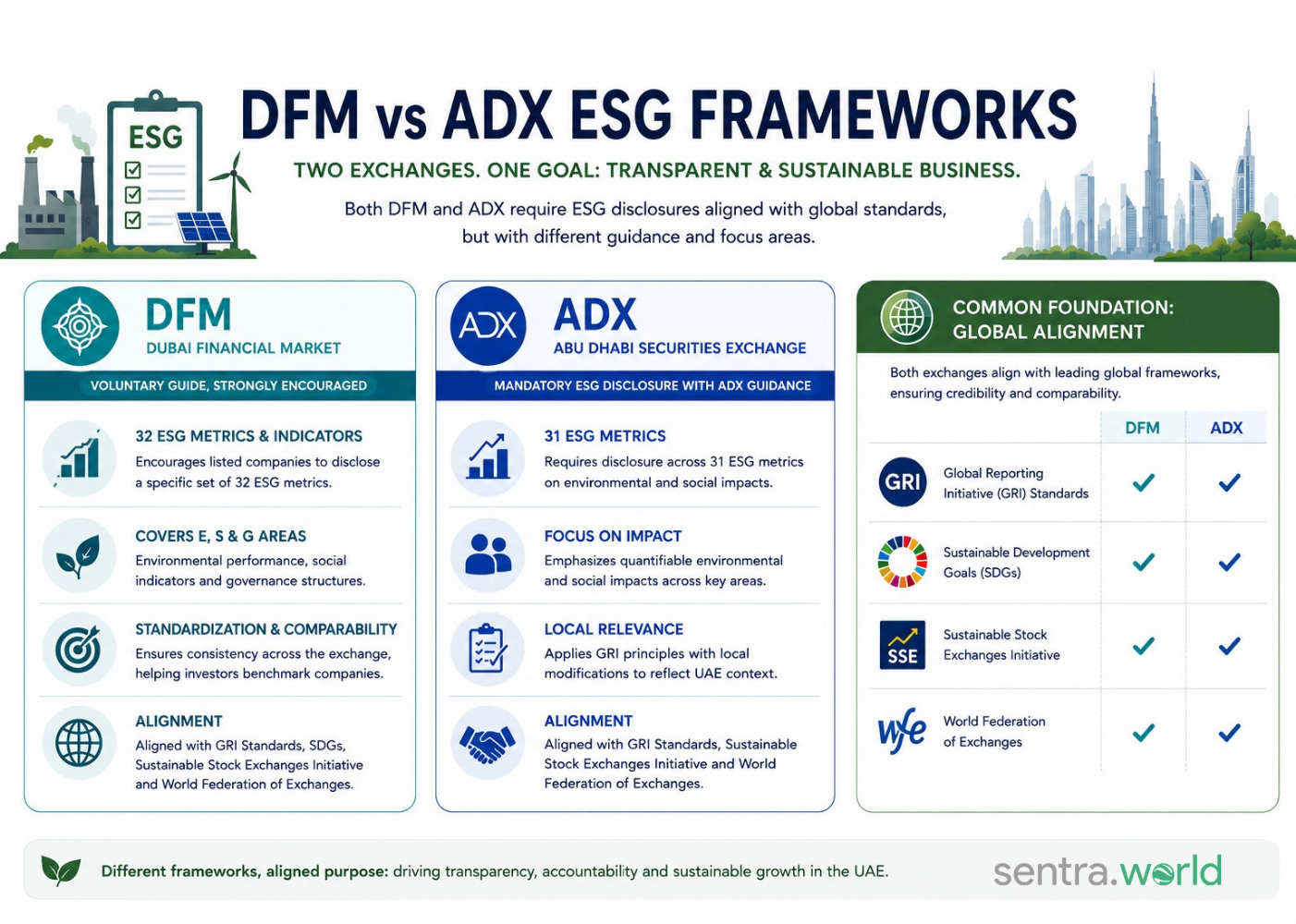
| DFM ESG Reporting Guide | DFM-listed companies | Voluntary guide, strongly encouraged | DFM |
| Climate / GHG-related obligations | Public and private legal persons whose activities release GHGs | Mandatory under the Climate Change Law | MOCCAE / competent authorities |
Industrial leaders must understand the distinction: financial market reporting and climate-specific reporting are governed by separate frameworks. The SCA dictates what listed companies disclose to investors, while the Ministry of Climate Change and Environment (MOCCAE) manages emissions accountability at the national level. Both frameworks are active and demand quantifiable data.
Knowing who requires what is only part of the challenge. The deeper complexity lies in the specific metrics each exchange demands, where the DFM and ADX frameworks diverge significantly.
Navigating the SCA, ADX, and DFM Frameworks in ESG Reporting in UAE
With compliance deadlines defined, the practical question is: what do these frameworks require you to report? Each exchange operates under distinct guidance, forming a coherent and increasingly demanding disclosure ecosystem.
| Exchange | Primary Framework | Key Requirement |
| DFM | GRI Standards | 32 standardized ESG metrics and indicators |
| ADX | ADX ESG Disclosure Guidance | Environmental and social impact disclosures |
| SCA | UAE Corporate Governance Code | Oversight of listed entity ESG compliance |
The DFM’s 32-Metric Standard
The Dubai Financial Market ESG Reporting Guide encourages that the listed companies disclose a specific set of 32 ESG metrics and indicators.The guide is voluntary, but DFM strongly encourages listed companies to use it as a starting point for sustainability reporting.
This standardized list ensures consistency and comparability across the exchange, covering environmental performance, social indicators, and governance structures. Standardization is crucial for investors to benchmark industrial firms confidently.
Accurate ESG reporting relies on quantitative data as qualitative narratives are insufficient for exchange requirements.
GRI Alignment Across Both Exchanges
Both the DFM and ADX frameworks align with Global Reporting Initiative (GRI) Standards, SDG’s, Sustainable Stock Exchanges Initiative, and the World Federation of Exchanges. This alignment allows companies familiar with GRI and other standards to adapt to existing processes rather than start anew. However, each exchange applies GRI principles with local modifications.
The ADX ESG Disclosure Guidance emphasizes quantifiable environmental and social impacts across 31 ESG metrics aligned with the Sustainable Stock Exchanges initiative and the World Federation of Exchanges. Industrial firms used to operational reporting will recognize the logic, though the scope is broader.
Meeting these requirements without robust ESG data management tools for reporting is increasingly difficult as metric counts grow, which is why ESG reporting services in UAE could support in framework mapping, data collection and evidence management. Spreadsheet-based tracking introduces risks, and vulnerabilities regulators won’t overlook.
The stakes for non-compliance extend beyond administrative issues, leading to penalties every industrial leader must understand.
The Cost of Non-Compliance: Fines and Penalties
Understanding framework requirements is essential, but knowing the consequences of ignoring them is equally critical.
Non-compliance with emissions reporting isn’t just a paperwork issue, it’s a financial liability that can reach seven figures.
According to Federal Decree-Law No. 11 of 2024, fines for failing to comply with GHG emissions reporting range from AED 50,000 to AED 2,000,000-approximately $13,600 to $544,000 USD.
⚠️ Penalty Alert: Violations of emissions reporting obligations can incur fines up to AED 2,000,000. Repeat offenses within two years are subject to a doubling rule, raising maximum exposure to AED 4,000,000 per incident.
The escalation mechanism often surprises industrial firms. A first-year oversight can become a second-year crisis if corrective actions are not documented and implemented. Companies tend to underestimate audit frequency and treat ESG disclosures as secondary rather than a compliance priority.
For listed firms, the stakes go beyond fines. Institutional investors increasingly screen ESG data before capital allocation, and a public compliance failure can trigger credit rating reviews, shareholder inquiries, and index exclusion reviews.
For MSMEs within larger industrial supply chains, the risk is structural. Preferred supplier status, often dependent on demonstrated ESG transparency, can be quickly revoked when reporting gaps appear.
Investing in a reliable ESG data management platform is no longer optional for firms at this scale; it prevents penalties and reputational damage from compounding.
This financial exposure ties to another strategic lever-one that rewards strong ESG data instead of just penalizing its absence.
Industrial Strategy: Monetizing Data through Green ICV
Beyond avoiding fines, forward-thinking leaders find ESG data has direct monetary value. The UAE’s In-Country Value (ICV) Program offers financial incentives to make sustainability performance measurable and verifiable, turning compliance from a cost into a competitive asset.
MoIAT’s Green ICV criteria add a sustainability-linked bonus to the National ICV Program. Companies can gain up to 3% bonus on their overall ICV score by demonstrating sustainability-related standards and policies, including water management, circularity, and emissions reduction. For manufacturers, this makes ESG data useful not only for reporting, but also for procurement competitiveness.
Government Incentives and the Green ICV Connection
The ICV Program rewards companies that localize spending, develop national talent, and invest in UAE-based supply chains. Its Green ICV component extends to sustainability metrics, meaning firms demonstratingverifiable environmental and social performance earn higher ICV scores-directly translating into better positioning on government contracts.
- Improved bid ranking on federal and emirate-level tenders
- Access to incentive-linked financing from industrial development funds
- Priority consideration in ADNOC, EDGE Group, and other buyer programs
Solving the Data Challenge: ESG Reporting Services in UAE for Enterprises
As sustainability reporting requirements in the UAE become more specific and enforceable, the data challenge can’t be ignored. Manual collection fails in manufacturing environments because the data exists in too many places. Production floors, utility systems, HR databases, and supplier records all generate ESG-relevant data. Without automated aggregation, gaps are inevitable.
5 Must-Have Features for Industrial ESG Software
When evaluating ESG Reporting Services in UAE, industrial companies should prioritize these capabilities:
- Real-time emissions tracking – Continuous Scope 1 and 2 data capture, not reconstructed quarterly
- Multi-site data consolidation – Aggregate metrics across facilities into a single view
- Audit-ready documentation – Timestamped data trails satisfying third-party verifiers and regulators
- Framework alignment – Pre-built templates mapped to DFM, ADX, and GRI standards
- Workflow automation – Automated alerts, data validation, and report generation reduce errors
DFM and ADX metrics are quantitative; companies need reliable internal systems to collect, validate and report ESG data across departments and reporting periods.
sentra.world: An ESG Reporting Platform for Manufacturing Industries
So, is ESG mandatory in the UAE? The answer is increasingly yes, with clear movement toward full enforcement. Listed companies on the ADX and DFM face structured disclosure obligations, and voluntary frameworks are becoming baseline expectations across the industrial sector.
Throughout this guide, the central challenge is clear: ESG compliance in the UAE isn’t a single checkbox. It’s a convergence of regulatory pressure from the SCA, exchange-specific frameworks from ADX and DFM, green ICV opportunities, and the operational difficulty of collecting reliable, audit-ready data across complex environments.
The industrial leaders who will succeed aren’t just those who comply-they’re those who turn compliance infrastructure into competitive advantage.
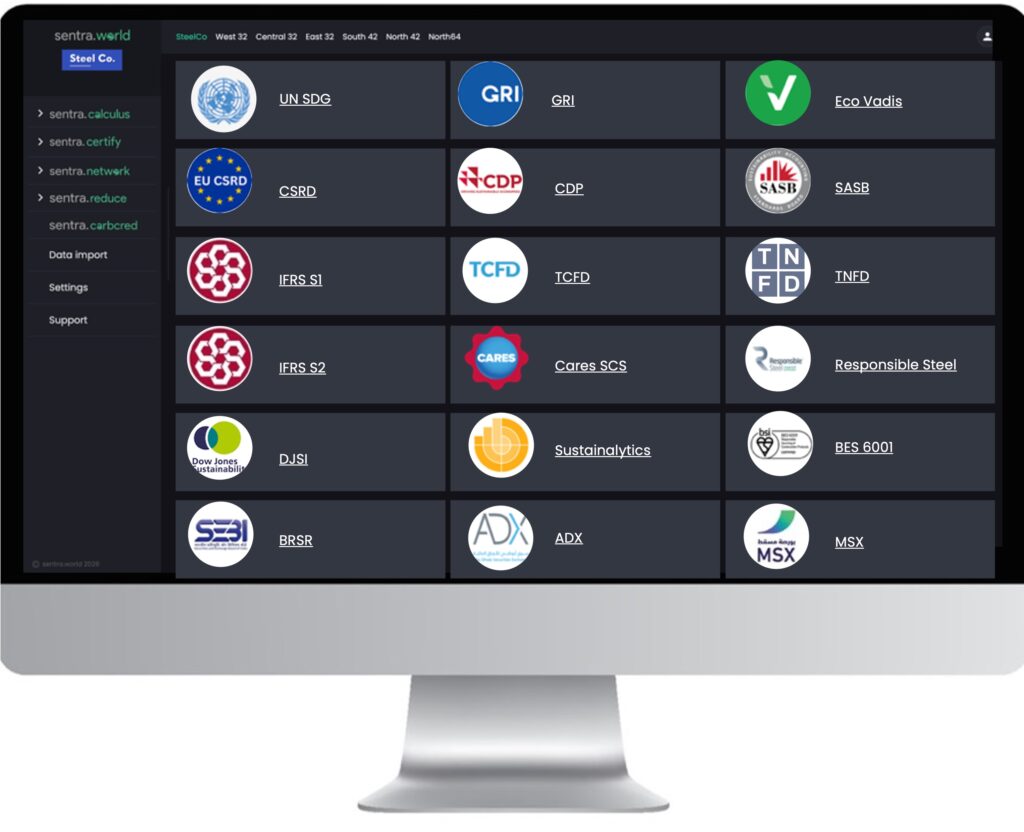
For manufacturing enterprises navigating this landscape, sentra.world is purpose-built for this challenge. Instead of adapting generic reporting tools, sentra.world addresses the data complexity of industrial operations -energy consumption, emissions tracking, supply chain metrics, and workforce indicators – in a single, structured platform.
Key capabilities aligned to UAE compliance needs include:
- Automated data collection mapped to GRI, ADX, and DFM disclosure requirements
- Audit-ready reporting satisfying regulatory scrutiny
- Green ICV alignment to maximize procurement scoring
- Real-time dashboards for ongoing ESG performance monitoring
The UAE’s sustainability agenda is accelerating. The question for industrial leaders isn’t whether to act-it’s whether to lead or catch up. Looking for ESG Reporting Services in UAE for your manufacturing business? – Reach Out To Us Now!