
You know how every food product has a nutrition label telling you what’s inside? Well, industrial manufacturing’s got something similar now. It’s called an Environmental Product Declaration (EPD). Think of it as a detailed report card for a product’s environmental impact throughout its life, from when it’s made to when it’s tossed. This document is verified by a third party and follows ISO 14025 and EN 15804 standards.
Just like nutrition labels show calories and fat, an EPD reporting highlights Global Warming Potential (GWP)-basically, the carbon footprint of things like steel, concrete, or insulation. It turns invisible data into something everyone can understand, from engineers to regulators.
An Environmental Product Declaration (EPD) is a verified document that explains the environmental impact of a product across its life cycle. It is based on a Life Cycle Assessment (LCA) and follows a defined Product Category Rule (PCR), so products in the same category can be compared more consistently.
In simple terms, an EPD shows the environmental footprint of a product — including indicators such as carbon emissions, energy use, water use, resource consumption, waste, and other environmental impacts.
Here’s the thing: EPD reporting used to be optional, kind of like a bonus for companies with eco-friendly initiatives. But now, they’re becoming a must-have in procurement specs, green building standards, and government contracts. If manufacturers can’t provide verified environmental data, they’re often left out of the game.
EPD reporting also cover Scope 3 emissions-those tricky supply chain emissions that make up most of a company’s carbon footprint. This shift from optional to essential is happening faster than many realize, and it starts with one key number.
Table of Contents
Why EPD Matters Now ?
So, why are EPDs turning into a necessity? Well, the market is all about verified data now. What used to be a nice-to-have is now a must-have for competing globally. Procurement teams and government agencies are demanding more transparency, and companies without EPDs might miss out on big contracts.
Green building certification programs are a big part of this change. Programs like LEED and BREEAM give points for using products with EPDs. Under LEED v4 and v4.1, project planners want materials with Life Cycle Assessment data. This means EPDs are now expected rather than extra.
But it’s not just about certifications. “Buy Clean” policies in the U.S. and Europe are changing how materials like steel and cement are sourced for major projects. These policies require suppliers to provide verified environmental data, with EPDs serving as the proof.
The risk here is real. Industry analysis shows that the number of projects needing verified environmental data is rising fast. Manufacturers without it might get disqualified, no matter how good their products are.
But what exactly goes into an EPD? It’s important to understand the connection between the scientific process behind the data and the standardized report that presents it. To understand why EPD matters for manufacturers and how it supports product-level sustainability disclosure, explore our detailed EPD solutions page.
LCA vs. EPD : Understanding the Engine and the Dashboard
Imagine this: a Life Cycle Assessment (LCA) is like the engine under the hood, while an Environmental Product Declaration (EPD) is the dashboard that shows everyone else what’s going on.
The LCA is the science part. It’s a method that measures every environmental impact a product has throughout its life-from start to finish. This includes calculating things like embodied carbon and energy use. The LCA follows ISO 14040 and ISO 14044 standards and involves a lot of data crunching to give a clear picture of a product’s environmental footprint.
The EPD is the communication part. It takes the LCA’s complex data and turns it into a report that people like specifiers and regulators can understand and use. An EPD offers a transparent, third-party-verified look at a product’s environmental performance.
Here’s the key takeaway for industrial leaders: a valid ISO 14025:2026 needs a strong, verified LCA behind it. The EPD’s credibility depends on the data it uses. A weak LCA means an EPD that won’t hold up under scrutiny, and that’s risky in today’s market.
| Basis | LCA | EPD |
|---|---|---|
| Full Form | Life Cycle Assesment | Environment Product Declaration |
| Purpose | Measures the environmental impact of a product across lifecycle stages | Communicates verified product environmental performance in a standardised format |
| Output | LCA study or LCA report | Verified EPD document |
| Based on | Lifecycle data, system boundaries, assumptions and impact assessment methodology | LCA results, Product Category Rules and third-party verification requirements |
| Use | Internal analysis, impact assessment, hotspot identification and reduction planning | Customer disclosure, green procurement, market-facing sustainability claims and product comparison |
Now, how does one go about creating a verified EPD reporting, step by step?
EPD Types: Which EPD Reporting Format Fits Your Product?
Not every Environmental Product Declaration is created in the same way. Depending on the product, market, company structure, and data availability, EPD Reporting can be prepared under different EPD types.
The most common format is a single-company, single-product EPD, which represents one specific product or service from one manufacturer. This is typically used when a company wants to disclose the verified environmental performance of a defined product already available in the market.
Other EPD types may include:
- EPD for multiple products from one company
- Sector EPD, representing an industry or product group
- EPD published by a trader
- EPD for a product not yet on the market
- EPD for a product recently introduced to the market
For manufacturers, choosing the right EPD type matters because it affects the scope of data collection, LCA boundaries, verification process, and how customers or procurement teams interpret the declaration.
A product-specific EPD can be especially useful when buyers need verified product-level data for tenders, green procurement, low-carbon material selection, or customer sustainability disclosures.
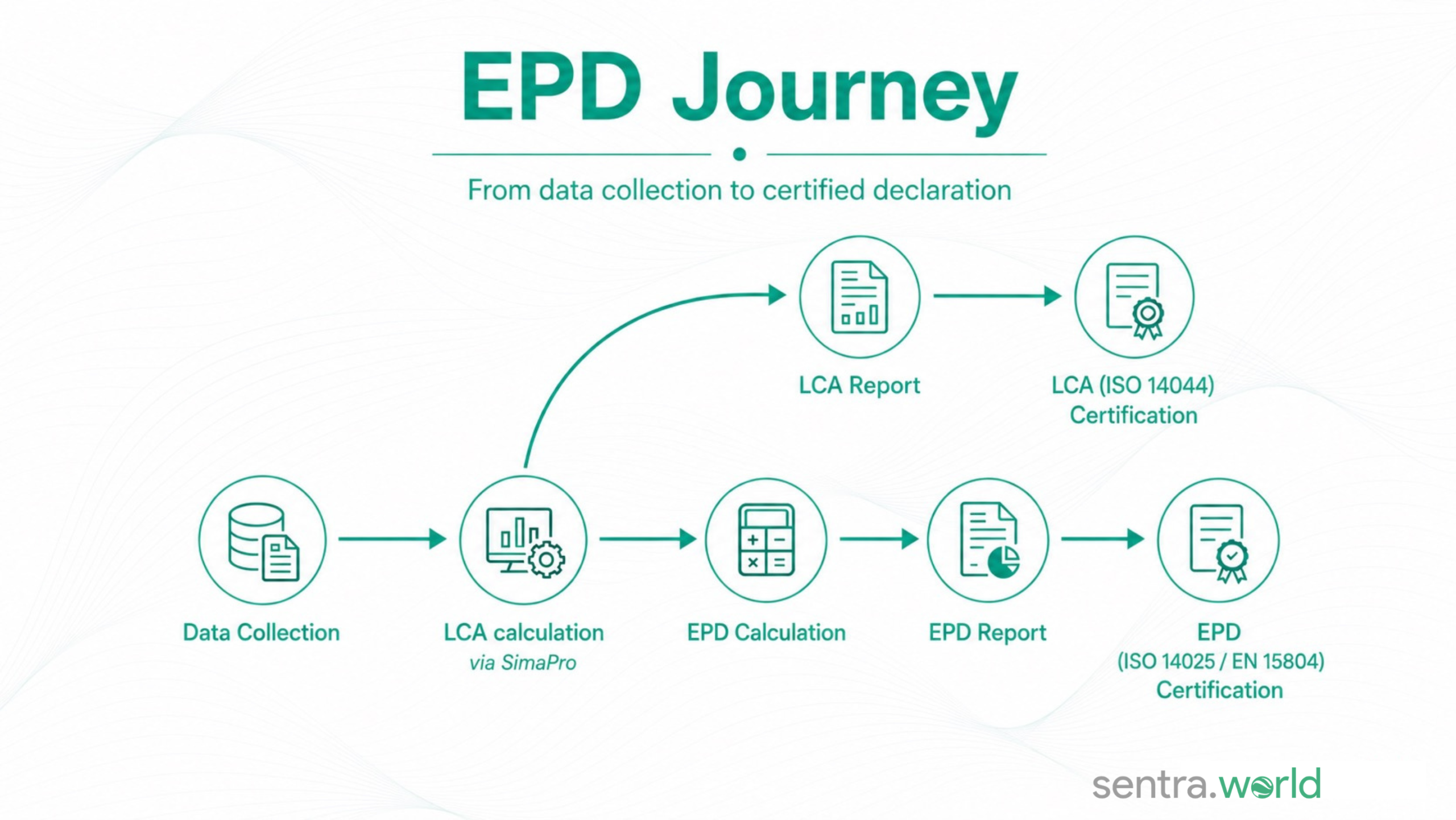
The 5-Step Roadmap to a Verified EPD Reporting
Now that you know what an EPD is and why it’s important, you might wonder: how do you create one? The process is detailed, but knowing the steps helps avoid mistakes.
Step 1: Select the Right Product Category Rules (PCR)
- Every EPD starts with Product Category Rules (PCR). These are instructions on how to conduct the LCA for a specific product. Choosing the wrong PCR means your results won’t match others, which defeats the purpose. Check the registry for the right PCR before starting any analysis.
Step 2: Conduct the Life Cycle Inventory and Assessment
- Once you have the PCR, collect Life Cycle Inventory (LCI) data. This includes energy inputs, raw materials, emissions, and waste at every stage of production. This data feeds into the LCA, turning raw numbers into standardized environmental impact indicators like Global Warming Potential (GWP).
Step 3: Draft the EPD Document
- The EPD must follow EN 15804 standards (for construction products) or other relevant standards. As per many compliance guidances, sticking to these formats is crucial for market acceptance.
Step 4: Independent Third-Party Verification
- Third-party verification is vital for credibility. An independent verifier checks your LCA and EPD against the PCR requirements to confirm the data’s accuracy. Without this, the EPD won’t be taken seriously.
Step 5: Register With an EPD Program Operator
- Finally, register your verified EPD with an accredited program operator. This makes it publicly searchable and legally defensible, ensuring it meets international standards. The steps seem simple on paper, but the real complexity lies within each step.
Overcoming the ‘Data Wall’: Challenges in EPD Reporting
With the 5-step roadmap in mind, you might think the process is easy. But in reality, moving from intent to a verified EPD report is full of challenges that can surprise even well-prepared teams.
- Scope 3 Data: The Hardest Puzzle Piece : Gathering Scope 3 emissions data is tough. Your facility data is manageable, but an EPD needs visibility from start to finish. This means getting accurate data from suppliers and partners who might not have sustainability reporting systems. Often, suppliers either don’t have the data or give inconsistent info, which weakens the whole assessment.
Reliable EPDs are only as strong as the weakest data point in your supply chain.
- Timeline and Cost Realities : Collecting data manually can take 6-12 months before verification even starts. Then there are verification fees, which vary by program operator and product category.
- Navigating PCR Variations : ISO 14025 sets the global framework, but Product Category Rules (PCRs) differ between regions and operators. A PCR for concrete in North America might have different boundaries than one in Europe, complicating efforts to produce EPDs for multiple markets.
But these hurdles aren’t permanent. With the right tools, processes, and partners, your EPD data can be more than just compliance paperwork, it can be a valuable business asset.
EPD compliance tools for manufacturers can help reduce this complexity by organising product data, supplier inputs, LCA assumptions, evidence documents and verification-ready outputs in one system. This is especially useful for industrial companies where data is spread across plants, ERP systems, meters, invoices and production teams.
Leveraging EPDs to Drive Business Growth
After overcoming data and verification challenges, many leaders find an unexpected benefit: the EPD process itself becomes a useful business tool, not just a compliance task.
- Turn LCA Hotspots into Cost Savings : The detailed data from a life cycle assessment doesn’t have to just sit there after verification. LCA hotspots-the stages that use the most energy or create the most emissions-often point to inefficiencies. Fixing these can lower your carbon footprint and costs at the same time. That’s a win-win that smart operations teams are starting to focus on.
- Market to the Decision-Makers Who Care : Architects and developers aiming for LEED, BREEAM, or similar certifications look for suppliers with verified EPDs. Standards like EN 15804 provide consistent data formats that project teams trust when comparing materials. A verified EPD isn’t just a piece of paper-it’s a reliable signal that cuts through greenwashing and gives decision-makers a reason to pick your product over others.
- Strengthen Your Supply Chain Position : Sharing transparent carbon data builds trust with partners who have their own sustainability goals, making you a preferred, lower-risk collaborator.
The challenge is getting that data right and fast-exactly where the right technology platform can make all the difference.
How sentra.world Accelerates Your EPD Reporting Journey
All the insights in this guide-from understanding Environmental Product Declarations to tackling data walls and turning transparency into growth-boil down to one thing: execution. That’s where the right platform comes in handy.
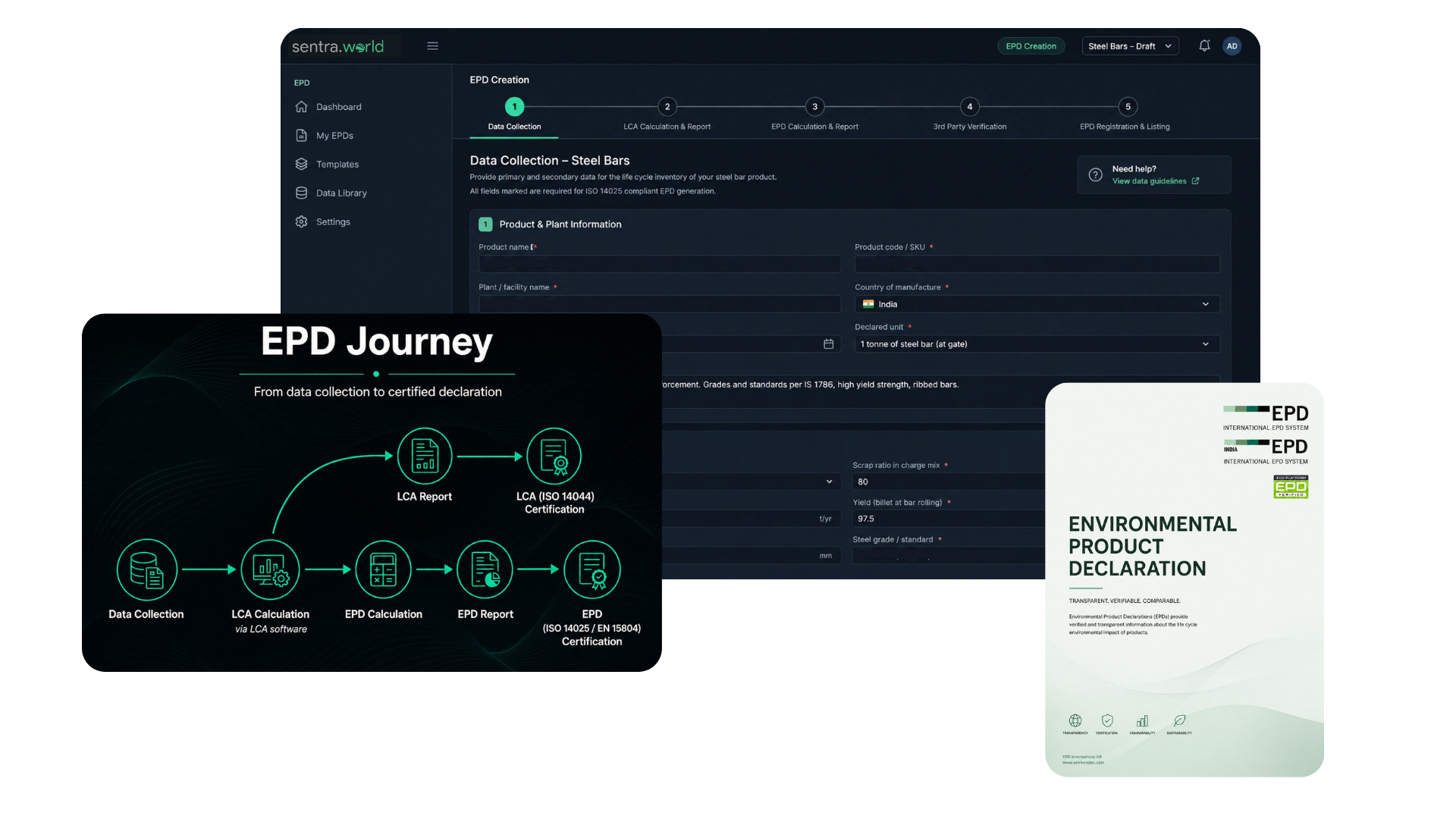
sentra.world acts as an automated EPD reporting platform for industrial manufacturers that cannot rely on manual spreadsheets, disconnected plant records and repeated data rework. By automating the life cycle assessment process, it removes errors and inconsistencies that often derail EPD reporting projects. Manual methods usually lead to constant rework, but automation stops that cycle.
Along with platform support, sentra.world provides an EPD consulting service to help manufacturers define product scope, select the right PCR, organise LCA data, prepare EPD documentation, coordinate verification readiness and move toward a publishable EPD reporting declaration.
Streamlining third-party verification is just as crucial. sentra.world creates standardized data exports to meet verifier expectations, cutting down on back-and-forth and speeding up timelines.
Want to be ahead of the curve and make EPD reporting easy? Get in Touch Now!