
The Carbon Border Adjustment Mechanism, or CBAM, is the European Union’s carbon border policy that puts a carbon price on selected imported goods based on their embedded emissions.
CBAM is not always straightforward, especially CBAM for foundries. Many foundry products may not be directly covered today unless they fall under specific CN codes in the iron, steel or aluminium categories. However, that does not mean foundries can wait.
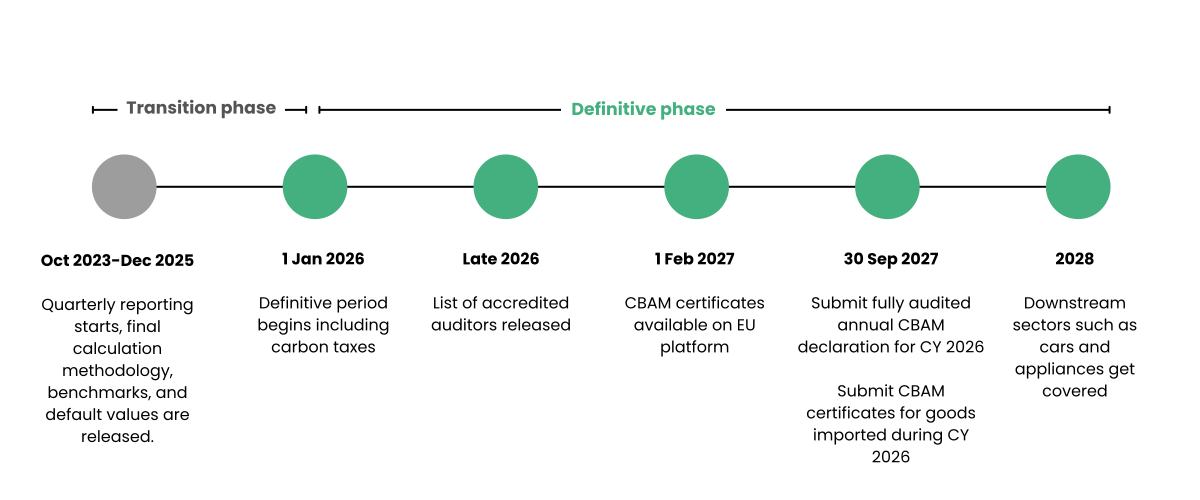
Foundries supply castings, machined components, housings, flanges, brackets, fasteners, forgings, pipe fittings and aluminium parts to automotive, engineering, machinery, construction and industrial equipment companies. Many of these customers may already be exposed to CBAM, and downstream steel and aluminium products are expected to come into CBAM scope from 2028, subject to final EU legislative approval.
This means foundries may start receiving customer requests much earlier than 2028. EU buyers and downstream manufacturers may ask for product-level embedded emissions values, actual emissions data, electricity and fuel records, scrap mix data, supplier declarations and supporting evidence.
The key message for foundries is simple: even if your product is not directly covered today, the company you supply to may need your emissions data for its own CBAM reporting, cost calculation or customer disclosure.
A CBAM consultant for exporters can help foundries check product applicability, map CN codes, calculate embedded emissions, estimate cost exposure and prepare customer-ready CBAM documentation. This is why CBAM for foundries will be an important step to take for smooth operations in the future.
What has Changed in 2026?
From 2026, CBAM has moved into its definitive phase. This means CBAM is no longer only about reporting. It starts creating financial exposure for covered imports into the EU, making accurate emissions data more important for importers and their suppliers.
The European Commission has published the first CBAM certificate price for Q1 2026 at €75.36 per tonne of CO₂. In 2026, CBAM certificate prices are published quarterly, while from 2027 onwards, prices will be calculated and published weekly.
For foundries, this matters because EU customers now have stronger commercial reasons to ask suppliers for actual embedded emissions data. If a foundry cannot provide reliable product-level data, the customer may rely on default values or conservative assumptions, which can weaken the foundry’s position in pricing and supplier discussions.
Are Foundry Products Covered Under CBAM?
Some foundry-linked products may already be relevant under CBAM if they fall under covered iron, steel or aluminium CN codes. Others may be treated as downstream products and are expected to become more relevant from 2028 as CBAM expands to additional steel and aluminium products.
Foundries should not decide CBAM applicability based only on product names such as “casting,” “component,” “housing,” “bracket,” “flange,” “pipe fitting” or “machined part.” CBAM relevance depends on CN code and customs classification.
Foundries should take a practical approach:
- Check the CN code of every EU-bound product.
- Identify whether the product falls under current CBAM-covered categories.
- Track 2028 downstream CBAM expansion for automotive, engineering and industrial components.
- Prepare product-level embedded emissions data even if the product is not directly covered today.
- Be ready to support EU customers with actual emissions data and supporting evidence.
CN Codes that apply to CBAM for Foundries
Foundries should not assume they are outside CBAM just because they manufacture components. CN code mapping should be reviewed carefully with customs, export and compliance teams.
The following CN codes may be relevant for foundries, automotive suppliers, engineering manufacturers and component exporters. These should be reviewed with customs, export and compliance teams.
| CN Code | Description | Application in Auto & Engineering |
|---|---|---|
| 7318 15 00 | Threaded screws and bolts, with or without nuts/washers | Engine head bolts, chassis fasteners, socket head cap screws |
| 7318 16 00 | Threaded iron or steel nuts | Hex nuts, flange nuts, self-locking fasteners |
| 7318 21 00 | Spring washers and lock washers | Anti-loosening hardware for machinery and suspension |
| 7318 22 00 | Non-threaded flat washers and spacers | Industrial shims and load-distributing washers |
| 7318 23 00 | Iron or steel rivets | Structural rivets and sheet metal joints |
| 7616 10 00 | Aluminium fasteners | Screws, bolts, nuts, rivets and washers for lightweight assemblies |
| 7304 31 00 | Seamless tubes and pipes of iron/steel | Hydraulic lines, fuel injector tubes and drive shafts |
| 7307 91 00 | Flanges of iron or steel | Machinery fluid connections and pump pipe joints |
| 7307 92 00 | Threaded elbows, bends and sleeves of iron/steel | Hydraulic routing and steering connectors |
| 7608 20 00 | Tubes and pipes of aluminium alloys | Radiators, HVAC lines and EV cooling systems |
| 7609 00 00 | Aluminium tube or pipe fittings | Connectors and couplings for lightweight fluid networks |
| 7326 19 10 | Open-die forgings of iron or steel | Equipment pins, arms and structural links |
| 7326 19 90 | Closed-die forgings of iron or steel | Crankshafts, connecting rods and transmission gear blanks |
| 7326 90 98 | Other articles of iron or steel | Brackets, housings, mounting plates and welded assemblies |
| 7616 99 90 | Other articles of aluminium | Cast aluminium housings, brackets and EV battery enclosure modules |
This table should not be treated as a final applicability decision. Foundries should validate product classification before confirming whether a product is inside or outside CBAM scope.
Check if your products are covered under CBAM with sentra.world’s Free Eligibility Checker : https://sentra.world/cbam-eligibility-checker/
Just enter your 8 digit CN code and check if you are eligible under CBAM.
Why Foundries Should Not Wait Until 2028
The 2028 downstream expansion does not mean foundries should start preparing in 2028. By then, EU customers may already be asking suppliers for data.
Foundries should start now because CBAM-ready data is not easy to prepare at the last minute. It requires historical records, product-level allocation, furnace data, electricity and fuel consumption, charge mix details, scrap records, supplier data and audit trails.
A foundry may need to answer questions such as:
- What is the embedded emissions value for this casting or component?
- Which furnace or route was used to manufacture it?
- How much electricity and fuel was consumed?
- What was the scrap, pig iron, alloy or aluminium input mix?
- What emission factors were used?
- Can the data be supported with invoices, meter readings and production records?
- Can emissions be linked to product families, batches or shipments?
If this data is not already structured, responding to customer requests can become slow, manual and inconsistent.
Who Pays CBAM for Foundries : Exporter or Importer?
Under CBAM, the EU importer is responsible for the formal compliance obligation. The importer submits CBAM declarations and, under the definitive regime, purchases and surrenders CBAM certificates for covered imports.
The non-EU foundry or exporter does not directly pay CBAM certificates to the EU. However, the foundry’s emissions data affects how the importer’s CBAM liability is calculated.
| Non-EU Foundry / Exporter | EU Importer / Customer |
|---|---|
| Shares product-level emissions data | Uses supplier data for CBAM reporting |
| Provides energy, fuel and process data | Estimates CBAM cost exposure |
| Maintains supporting evidence | Submits declarations where applicable |
| Helps reduce reliance on default values | May request verified or audit-ready data |
The importer pays the CBAM cost, but the foundry’s data can influence the cost calculation, supplier evaluation and future procurement decisions.
How Foundries Should Prepare for CBAM
Foundries exporting to the EU or supplying customers that export to the EU should start with a structured CBAM readiness plan.
1. Map EU-bound and EU-linked products : Identify products exported directly to the EU and products supplied to customers that export to the EU.
2. Check CN codes : Review CN codes with customs, export and compliance teams.
3. Ask customers what data they need : Check whether buyers need embedded emissions values, supplier declarations, product-level reports, PCF values or supporting evidence.
4. Build product-level data records : Connect raw materials, energy, fuel, production, yield and shipment data to product families or batches.
5. Prepare evidence : Maintain invoices, meter records, ERP extracts, production logs, supplier declarations and calculation assumptions.
6. Estimate CBAM exposure : Use a CBAM Eligibility Checker and CBAM Liability Calculator to understand applicability, data gaps and potential cost exposure.
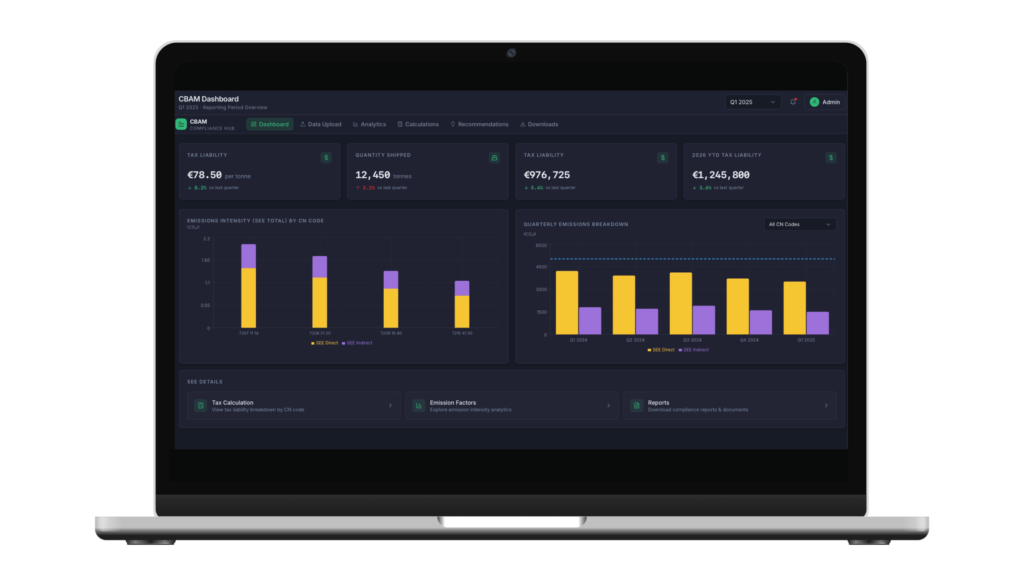
With sentra.world, an officially appointed CBAM consultant foundries can move from manual CBAM data collection to structured, audit-ready and customer-ready emissions reporting.
What Data Foundries Need to Collect
Foundries should start building a CBAM-ready data system covering both product-level and process-level information. This is important because customer requests may not be limited to one annual emissions number.
EU buyers may ask for emissions data connected to a specific product, product family, production route, shipment or reporting period. Foundries that can organise this data early will be able to respond faster and with more confidence. Foundries should start building a CBAM-ready data system covering:
- Product and shipment data : Product name, CN code, customer, shipment quantity, production site, reporting period and exported volume.
- Raw material and charge mix data : Scrap, pig iron, sponge iron, ferro alloys, aluminium ingots, returns, alloys, additives and other metallic inputs.
- Energy and fuel data : Electricity consumption, furnace electricity, diesel, LPG, natural gas, furnace oil, coke or other fuels where applicable.
- Process and production data : Melting route, furnace type, heat treatment, moulding, machining, finishing, production volume, yield, rejection and process losses.
- Evidence and audit trail : Invoices, meter readings, ERP exports, production logs, supplier declarations, calculation methodology, emission factors and assumptions.
Real Challenges for CBAM for Foundries
CBAM is difficult for foundries because the required data is operational, product-specific and often scattered across departments. The challenge is not only calculation; it is connecting real plant data with customer-ready reporting.
Foundries often have the data somewhere, but not in one structured system. Furnace logs, ERP records, electricity bills, scrap records, production reports and dispatch documents may all exist separately.
1. Customers may ask for data before the foundry is directly covered
A foundry may not be directly in scope today, but its EU customer or downstream manufacturer may still need emissions values for CBAM reporting, supply-chain carbon accounting or customer disclosure.
2. Product-level allocation is complex
Foundries manufacture multiple products, grades, weights and part types. Allocating electricity, fuel, furnace usage, scrap, alloys, returns, rejects and process losses to each product can be difficult.
3. Furnace and heat-level records are not always linked to shipments
Melting logs, heat records, charge mix data and energy records may exist, but they are often not connected to finished goods, product families, export invoices or customer shipments.
4. Scrap and returns need clear documentation
Scrap-based production may support lower emissions, but foundries need proper records for purchased scrap, internal returns, yield, rejection and material flow.
5. Supplier data can be missing
Alloys, ferro alloys, aluminium inputs, outsourced machining, heat treatment, packaging and logistics may require supplier-level data or reliable emission factors.
6. Evidence is scattered
Invoices, meter readings, ERP records, production logs, supplier declarations and calculation assumptions are often stored in different departments.
7. Default values can create commercial risk
If actual data is not available, customers may use default or conservative values. This can make a foundry appear more carbon-intensive than it actually is.
Default Values vs Actual Emissions Data
If actual emissions data is not available, EU customers may rely on default values or conservative assumptions. This can weaken a foundry’s commercial position because default values may not reflect the real performance of an efficient plant.
Actual emissions data can help foundries show their real carbon performance, reduce dependence on default values and build trust with EU customers. For foundries supplying competitive export markets, this can become an important commercial advantage.
Actual emissions data can help foundries:
- show their real carbon performance
- reduce dependence on default values
- build trust with EU customers
- support better price discussions
- prepare for verification and audit requirements
- differentiate from suppliers that cannot provide data
For foundries using efficient induction furnaces, higher scrap content, improved yield or cleaner electricity, actual data can become a competitive advantage.
How to Estimate CBAM Cost for Foundries and their Products
CBAM cost depends on embedded emissions and the applicable CBAM certificate price.
A simplified formula is:
CBAM cost exposure = chargeable embedded emissions × CBAM certificate price
Example:
| Input | Value |
|---|---|
| Export volume | 500 tonnes |
| Chargeable embedded emissions | 2.0 tCO₂e/t |
| CBAM certificate price | €75.36/tCO₂e |
Estimated exposure:
500 × 2.0 × €75.36 = €75,360
This is a simplified example. Actual CBAM calculation depends on product classification, methodology, embedded emissions, carbon price paid in the country of origin and other applicable rules.
Exporters can use a CBAM Liability Calculator to estimate potential cost exposure and understand how emissions intensity affects buyer cost.
How sentra.world Helps CBAM for Foundries?
sentra.world provides CBAM Solutions for foundries and exporters that need to move from scattered plant data to CBAM-ready emissions reporting.
sentra.world is an officially appointed CBAM consultant by EEPC India and supports exporters with embedded emissions calculation, supplier data collection, audit trail management and customer-ready documentation.
sentra.world helps foundries with:
1. Automated data collection : Collect data from ERP systems, Excel files, electricity bills, fuel records, furnace logs, production reports and supplier records.
2. Product-level emissions calculation : Calculate embedded emissions at product, product family, production route, heat, batch or shipment level.
3. Supplier and input data management : Track metallic inputs, alloys, scrap, fuels, electricity, outsourced processes and supplier declarations.
4. Evidence and audit trail management : Maintain documents, assumptions, approvals, emission factors, calculation notes and version history in one place.
Want to know more about how it applies to your foundry? Get in Touch Now!
Final Takeaway for CBAM for Foundries
Foundries should not treat CBAM as a distant 2028 issue. The shift has already started in 2026 because EU importers now have stronger financial and compliance reasons to ask suppliers for accurate embedded emissions data.
Even if a foundry product is not directly covered today, the customer may still need product-level emissions values for CBAM reporting, supply-chain disclosures, cost estimation or procurement decisions. The foundries that prepare early will be able to respond faster, avoid dependence on default values and build stronger trust with EU buyers.
The best starting point is simple: map EU-linked products, check CN codes, collect product-level activity data, maintain evidence and estimate potential CBAM exposure before customer requests become urgent.