
For industrial companies navigating compliance requirements in 2025, confusing a sustainability report with an ESG disclosure isn’t just a semantic mistake – it can mean submitting the wrong data to the wrong audience at exactly the wrong time. Understanding what each term actually means is the first step toward staying compliant with different frameworks like CSRD, BRSR etc.
Sustainability Report : A broad, narrative-driven document that describes a company’s relationship with the environment, society, and its workforce – typically aimed at customers, communities, and employees rather than regulators.
ESG Reporting : A structured disclosure of Environmental, Social, and Governance data designed for investor risk assessment and regulatory review, governed by a recognised ESG reporting framework such as GRI, TCFD, or ESRS.
Audit-Ready Data : Emissions and performance figures verified to a standard that can withstand third-party assurance – a hard requirement under CBAM, where sourcing verified upstream emissions data from suppliers is one of the most operationally demanding challenges manufacturers face.
Double Materiality : A reporting principle, central to CSRD, requiring companies to disclose both how sustainability issues create financial risk for the business and how the business’s activities impact the external world.
So what is a sustainability report, practically speaking? Think of it as a brand-facing story. According to GEP, sustainability reports are narrative-driven and aimed at broad stakeholders, while ESG reports are structured, data-heavy disclosures built for investors. One communicates values; the other demonstrates verifiable performance. For industrial operators under regulatory scrutiny, that distinction carries real compliance weight.
However, it’s worth noting that neither format is inherently superior — their value depends entirely on the audience, the regulatory context, and the reporting cycle. In practice, many companies need both, but they serve fundamentally different functions.
The clearest way to choose the right approach is to first understand who is reading the report and what decisions they will make with it – which is exactly what the side-by-side comparison ahead breaks down.
ESG Reporting vs. Sustainability Reports
Understanding the distinction matters most when compliance deadlines are on the line. While the previous section established what each report is, this comparison breaks down how they behave in practice and why industrial operators can’t treat them as interchangeable.
The core split comes down to audience and intent. An ESG report speaks directly to investors and regulators who need standardized, quantifiable data to benchmark performance and assess risk. According to the EY Global Institutional Investor Survey, 91% of institutional investors factor ESG performance and disclosure into their investment decisions – statistic that underscores why precision matters here. Sustainability reports, by contrast, are traditionally narrative-driven documents aimed at customers, employees, and community stakeholders, often prioritizing story over structure.
Regulatory pressure is where the gap becomes critical for industrial firms. The EU Carbon Border Adjustment Mechanism requires quarterly emissions data for steel and ferro-alloy imports during its transitional phase. That cadence i.e. quarterly, not annual – reflects a broader shift toward compliance-grade rigor that sustainability reports were never designed to meet. Manufacturers targeting EU markets should also note that audit-ready ESG reports is now a baseline requirement for global supply chain access.
The table below captures these differences across four operational dimensions:
| Dimension | ESG Report | Sustainability Report |
|---|---|---|
| Audience | Investors, regulators, lenders | Customers, employees, communities |
| Data Type | Quantitative, standardised metrics | Qualitative, narrative-led |
| Regulatory Pressure | High – CSRD, BRSR mandate compliance | Traditionally voluntary |
| Reporting Frequency | Annual or quarterly | Often ad-hoc or biennial |
For industrial enterprises operating under mandatory frameworks, deploying the right ESG reporting tools and services isn’t optional – it’s what separates audit-ready data from costly rework. However, it’s worth acknowledging that sustainability reports still hold value for brand positioning and stakeholder trust, particularly in sectors where public perception influences procurement.
The format you choose signals your compliance maturity and increasingly, your access to global markets.
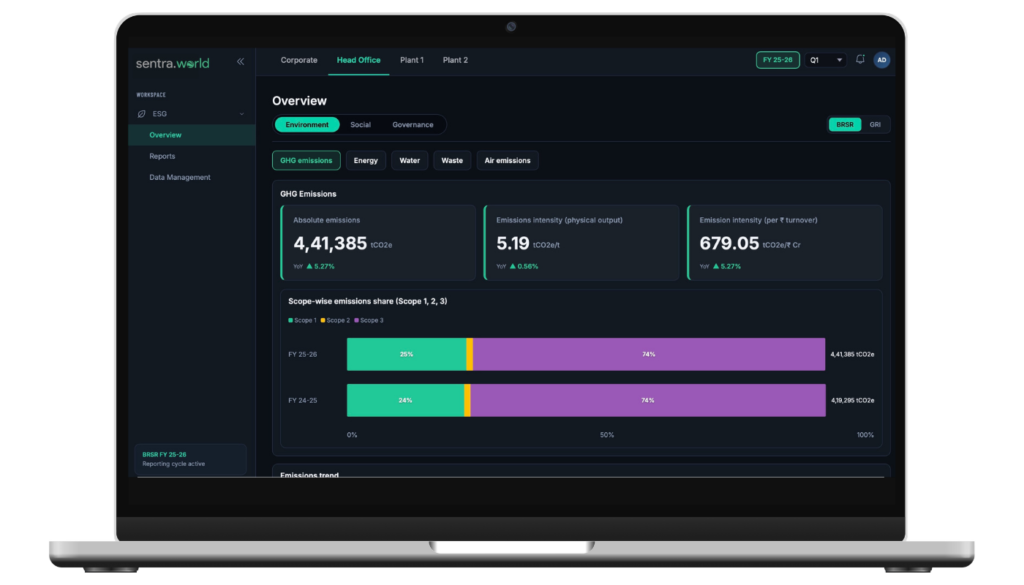
Choosing the right ESG Reporting Strategy for your business
For industrial firms particularly those in steel, metals, and heavy manufacturing, the gap between a sustainability report and a structured ESG reporting disclosure is no longer a matter of preference. It’s a compliance threshold. Markets in the EU and India have made that clear: without meeting mandatory ESG reporting disclosure requirements under frameworks like CSRD, BRSR, companies risk losing supply chain access, financing eligibility, and regulatory standing.
Key Takeaways
- Market access depends on it: EU and Indian regulators now treat ESG reporting disclosures as a baseline, not a bonus as non-compliance can lock industrial firms out of key markets.
- Automation isn’t optional: Research from the International Journal of Science and Research Archive shows AI-driven carbon accounting can cut reporting cycles by up to 40% and improve data quality by over 30%.
- Narrative reports have limits: Transitioning from qualitative storytelling to structured, data-driven disclosures converts compliance from a cost center into a measurable green asset.
- Standardization is the new baseline: ESG reporting frameworks like BRSR and CSRD are no longer optional, global steel buyers and institutional investors screen for them by default.
- Platform support matters: Managing multiple frameworks simultaneously requires purpose-built tools, not spreadsheets or general-purpose software.
In practice, the firms that treat ESG reporting as infrastructure rather than a periodic exercise are better positioned to respond to regulatory shifts without scrambling. On the other hand, companies still relying on manually assembled reports face compounding risk as disclosure cycles shorten and auditor scrutiny increases. Understanding factors driving ESG compliance costs for industrial operations is a practical starting point for identifying where automation delivers the fastest return.
AI-powered platforms like sentra.world are purpose-built for this transition, aggregating supplier data, mapping emissions to recognised frameworks, and generating audit-ready outputs across BRSR, CSRD, and GRI simultaneously. That kind of integration is what separates reactive compliance from strategic advantage.
The choice isn’t between ESG and sustainability reporting – it’s between building a system that scales and falling behind in frameworks that are rapidly evolving.