

The Carbon Border Adjustment Mechanism (CBAM) has transformed from a mere reporting requirement into a major financial obligation. SEFA now plays a crucial role in determining the costs that exporters must cover under this mechanism.
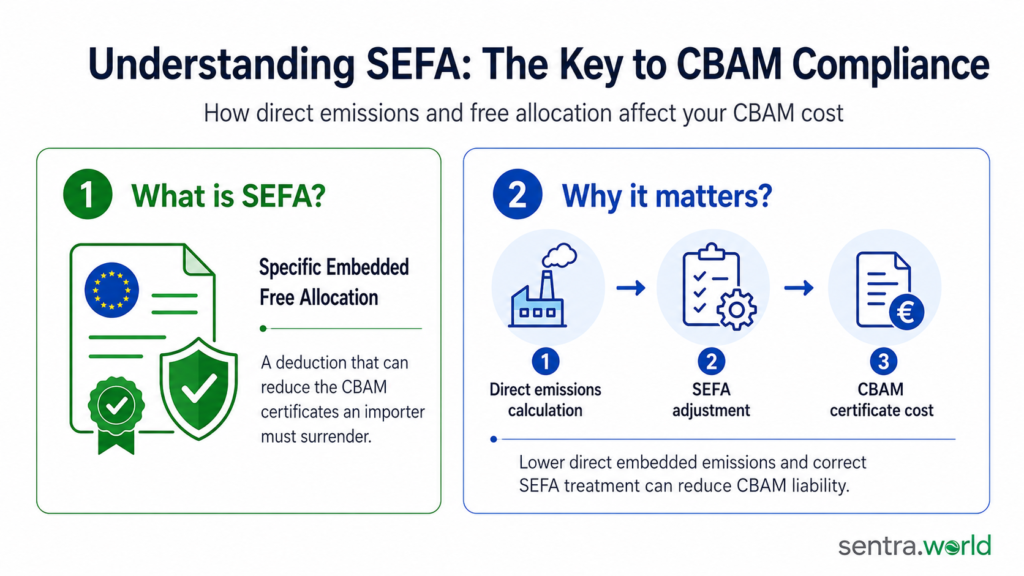
What is SEFA — Specific Embedded Free Allocation? It refers to the EU ETS free allowances that EU producers receive for similar products. This deduction is applied to adjust the CBAM certificates importers must surrender, preventing “double protection,” where EU industries might benefit from both domestic carbon cost relief and CBAM protection. Without the CBAM free allocation adjustment, EU producers could gain an unfair advantage, potentially leading to legal and political challenges.
It’s crucial to clarify what SEFA is not. It is not a loophole to avoid CBAM costs but a precise, product-specific deduction applied to the CBAM certificates an importer must surrender. The deduction size is influenced by factors such as benchmark data, production methods, and the allocation of free allowances within the EU ETS. These factors will evolve as the EU progressively reduces free allowances until 2034.
During the transitional phase, exporters were required to file quarterly reports without financial charges, a period which ended on January 1, 2026. Exporters who underestimated the significance of SEFA CBAM mechanics may find themselves miscalculating their certificate of exposure. Consulting with a CBAM consultant for exporters can help mitigate such errors.
Relying on defaults could be costly, and using a CBAM Liability Calculator can provide more accurate assessments with the help of an experienced CBAM consultant.
How to Calculate Direct Embedded Emissions Before Applying SEFA
1. Calculate Direct Embedded Emissions
Exporters must first calculate direct emissions from fuel combustion, process emissions, and production-related emissions within the installation boundary.
2. Include Precursor Emissions Where Applicable
For complex goods, especially steel and aluminum products, relevant precursor inputs may need inclusion as per CBAM calculation methodology.
3. Determine the Production Route
SEFA relies on the applicable production route and benchmark. For instance, crude steel may have different treatment depending on the BF–BOF, DRI, or EAF route.
4. Apply SEFA as a Free Allocation Adjustment
Once direct embedded emissions are calculated, SEFA is applied to adjust the number of CBAM certificates to be surrendered. It is not an emissions factor and is not linked to indirect electricity emissions.
5. Calculate Final Certificate Exposure
After applying SEFA, the importer can estimate the net CBAM certificate obligation, along with any eligible deduction for carbon price already paid in the country of origin.
SEFA should not be part of the indirect emissions calculation. Under CBAM, exporters must first calculate the direct embedded emissions of the goods using actual installation-level data wherever possible. This includes emissions from fuel use, process emissions, production activity, and relevant precursor inputs for complex goods. Once the embedded emissions are calculated, SEFA is applied separately as a free allocation adjustment to reduce the number of CBAM certificates to be surrendered. Simply put, direct emissions calculation comes first; SEFA is applied afterward as an adjustment mechanism linked to EU ETS free allocation and CBAM benchmarks.
The SEFA Formula in Emissions Calculation
SEFA reduces what exporters owe under CBAM, but only if they can substantiate their emissions with verified, plant-level data.
To understand SEFA’s role in the broader context of embedded emissions, consider CBAM’s liability formula. Total embedded emissions for a product combine direct emissions (from production). SEFA is applied as a free allocation adjustment to reduce the number of CBAM certificates to be surrendered.
The steel sector presents particular challenges. Boston Consulting Group notes that “the complexity of calculating embedded emissions, especially Scope 3 and precursor materials in steel, is a major administrative hurdle.” Steel production often involves numerous upstream inputs – iron ore, coke, ferroalloys, and recycled scrap, each contributing its own carbon footprint. Understanding Scope 3 emissions is crucial before applying any SEFA adjustment, as indirect emissions from these materials complicate calculations at every stage.
Primary data is essential. The CBAM framework allows a SEFA adjustment only when exporters provide actual, installation-specific emissions data – not regional averages or estimates. For non-EU producers, this means a significant data-tracking responsibility: they must collect and present detailed energy data that meets EU verification standards. Those who fail to do so face default SEFA values, which are conservative and carry higher financial risks. For complex products like ferro-alloys and specialized steel, this administrative burden is especially challenging for smaller producers with limited resources.
Navigating Compliance for Steel MSMEs and Global Exporters
SEFA can be a financial lifesaver for exporters, but accessing it requires a level of administrative precision that smaller manufacturers often lack. CBAM solutions can provide the necessary support to navigate these challenges.
Industries most affected by SEFA-related complexity include steel, aluminium, cement, fertilisers, and hydrogen, sectors where production is common and emissions vary significantly by plant. For mid-sized steel mills or aluminum smelters exporting to the EU, using verified plant-level data instead of default CBAM benchmarks can save tens of thousands of euros in certificate purchases annually, as provisional benchmark data indicates.
The burden is particularly heavy on micro, small, and medium enterprises. The European Parliamentary Research Service notes that SME administrative costs for CBAM compliance can reach €10,000–€25,000 annually per installationwithout automated systems. Manual data collection i.e. tracking emissions use, sourcing emission factors, reconciling invoices consumes staff time that smaller businesses don’t have. Automated systems can reduce this burden, but they require upfront investment that many MSMEs delay.
Delays can be costly. CBAM rules impose fines of €10 to €50 per tonne of CO₂ for unreported or inaccurately reported emissions, based on the gap between declared and actual emissions. For a steel exporter shipping thousands of tonnes annually, even a small reporting error can result in a substantial penalty. Staying informed about CBAM changes in 2026 is not just prudent – it’s a financial strategy.
Understanding where compliance often falters is the next logical step and these pitfalls are more common than exporters might realise.
Common Mistakes in CBAM Emissions and SEFA Reporting
Errors in CBAM emissions calculations don’t just cause compliance headaches – they lead to financial penalties ranging from €10 to €50 per tonne of unreported emissions, according to the European Commission.
The most costly mistakes are usually avoidable. Here are four common pitfalls that frequently trip up exporters:
- Over-reliance on EU default values. Default benchmarks are conservative and can penalize exporters with cleaner processes. Utilizing installation-specific data, even partially can reduce your emissions figure and certificate obligations.
- Misunderstanding the 50-tonne threshold. Small shipments under 50 tonnes of net mass are exempt from CBAM reporting. Many exporters misapply this threshold across shipments or fail to document it properly, risking audits.
- Ignoring carbon costs already paid. CBAM allows a deduction for carbon costs paid in the exporting country. Overlooking this step means leaving money on the table and overpaying for certificates.
- Inconsistent data mapping between suppliers and the final report. When emissions data flows from sub-suppliers to the declarant, unit mismatches, conversion errors, or version discrepancies often occur and auditors notice.
Avoiding these mistakes requires more than good intentions. It demands structured data management from production to final submission. Working with experienced CBAM consultant support early in the process reduces the risk of compounding errors. Understanding the full scope of CBAM obligations is the best way to stay compliant and competitive.
The Bottom Line: Key Takeaways for Exporters
Accurate CBAM embedded emissions calculation isn’t just a formality – it’s the most crucial tool exporters have to lower their financial exposure now that CBAM’s full enforcement is underway.
SEFA is your top cost-cutting tool. Every tonne of CO₂ equivalent covered by a verified free allocation offsets a certificate you’d otherwise purchase. That direct relationship makes SEFA documentation one of the best compliance investments a steel exporter can make. Yet, its value depends entirely on having the data to back it up.
- Primary installation data is always best. EU default benchmarks are conservative and provisional figures show they penalize producers relying on them. Facility-specific emissions records lead to lower certificate obligations.
- Document emissions attribution carefully. Assumptions without support invite auditor rejection and penalties.
- Automation is crucial for MSMEs. Manual tracking across multiple sites and inputs becomes unmanageable at scale. For complex scenarios, understanding how emissions span facility boundaries is essential groundwork.
- Time’s ticking. Financial obligations began in 2026, but the EU CBAM reporting framework requires verifiable primary data collection now.
EU regulators prioritize primary data over defaults, meaning the groundwork exporters lay now will determine their future certificate burden. The next challenge is finding the right infrastructure to efficiently implement this framework where purpose-built industrial carbon accounting tools become key.
Mastering Industrial Carbon Accounting with sentra.world
Getting CBAM emissions right requires specialized tools -not spreadsheets or generic platforms, but software designed for industrial manufacturing and global trade regulations.
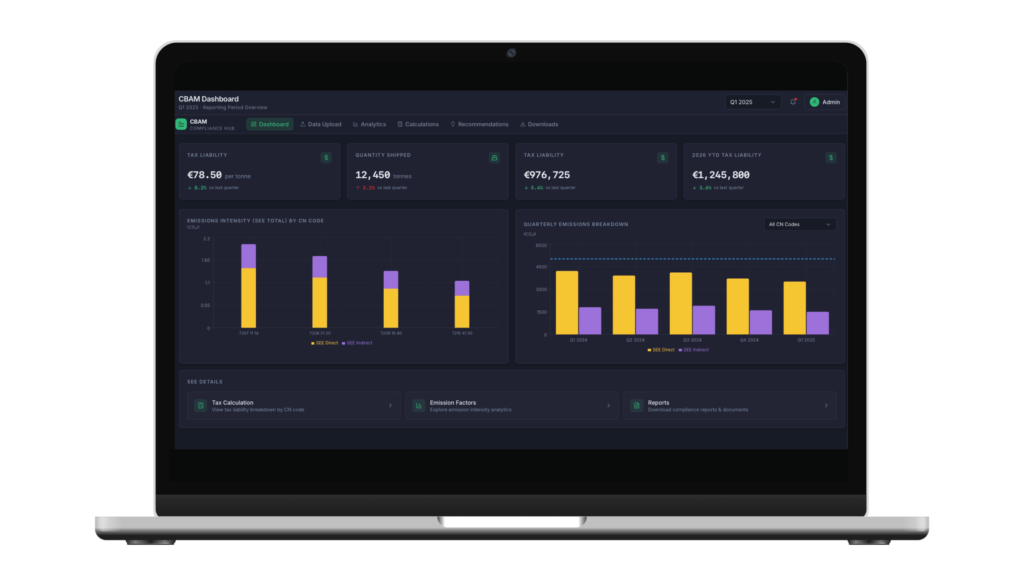
sentra.world automates the embedded emissions calculations behind every CBAM declaration by applying the right SEFA formula, incorporating verified emissions data, and calculating free allocation deductions without manual errors. For steel exporters facing 2026 benchmark phase-ins, this automation isn’t merely convenient; it’s essential for risk management.
sentra.world also addresses the tougher challenge: Scope 3 precursor data. Steel production involves iron ore, scrap, pig iron, and energy inputs from various suppliers and locations. Tracing emissions through that supply chain as CBAM requires – is impossible without a networked data layer. This is especially relevant for foundry and specialty product exporters who often underestimate their exposure.
Audit your SEFA readiness today before a default benchmark does it for you. Explore sentra.world, your trusted CBAM consultant, and its automated platform for CBAM to see where your emissions data stands.