

The initial phase of the Carbon Border Adjustment Mechanism (CBAM) was more flexible. Reports could be filed with default values, estimates had fewer consequences, and errors could be corrected in later quarters. That tolerance is now ending. From 2027, importers submitting CBAM declarations for 2026 goods will need either actual verified emissions data or applicable default emissions values for their CBAM verification. For exporters that want EU customers to use actual values instead of defaults, the emissions data must be verified by an accredited CBAM verifier.
Over 12,000 operators had applied for CBAM authorisation by early January 2026, which means the same population is already moving through the authorisation process during 2026. This will place pressure on the verifier market just when demand starts to rise.
The mechanics are simple, but the operational consequences are not. Under the definitive regime, an authorised CBAM declarant cannot submit a CBAM declaration unless the embedded emissions figures have been checked and signed off by an accredited verifier. A rejected verification statement can block the declaration, and without a valid declaration, goods may face serious disruption in EU market access.
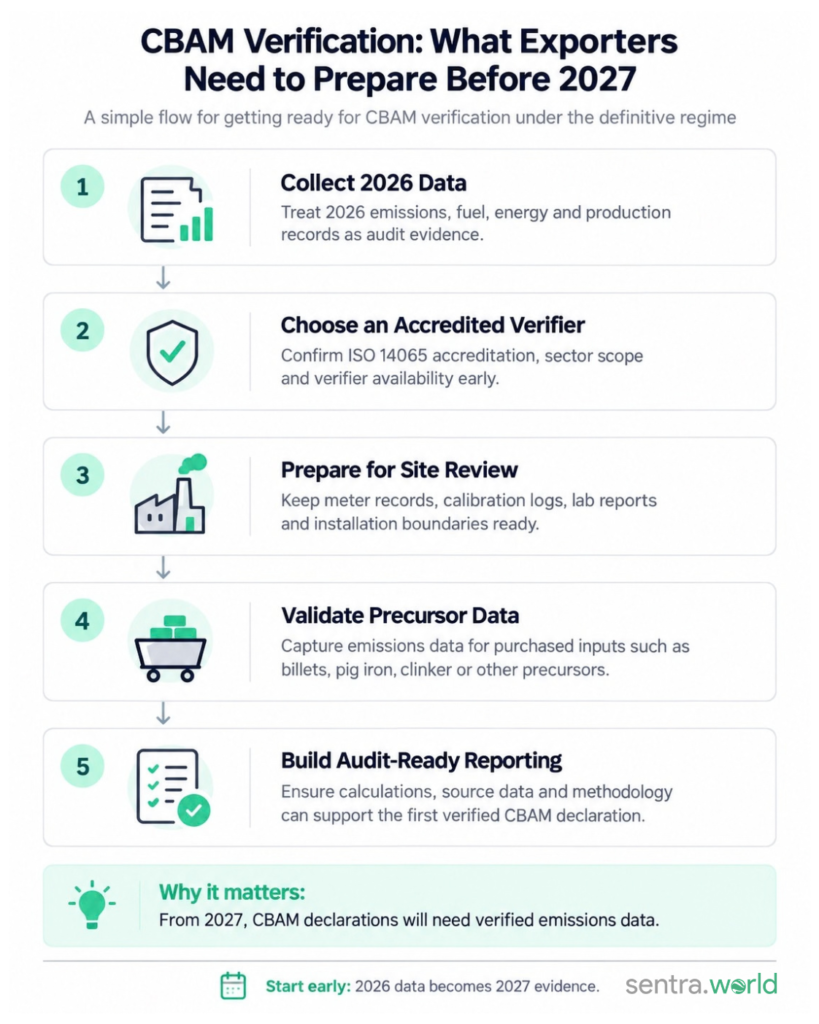
What CBAM regulation now demands is evidentiary, not descriptive. Auditors will not only ask for the final emissions number. They will ask how that number was produced, from which meter, on which date, and reconciled against which production record. Emissions data generated during 2026 is therefore already regulated data. The 2026 reporting year is the audit trail that 2027 CBAM verification will examine line by line.
Securing Accredited Verifiers: Why the EU/EEA NAB-accredited CBAM verifiers Matters for CBAM Verification
A verification statement is only valid if the body issuing it holds the right accreditation. For CBAM purposes, this means accreditation against ISO 14065 for greenhouse gas validation and verification, granted by a recognised national accreditation body, with a scope that covers the relevant sector.
This matters because a verifier accredited for corporate inventory work is not automatically competent to verify an integrated steel plant, cement facility, aluminium smelter or ferro alloy unit. A mismatched scope can make the verification statement unusable.
For CBAM, exporters should work with verifiers that have CBAM accreditation from an EU national accreditation body, or an eligible EEA national accreditation body once applicable. Verification companies established outside the EU may apply to an EU/EEA NAB offering CBAM accreditation services, but ordinary domestic GHG accreditation alone should not be treated as sufficient for CBAM.
Capacity is the real risk. Verifier availability, sector scope and site visit windows should be checked before the 2027 filing period, not after. A CBAM consultant can support exporter teams in scoping the requirement, preparing documentation and identifying the right verification route, but the verification itself must remain independent of anyone who prepared the data.
The 2026 Site Visit Checklist: Preparing for Physical Audits
Verification under the definitive regime is not only a desk review. Verifiers are expected to assess the installation itself: its boundaries, measurement systems, production records and whether the physical plant can support the emissions numbers reported.
For steel, cement, aluminium and other energy-intensive sectors, this site visit is where most findings can originate. Exporters should prepare the following evidence in advance:
- Flow meters and gas meters for all fuel and process gas lines
- Weighbridge calibration certificates covering the reporting period
- Continuous emissions monitoring records, including downtime and substitution methods
- Laboratory analysis reports for calorific value, carbon content and material composition
- Maintenance and repair logs for instruments used in emissions calculation
- Production records reconcilable with energy and fuel data
- Installation boundary maps showing included and excluded units
An uncalibrated meter can weaken every measurement it produced during the affected period. Verifiers routinely downgrade or reject data where calibration intervals have lapsed, even if the readings appear reasonable. Maintenance logs therefore carry the same evidentiary weight as the emissions figures because they prove that the figures came from functioning instruments.
Managing Precursor Data: The Hidden Verification Risk
Precursor data is where many industrial exporters will struggle. A rebar producer may have strong furnace data, but the declared figure must also include emissions embedded in purchased billets, pig iron or other relevant inputs. A cement grinder is accountable for the clinker it buys. Under the definitive regime, precursor emissions are part of the verified total.
Suppliers may not have direct exposure to the EU border charge, so they may not maintain audit-grade carbon records unless the buyer requires it. When a verifier requests source documentation for precursor inputs and receives unsupported email estimates, the affected quantities may be rejected or pushed toward default values that increase liability.
Procurement agreements for CBAM-relevant precursors should include a clear CBAM data clause. Suppliers should be required to provide embedded emissions data per tonne of product, calculated using the applicable CBAM methodology, along with supporting records and any available verification statement.
This requirement should also be tied to commercial consequence: payment terms, supplier requalification, or volume allocation. Supply chain carbon integrity survives only where data obligations are enforceable.
Automating Embedded Emissions Tracking for CBAM Audit Readiness
The spreadsheet workflow is one of the biggest verification risks in industrial firms. A manual process usually involves plant teams transcribing meter readings into monthly workbooks, sustainability teams consolidating files quarterly, and formulas that may not have been reviewed for months.
Provenance is lost at every handoff. When a verifier asks which reading produced a specific embedded emissions figure, the answer should not be an email thread.
An automated workflow changes this and this is where an automated platform like sentra.world helps in.Data is ingested from meters, historians, ERP production records and supplier submissions. Emission factors are version-controlled and time-stamped. Calculations are performed using a fixed methodology, with every input retained.
This creates a golden thread: an unbroken link from the factory floor instrument to the line item in the final CBAM report. When a verifier tests a sample, the system can show the source reading, calibration status, factor applied and methodology version in force at that time.
The return is visible during verification. Audit effort is driven by how long the verifier spends reconstructing evidence. Firms that provide traceable datasets reduce findings, shorten review cycles and lower the risk of missing declaration timelines and makes the CBAM verification process a lot easier.
Common Pitfalls in CBAM Reporting
Several problems appear repeatedly during CBAM reporting and verification preparation.
- The first is misalignment between production and energy data. Verifiers will test whether fuel and power consumption make sense for the tonnage produced. If production comes from one reporting calendar and energy comes from another, the numbers may fail a basic plausibility check.
- The second is inconsistent use of emission factors. A new fuel supplier, updated calorific value or changed default factor can alter results, but the reason must be documented. Exporters need a version-controlled factor register showing which value applied to which period and why.
- The third is undocumented methodology. Under definitive CBAM reporting requirements, the calculation method itself is auditable. Boundary definition, allocation rules, treatment of waste gases and precursor treatment must be written, approved and retained.
- The fourth is treating complex goods as simple goods. A finished steel or aluminium product with purchased precursors may require precursor-level reporting. Reporting only direct emissions can result in an incomplete declaration.
The Bottom Line: Preparing for 2027 CBAM Verification
The compliance question is no longer whether emissions data exists. It is whether the data can withstand testing by an accredited third party against physical instruments, production records and supplier documentation.
Four actions now matter most.
- First, audit your 2026 data infrastructure. The reporting year currently underway is the evidence base for the first verified CBAM declaration. Gaps in calibration records, meter coverage or production reconciliation cannot be rebuilt later with confidence.
- Second, secure the right verifier early. ISO 14065 accreditation, sector scope and site visit capacity should be checked well before the filing window.
- Third, update procurement contracts with CBAM data clauses. Every relevant precursor input should carry a data obligation, supporting evidence requirement and commercial consequence.
- Fourth, move away from manual consolidation. Automated carbon accounting improves traceability, reduces audit findings and protects the accuracy of CBAM reporting.
The window for treating CBAM verification as a future project has closed. Data quality problems discovered in 2027 cannot be fixed in 2027 if the underlying measurements were not captured correctly in 2026.
Future-Proofing EU Market Access with sentra.world
Carbon data is becoming a trade document. Exporters that recognise this early stop treating measurement as a compliance cost and start treating it as commercial infrastructure, similar to quality certification or material traceability.
Verified, low-intensity product data can become a differentiator at the EU border. It can support customer negotiations, green procurement tenders and sustainability-linked financing.
Sentra.world is built for this transition in heavy industry. sentra.world helps structure the path to CBAM verification by capturing installation-level data with full provenance, applying CBAM methodology consistently across reporting periods, maintaining calibration and methodology records, and producing audit-ready documentation for accredited verifiers.
sentra.world, as a trusted CBAM consultant, extends the same discipline upstream by helping precursor suppliers submit product-level emissions data against defined requirements. This closes one of the most common CBAM verification gaps in complex goods.
For exporters, the priority is clear: assess the quality of 2026 data now, before a verifier does. To build your CBAM report and be audit-ready – Get in Touch Now!