
BRSR (Business Responsibility and Sustainability Report) is the full ESG disclosure that India’s top 1,000 listed companies by market capitalisation file with their annual report. BRSR Core is a smaller set of key indicators taken from that report, grouped into nine attributes, which must be independently assessed or assured. Put simply: BRSR is what you disclose; BRSR Core is the part of it someone outside the company has to check.
FY 2026-27 is the year the gap closes. Under SEBI’s glide path, the BRSR Core check now reaches all top 1,000 listed entities, which means every BRSR filer is in scope. This guide explains the difference, what changed in SEBI’s March 2025 circular, how value chain disclosures pull in unlisted suppliers such as steel and metals MSMEs, and what to fix before your FY 2026-27 data is checked.
What is the difference between BRSR and BRSR Core?
BRSR is the complete ESG report, structured in three sections and built around the nine principles of the National Guidelines on Responsible Business Conduct (NGRBC). BRSR Core is a subset of those disclosures, organised into nine attributes such as GHG, water and energy footprints, and it carries a mandatory independent assessment or assurance that full BRSR does not.
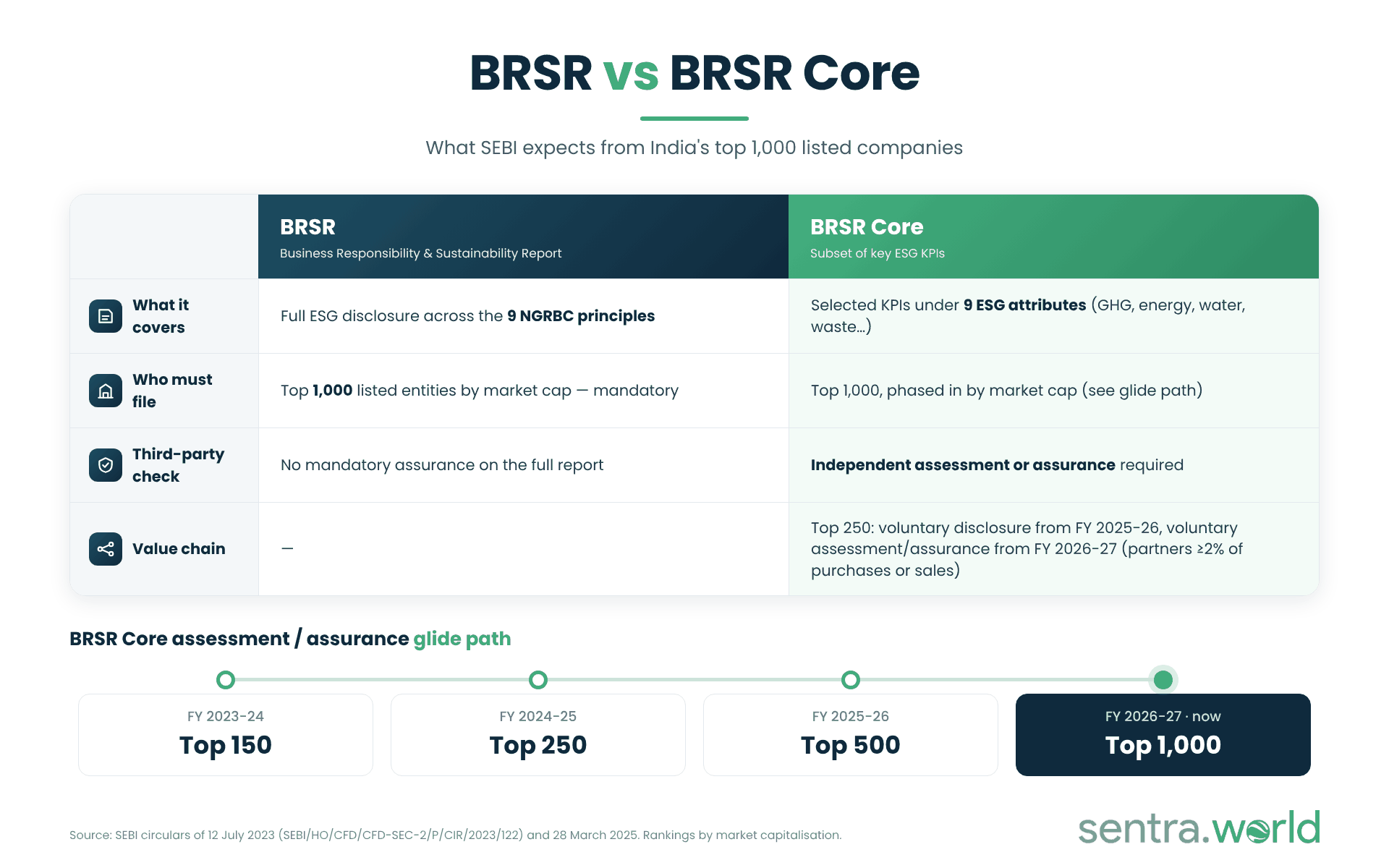
The two are not separate reports. A listed company files one BRSR; the BRSR Core indicators sit inside it and are flagged for verification. The comparison below shows where the obligations differ.
| Aspect | BRSR | BRSR Core |
|---|---|---|
| What it is | Full ESG disclosure format filed with the annual report | Subset of key indicators from BRSR, grouped into 9 attributes |
| Who must comply | Top 1,000 listed entities by market capitalisation | Same entities, phased in; all top 1,000 from FY 2026-27 |
| Structure | Section A (general), Section B (management and process), Section C (principle-wise performance) | 9 attributes with defined KPIs and an “assessment or assurance approach” for each |
| Independent check | Not mandatory | Mandatory assessment or assurance |
| Value chain | Not required | Top 250: voluntary disclosure from FY 2025-26; voluntary assessment or assurance from FY 2026-27 |
| Who checks | Optional, company’s choice | Independent provider with the necessary expertise and no conflict of interest |
Which companies must file BRSR and BRSR Core?
BRSR is mandatory for the top 1,000 listed entities by market capitalisation under Regulation 34(2)(f) of SEBI’s LODR Regulations. BRSR Core assessment or assurance follows a glide path: top 150 from FY 2023-24, top 250 from FY 2024-25, top 500 from FY 2025-26 and the top 1,000 from FY 2026-27.
| Financial year | Listed entities needing BRSR Core assessment or assurance |
|---|---|
| FY 2023-24 | Top 150 by market capitalisation |
| FY 2024-25 | Top 250 |
| FY 2025-26 | Top 500 |
| FY 2026-27 | Top 1,000 |
Unlisted manufacturers have no direct BRSR obligation. In practice, though, many are already answering BRSR-style questionnaires from listed customers who need supplier data for their own disclosures. For the full applicability rules, see our guide to BRSR reporting in India.
What are the nine BRSR Core attributes?
SEBI’s BRSR Core format lists nine attributes: GHG footprint, water footprint, energy footprint, circularity (waste management), employee wellbeing and safety, gender diversity, inclusive development, fairness in engaging with customers and suppliers, and openness of business. Each has defined KPIs that the assessor or assurer tests.
- Green-house gas (GHG) footprint: Scope 1 and Scope 2 emissions and emission intensity.
- Water footprint: water withdrawal, consumption and discharge.
- Energy footprint: total energy consumed, share from renewables and energy intensity.
- Embracing circularity: waste generated, recovered and disposed of.
- Enhancing employee wellbeing and safety: wellbeing spending and safety incidents.
- Enabling gender diversity in business: for example, wages paid to women as a share of total wages.
- Enabling inclusive development: sourcing from MSMEs and small producers, and job creation in smaller towns.
- Fairness in engaging with customers and suppliers: data-privacy incidents and payables days.
- Open-ness of business: concentration of purchases and sales, and related-party transactions.
For energy-intensive manufacturers, the first three attributes usually carry the most audit risk, because they depend on meter readings, fuel invoices and emission factors spread across plants. Our explainer on GHG emissions scopes 1, 2 and 3 covers the calculation basics, and the free intensity calculator helps you sense-check intensity ratios.
Is BRSR Core assurance still mandatory after SEBI’s March 2025 changes?
Yes. SEBI’s circular of 28 March 2025 kept the check mandatory and the glide path unchanged, but gave listed entities a choice between “assessment” and “assurance”. Assessment means a third-party assessment under standards developed by the Industry Standards Forum (ISF) in consultation with SEBI. The same circular deferred value chain timelines by a year.
The circular made three other changes that matter for reporting teams:
- Stricter independence. The company’s board must ensure the provider has the necessary expertise, and the provider (and its associates) must not sell products or offer non-audit, non-assessment or non-assurance services, including consulting, to the company or its group.
- New disclosure fields. The BRSR now records the name of the assessment or assurance provider and the type of check obtained.
- Green credits. A new leadership indicator under Principle 6 asks how many Green Credits the company and its top ten value chain partners generated or procured, from FY 2024-25 reports onwards.
The independence rule has a practical consequence: the firm that helps you build your BRSR data cannot be the one that checks it. Plan for two separate relationships.
What are BRSR value chain disclosures, and do they affect suppliers?
Value chain disclosures cover the top upstream and downstream partners that individually make up 2% or more of a listed company’s purchases or sales by value; companies may limit coverage to 75% of purchases and sales. For the top 250 listed entities, disclosure is voluntary from FY 2025-26 and its assessment or assurance voluntary from FY 2026-27.
Voluntary does not mean irrelevant. Where a listed customer reports on its value chain, it must also state what percentage of its purchases and sales those partners cover, and that creates pressure to collect real data rather than estimates. For a steel re-roller, forging unit or ferro-alloy MSME supplying a large listed buyer, expect requests for energy, emissions, water and waste figures, often in the BRSR Core format.
The suppliers that already hold clean, plant-level data answer these requests quickly. Those that don’t risk being replaced by an estimate, or by a competitor that can provide the numbers.
How should companies prepare for BRSR Core assessment or assurance in FY 2026-27?
Start by confirming whether you are in the top 1,000, then map every BRSR Core KPI to an owner, a source system and supporting evidence. Fix emission factors and intensity calculations early, appoint an independent assessor or assurer, and run an internal review before year-end so gaps surface while there is still time to correct them.
- ☐ Confirm your market-capitalisation rank and whether FY 2026-27 is your first year in scope.
- ☐ Assign an owner and source system for each BRSR Core KPI (energy, emissions, water, waste, HR, procurement, finance).
- ☐ Build an evidence trail: meter readings, fuel and power invoices, waste manifests, payroll and payables data.
- ☐ Fix one methodology for Scope 1 and 2 emissions and emission factors, and apply it across all plants.
- ☐ Reconcile turnover used in intensity ratios with audited financial statements.
- ☐ Decide between assessment (ISF standards) and assurance, and appoint a provider with no consulting conflict.
- ☐ Identify value chain partners at the 2% threshold and decide whether to report voluntarily.
- ☐ Run a mock assessment on Q1–Q3 data before the year closes.
Our BRSR Core checklist goes indicator by indicator, and BRSR reporting solutions compares ways to automate data collection.
How can Sentra help with BRSR Core?
sentra.calculus calculates Scope 1, 2 and 3 emissions and energy, water and waste intensities at plant level, with the evidence trail an assessor or assurer will ask for. sentra.network collects data from suppliers and value chain partners in a consistent format, so listed manufacturers can cover their 2% partners, and suppliers can answer customer requests once rather than many times. See our ESG reporting page for the full approach.
Facing your first BRSR Core check in FY 2026-27, or answering value chain requests from a listed customer? Talk to sentra.world about getting your BRSR Core data assessment-ready.
Frequently asked questions
What is the full form of BRSR?
BRSR stands for Business Responsibility and Sustainability Report. It is SEBI’s ESG disclosure format for the top 1,000 listed companies in India, filed as part of the annual report.
Is BRSR Core mandatory for unlisted companies?
No. BRSR and BRSR Core apply to listed entities. Unlisted suppliers may still be asked for BRSR Core-style data by listed customers that report on their value chain.
When does BRSR Core apply to the top 1,000 listed companies?
From FY 2026-27. The glide path covered the top 150 in FY 2023-24, the top 250 in FY 2024-25 and the top 500 in FY 2025-26.
What is the difference between BRSR Core assessment and assurance?
Since SEBI’s 28 March 2025 circular, companies can choose either. Assessment is a third-party assessment under standards developed by the Industry Standards Forum in consultation with SEBI; assurance is an engagement by an assurance provider. Either way, the provider must be independent of the company.
Are BRSR value chain disclosures mandatory?
Not at present. For the top 250 listed entities, value chain disclosure is voluntary from FY 2025-26 and its assessment or assurance voluntary from FY 2026-27. Check SEBI’s latest circulars for any changes.
How many attributes are there in BRSR Core?
Nine: GHG footprint, water footprint, energy footprint, circularity, employee wellbeing and safety, gender diversity, inclusive development, fairness with customers and suppliers, and openness of business.
Sources
- SEBI circular SEBI/HO/CFD/CFD-PoD-1/P/CIR/2025/42 (28 March 2025): assessment or assurance, value chain, green credits
- SEBI, Format of BRSR Core (Annexure I)
- SEBI, Updated BRSR format (Annexure II)
- SEBI circular SEBI/HO/CFD/CFD-SEC-2/P/CIR/2023/122 (12 July 2023): BRSR Core framework for assurance and ESG disclosures for value chain
- SEBI (Listing Obligations and Disclosure Requirements) Regulations, 2015, Regulation 34(2)(f)