

India’s regulatory framework for industrial emissions is undergoing a significant transformation. The Carbon Credit Trading Scheme (CCTS) represents a shift from energy efficiency metrics to direct accountability for greenhouse gas emissions, a critical change with substantial competitive implications for manufacturers.
Over the past decade, the Perform, Achieve and Trade (PAT) scheme assessed plant performance in terms of tonnes of oil equivalent (TOE), rewarding reduced energy consumption. However, the CCTS compliance framework has redefined this approach. Under CCTS, performance is measured in tonnes of CO2 equivalent (tCO2e) per unit of production, capturing the full climate impact of industrial activities rather than just their fuel intensity. As noted by the Bureau of Energy Efficiency (BEE), targets are set as Greenhouse Gas Emission Intensity (GEI) values, closely linked to India’s 2070 Net Zero goal.
The manufacturing sector is at the forefront of compliance. According to the Gazette of India, the Iron and Steel sector will begin its first compliance cycle in FY 2026-27, involving 255 designated units, more than any other sector in the initial phase. This reflects both the sector’s significant emissions footprint and its crucial role in India’s decarbonization strategy. For a detailed look at how these targets are calculated, you can explore the requirements for operational compliance.
Understanding the CCTS compliance mechanism, from target notification to credit issuance, is where strategic planning begins.
Understanding CCTS Compliance Mechanism and Target Setting
The Carbon Credit Trading Scheme operates in a structured, three-phase cycle that converts emission targets into tradable financial instruments. For manufacturers, understanding this cycle is crucial for making informed compliance decisions in the coming years.
The Bureau of Energy Efficiency (BEE) oversees the scheme from start to finish, from notifying obligated entities of their annual targets to managing credit issuance on the Indian Carbon Market. The cycle includes three key stages:
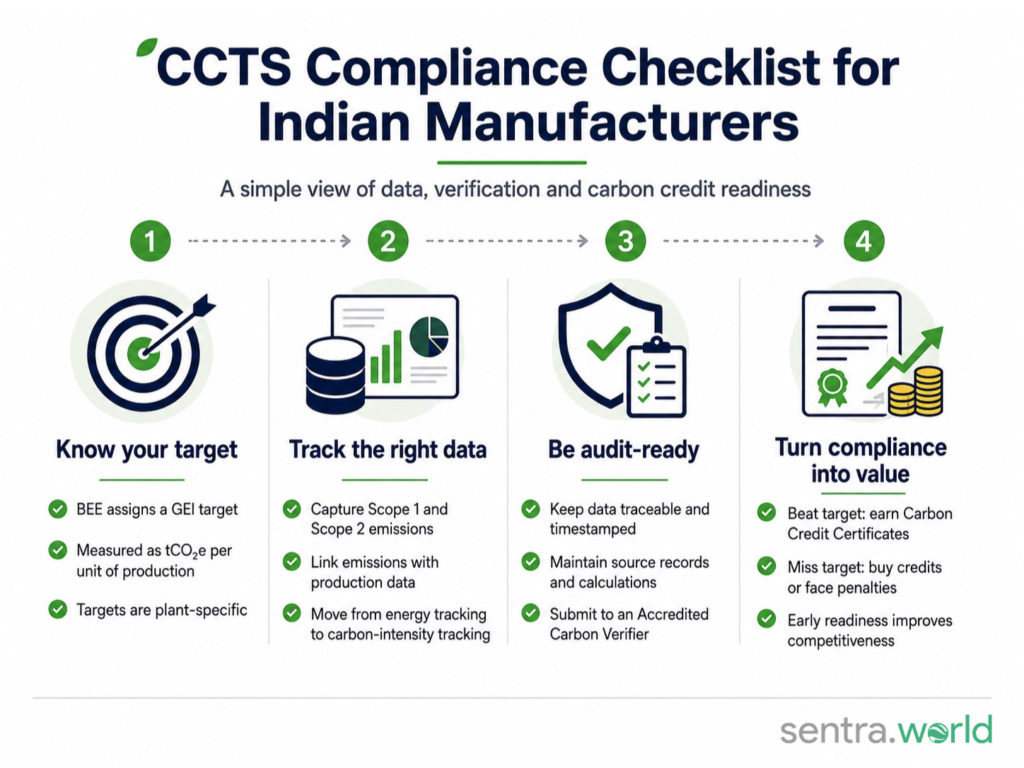
- Targeting: BEE assigns each plant a Greenhouse Gas Emission Intensity (GEI) threshold expressed as tCO2e per unit of production based on the plant’s historical baseline and industry benchmarks.
- Verification: At the end of each compliance year, plants submit monitored GEI data to an Accredited Carbon Verifier, who audits the reported figures against production records before forwarding results to BEE.
- Trading: Plants that exceed their GEI threshold receive Carbon Credit Certificates; those that underperform must purchase credits or face penalties. This is where the opportunity to sell carbon credits across India becomes commercially significant.
Target stringency varies. Manufacturers face a median emission reduction requirement of approximately 5.5% in the initial compliance phase, with individual plant targets ranging from 2.1% to 9.3%. Plants operating above an intensity of 3 tCO2e per unit of product face stricter obligations – a strategic design choice that rewards efficient operators while pressuring laggards to modernise. For more on how compliance obligations vary across notified sectors, the range of regulatory exposure becomes clearer.
In practice, this means two plants in the same sub-sector may face significantly different financial exposures depending on their process maturity and energy mix. This variability makes detailed, plant-level GEI tracking a top priority and raises important questions about the quality of the data used in these calculations, which the next section addresses directly.
Data and Verification: The Foundation of Carbon Credit Readiness
Accurate carbon data is not just a compliance formality – it’s the competitive currency of the Indian carbon market.
Manual spreadsheets pose a significant risk to CCTS compliance. Inconsistent data entry, version-control errors, and the lack of an audit trail mean that a spreadsheet-based approach can’t withstand scrutiny from an Accredited Carbon Verifier. Under CCTS compliance, verification is mandatory – a structural requirement before any Carbon Credit Certificate can be issued or penalties avoided.
The stakes are highest at the data-input level. The scheme requires manufacturers to account for both direct process emissions and indirect electricity emissions i.e. Scope 1 and Scope 2 – feeding directly into the GEI formula. A reporting error in either category distorts your carbon intensity figure, potentially moving you from a surplus to a compliance deficit. The formula allows no room for approximation.
Being “audit-ready” means your emissions data is traceable, timestamped, and verifiable at every production stage. Accredited Carbon Verifiers under the CCTS compliance framework are authorized to reject submissions lacking documentary evidence. In practice, this means manufacturers need automated carbon accounting systems that log Scope 1 and Scope 2 data continuously, not retroactively. Platforms like sentra.calculus are built specifically to meet this standard – structuring data flows so every tCO2e figure is traceable back to its source.
Understanding data integrity’s importance is crucial for making strategic decisions about readiness — which is exactly what the key takeaways ahead will address.
The Bottom Line: Key Takeaways for CCTS Compliance
Precise carbon emissions calculation is no longer optional for Indian manufacturers – it forms the foundation upon which compliance, competitiveness, and profit now rest.
With the CCTS framework now operational across nine energy-intensive sectors, covering around more than 400 obligated entities, the time for passive observation has ended. Below are three imperatives every manufacturer must understand before FY 2026-27 arrives.
- Transition from energy tracking to carbon-intensity tracking now. Energy consumption metrics were suitable for the PAT scheme, but CCTS compliance requires tCO2e per unit of production – a fundamentally different measurement discipline. Delaying this transition not only creates compliance risk but also erodes the baseline accuracy needed to withstand regulatory scrutiny.
- Know your baseline before targets are assigned. The Bureau of Energy Efficiency sets facility-level intensity benchmarks using historical data. If your tCO2e/unit figures are incomplete or inconsistent heading into the baseline period, you lose the ability to contest unfavorable targets and the cost of that disadvantage compounds across each compliance cycle.
- Excess reductions aren’t just savings, they’re revenue. Facilities exceeding their targets generate Carbon Credit Certificates (CCCs) that can be sold on the Indian carbon market. Conversely, underperformers face financial penalties and reputational exposure, which increasingly matters to global buyers and lenders.
The strategic picture is clear: CCTS compliance readiness is inseparable from operational excellence. How you translate that readiness into measurable market advantage is precisely what the right compliance framework can deliver.
Turning CCTS Compliance into Profit with sentra.world
For Indian manufacturers, the CCTS compliance isn’t just a regulatory obligation , it’s a structured opportunity to build long-term competitive advantage. Understanding the difference between PAT and CCTS is the first step: while PAT rewarded energy efficiency in isolation, CCTS integrates emissions performance directly into a tradable market mechanism, raising the financial stakes on every tonne of carbon.
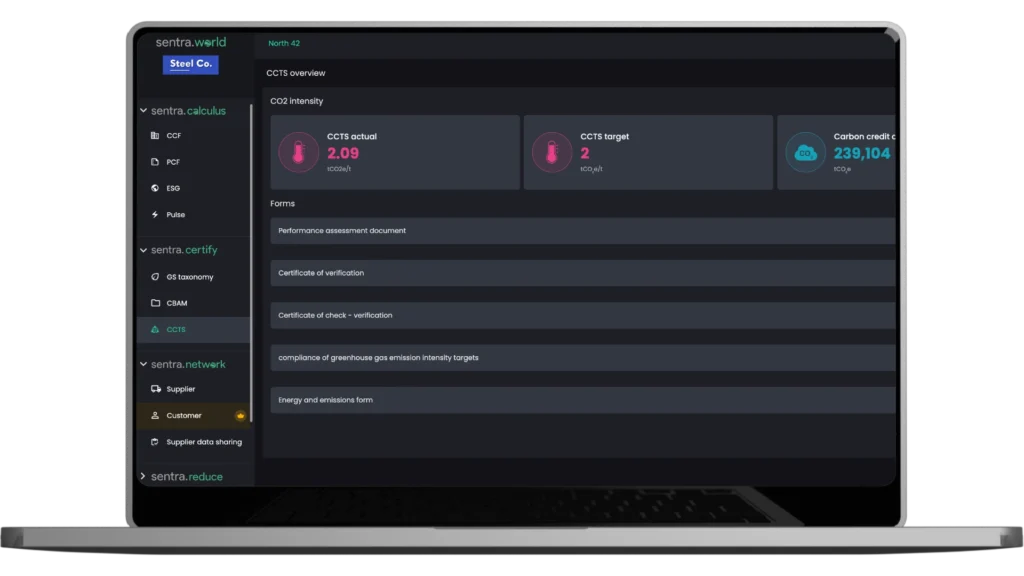
sentra.world’s digital platform addresses the full compliance lifecycle – from granular emissions tracking at the plant level to verified credit generation and market participation. It doesn’t treat compliance as a cost center; it treats it as a value chain.
It automates the most time-intensive element of that chain: CCTS compliance report generation. Instead of manual data aggregation across production lines and fuel sources, sentra.world consolidates verified emissions data into regulator-ready documentation, reducing reporting risk and freeing operational teams to focus on mitigation strategy rather than spreadsheet management.
Compliance data becomes a green asset when structured correctly. Manufacturers that meet or exceed their Carbon Credit Trading Scheme targets don’t just avoid penalties – they generate Indian Carbon Credits tradable on the Indian carbon market. As sentra.world positions it, the platform is “the #1 Carbon Accounting Platform for Industrial Manufacturing, designed to bridge the gap between environmental data and financial value.”
The window to establish early positioning in India’s carbon market is open now. Manufacturers that deploy robust measurement and reporting infrastructure today will hold a structural advantage when trading volumes scale. Explore sentra.world’s CCTS compliance suite and secure your place ahead of the curve. Get in Touch!