
EPD reporting for steel has quietly crossed a threshold -what was once a nice-to-have is now becoming a must-have for steel manufacturers. As buyers, infrastructure projects, contractors and global supply chains ask for verified product-level emissions data, EPD reporting is becoming a critical part of low-carbon steel positioning.
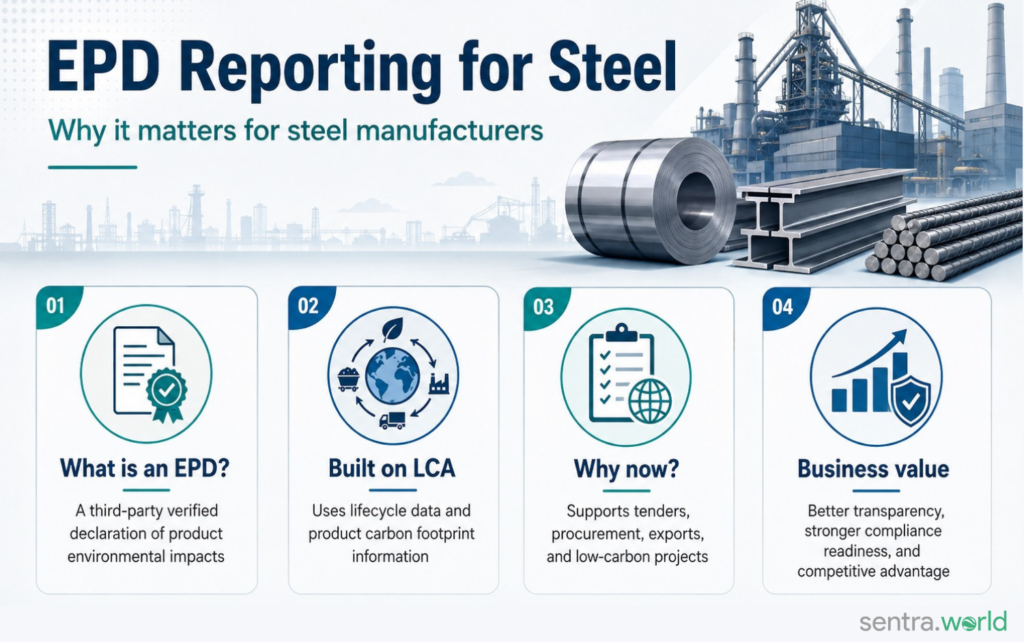
Environmental Product Declarations, or EPDs, are standardised, third-party verified documents that detail a product’s environmental impacts throughout its lifecycle. For steel manufacturers, they help communicate the impact of products such as rebar, structural steel, sections, pipes, tubes, coils, plates, wires and other steel products in a transparent and comparable format.
A significant push from regulators and procurement bodies is evident. Infrastructure buyers, public procurement agencies and low-carbon material programmes are increasingly asking suppliers to provide verified EPD documentation for sustainable products. For steel manufacturers, this means product-level environmental data is becoming important not only for compliance, but also for tenders, customer disclosures and export-linked opportunities.
Structural steel is under scrutiny. As one of the most carbon-intensive materials, it is receiving considerable attention from specifiers, owners, and regulators. Industry-wide EPDs for structural steel are becoming crucial for tracking and reducing embodied carbon. Regulators now view this as measurable, not merely aspirational. Understanding how carbon is measured and certified is essential for steel manufacturers.
The consequences of non-compliance are increasing rapidly, just like the mandates themselves. Hence, steel manufacturers need to swiftly embrace EPD compliance.
Why Manufacturers Must Prioritize EPD Reporting for Steel Now
The time for voluntary EPD reporting for steel is running out -regulatory deadlines are tightening, and delays may result in missed opportunities for significant projects.
As previously mentioned, EPD requirements have shifted from optional to essential in public procurement and commercial construction. For steel manufacturers, this shift is a substantial financial and competitive factor. Projects, procurement teams and large buyers are increasingly asking for verified EPDs before steel products are specified or approved. For steel manufacturers, this makes EPD reporting for steel a front-end requirement for customer engagement, rather than a document prepared after contracts are awarded.
Compliance is just one aspect. The embodied carbon of structural steel has decreased by over 10% since 2021 due to industry-wide EPD programs. Manufacturers who participated not only reduced carbon emissions but also built a track record that design teams trust and confidently specify.
The greatest pressure is market access. Increasingly, state procurement rules, such as those monitored by Caltrans’ EPD program, demand product-specific declarations before materials are even considered. Without current EPDs, you might as well be invisible in those bidding processes.
Maintaining strong supply chain relationships is equally important. Contractors and fabricators striving for low embodied carbon are selecting suppliers who provide transparent lifecycle data. This aligns with broader carbon market dynamics where verifiable emissions reductions hold real value. By establishing that documentation infrastructure now, manufacturers position themselves competitively -a position that’s hard to surpass as requirements increase.
How EPD Reporting for Steel Supports Regulatory Compliance and Green Building Standards
EPD Reporting for Steel is becoming more important as construction projects, infrastructure buyers and procurement teams move towards verified low-carbon material selection. Earlier, steel suppliers could rely on broad sustainability claims. Now, buyers increasingly want product-level environmental data that is standardised, comparable and independently verified.
This is where an Environmental Product Declaration becomes valuable. For steel products such as rebar, structural sections, pipes, tubes, coils, plates and wires, an EPD gives buyers a clear view of the product’s environmental impact. It helps answer a simple but important question: what is the environmental footprint of this steel product, and can the data be trusted?
The importance of EPDs is also growing because of green building and procurement frameworks. Programmes such as LEED v4, Buy Clean policies and low-carbon construction requirements often rely on verified environmental data to compare materials. For steel manufacturers, this means EPDs are not just technical documents. They can directly influence project eligibility, tender responses and customer preference.
At the core of every credible EPD is a Life Cycle Assessment (LCA). The LCA captures product-level environmental data across key stages such as raw material sourcing, energy use, steelmaking, processing, transport and end-of-life treatment or recycling. For steel, this usually includes indicators such as:
- Global warming potential or product carbon footprint
- Energy consumption
- Resource use
- Acidification and eutrophication potential
- Waste and end-of-life impacts
- Other environmental indicators required by the applicable Product Category Rule
This makes EPDs useful for both compliance and commercial conversations. A verified EPD can help a steel manufacturer respond faster to customer ESG requests, support green building documentation, participate in low-carbon procurement programmes and build stronger credibility with contractors, project owners, regulators and investors.
For steel companies, the key benefit is clear: EPD Reporting for Steel turns complex plant, process and product data into verified evidence. That evidence can support regulatory readiness, improve transparency in tenders and position steel products more effectively in markets where carbon performance is becoming a buying factor.
The Technical Core: LCA and Automated EPD Reporting for Steel Platform
Creating a reliable EPD reporting for steel begins well before any document is filed -it starts with detailed data collection and modeling that transforms raw production records into verified environmental claims.
An EPD is only as robust as the Life Cycle Assessment (LCA) underpinning it. The LCA serves as the analytical backbone: it tracks every input and output within a product’s defined system boundary, from raw material extraction to the manufacturing gate. For steel, this involves accounting for ore sourcing, scrap collection, energy consumption, alloy additions, and finishing processes. Each step contributes to the product’s embodied carbon in building materials profile -a figure that specifiers and procurement teams now scrutinize as closely as load-bearing capacity. So it is not LCA vs EPD but how LCA can be useful and used as a base for EPD.
Steel emissions can vary significantly depending on the production route. Predominantly steel products are produced by two processes: Blast Furnace(BF)/Basic Oxygen Furnace(BOF) and Electric Arc Furnace (EAF) route. This is why EPD Reporting for Steel cannot rely on generic assumptions alone. A blast furnace route, an electric arc furnace route, and a DRI-based route can have very different carbon profiles, which must be captured accurately through LCA and product-level data.
| Steel Production Method | CO₂ Emissions per tonne of steel |
|---|---|
| Blast Furnace (BF) | 2.25 – 2.8 tCO₂/t steel |
| Electric Arc Furnace (EAF) | 0.62 – 0.85 tCO₂/t steel |
| Gas based Direct Reduced Iron (DRI) | 1.12 – 1.35 tCO₂/t steel |
Product Carbon Footprint (PCF) is a similar metric but more focused. While LCA covers all environmental impact categories -global warming potential, acidification, eutrophication, and more -PCF zeroes in on greenhouse gas emissions as CO₂ equivalent. Both figures are included in the EPD, and they must align with the applicable Product Category Rule (PCR). For structural steel, that PCR specifies which life cycle modules to include, which impact categories to report, and which third-party verification standard applies. According to Nucor’s EPD primer, this standardization ensures EPDs are comparable across manufacturers and aren’t merely marketing tools.
Data quality is where many manufacturers encounter challenges. Primary data -real energy bills, material inputs, and emissions records -must be collected at the facility level. If there are gaps, secondary datasets can fill in, but verifiers will note the substitution, potentially weakening the EPD’s credibility. The UL EPD requirements for designated steel construction products outline the documentation thresholds necessary before a program operator can issue a verified declaration.
With a strong technical foundation, manufacturers can transform that verified data into something commercially valuable -which is where green building credits and procurement advantages come into play.
The Bottom Line: Key Takeaways for Steel Manufacturers
An EPD is no longer just a nice-to-have for steel producers -it’s the baseline credential for competing in a low-carbon market.
As we’ve explored throughout, the journey from data collection to a verified EPD touches every aspect of a steel operation: process energy, material inputs, logistics, and third-party verification. For high-volume steel products such as rebar, structural sections, plates, pipes, tubes and coils, the stakes are particularly high because customers increasingly want product-specific environmental data before making sourcing decisions. Specifiers, contractors, and public procurement officers are actively filtering suppliers by EPD availability, and that filter is tightening each year.
The clear pattern is this: manufacturers who invest in site-specific EPDs rather than relying on industry averages consistently earn stronger positions in green building certification projects and competitive bids. Product-level declarations provide buyers with detailed carbon data that generic figures cannot match -and that’s precisely what procurement teams now demand.
Data quality is the true differentiator. A well-maintained carbon accounting system -one that captures Scope 1, 2, and 3 emissions with sufficient detail -distinguishes a credible EPD from simply a compliance checkbox. If you’re determining where to begin, measuring and monetizing your carbon position is the logical first step before any EPD program can deliver its full commercial value.
The regulatory and market trends we’ve analyzed are only accelerating. What’s considered best practice today will soon become the minimum standard tomorrow -makingthe carbon accounting decisions you make now crucial for maintaining competitiveness in the long term.
Navigating the Future of EPD Reporting for Steel in Industrial Carbon Accounting
EPD compliance for steel isn’t merely a reporting task anymore -it’s the backbone of a robust competitive strategy in a world where carbon transparency is becoming essential.
The steel value chain is advancing rapidly towards product-level carbon transparency. Supply chain disclosure expectations, low-carbon procurement requirements and customer documentation requests are all becoming more structured. Steel producers who view their EPD as just another document -something to file and forget -may fall behind a market that increasingly expects live data, product-specific declarations and continuous improvement.
In practice, manufacturers who invest early in strong lifecycle assessment infrastructure gain compounding advantages: better data for contract bids, smoother inputs for carbon credit frameworks, and trust from specifiers who are also under scrutiny. Tools that integrate EPD and carbon footprint workflows into a single platform reduce the hassle of keeping declarations current as production processes evolve.
The path is evident. Industry-wide EPDs set the foundation; product-specific and plant-specific declarations push the boundaries. Regulatory signals -from Caltrans procurement rules to carbon credit certificate frameworks -indicate that verified environmental data will shape how steel is priced, specified, and traded in the future.
For steel manufacturers, the call to action is straightforward: treat your EPD program as evolving infrastructure, not a one-time compliance cost. The producers who establish that discipline now will set the bar that others will strive to reach later.
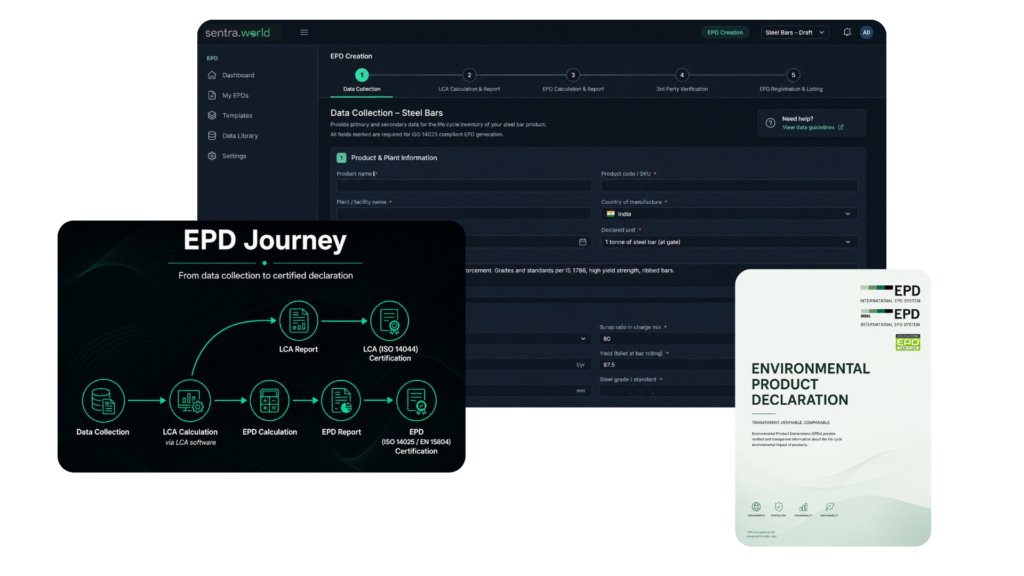
How sentra.world Supports EPD Reporting for Steel Manufacturers?
sentra.world helps steel manufacturers simplify EPD reporting by collecting, structuring and centralising product-level data from ERP systems, Excel files, meters, invoices, production records and supplier inputs. This helps manufacturers prepare EPD documentation for sustainable products with stronger traceability, consistency and verification readiness.
With an automated EPD reporting platform and expert-led EPD consulting service, sentra.world supports product scoping, LCA input preparation, data gap assessment, evidence management and EPD documentation workflows.
- Product scoping for EPDs
Identify the right steel products for EPDs, such as rebar, pipes, tubes, coils, plates, sections and structural steel. - LCA data preparation and LCA consultancy
Organise product-level inputs such as raw materials, scrap, fuels, electricity, process emissions, transport and production data. - Plant-level data collection and data gap assessment
Structure ERP data, Excel sheets, meters, invoices, production logs and supplier inputs while identifying missing or inconsistent data points. - Product carbon footprint and verification readiness
Support emissions calculations, evidence management, assumptions, approvals and review-ready documentation for third-party verification. - Automated EPD reporting workflows
Move from scattered plant records and manual spreadsheets to structured, repeatable workflows through an automated EPD reporting platform.
This helps steel manufacturers move from scattered plant records to audit-ready product sustainability disclosures. Want to generate an EPD for your steel company? Get in Touch Now!