

ESG Reporting in UAE
Turn complex ESG data into audit-ready sustainability reports with ESG compliance software built for industrial enterprises.
SCA, ADX, DFM & MOCCAE
The UAE’s ESG reporting is moving from voluntary sustainability communication to regulated, data-driven disclosure. Listed companies, industrial firms and GHG-emitting entities now need structured ESG data systems to meet exchange-level, regulatory and climate-related requirements.
sentra.world helps enterprises in the UAE collect ESG data, track emissions, map disclosures to SCA, ADX and DFM expectations, and build audit-ready ESG reports through an automated ESG data collection platform.
UAE ESG Reporting: Why It Matters Now?
The UAE ESG reporting is shaped by listed-company disclosure rules, stock exchange guidance and national climate policy. For public joint stock companies, ESG reporting is tied to corporate governance and annual reporting. For industrial companies, climate and GHG-related obligations are becoming increasingly important.
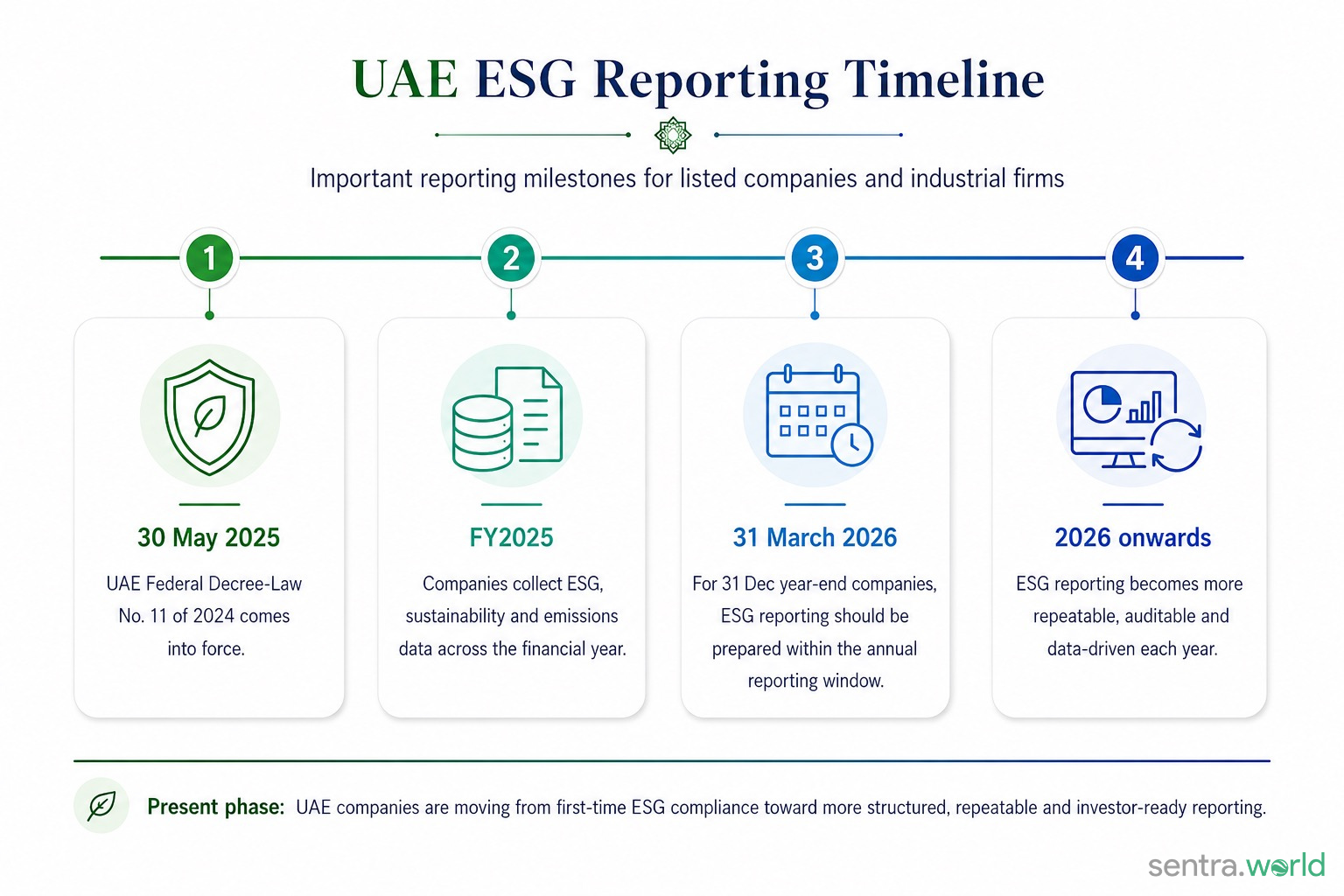
The DFM ESG Reporting Guide encourages listed companies to evaluate and disclose performance against 32 ESG metrics and indicators aligned with the Sustainable Stock Exchanges initiative and the World Federation of Exchanges (Dubai Financial Market). ADX also provides ESG disclosure guidance for listed companies and issuers, aligned with global standards and market expectations (adx.ae). Separately, UAE Federal Decree-Law No. 11 of 2024 on the Reduction of Climate Change Effects came into effect on 30 May 2025 and aims to manage emissions in the UAE, adding a national climate-law layer beyond stock exchange reporting. (UAE Legislation)
The message for UAE companies is clear: ESG reporting should not be treated as a year-end compliance task. Companies need reliable ESG data, emissions calculations, source evidence, and approval workflows throughout the year. This is where ESG data management tools for reporting become important. They help companies move from scattered spreadsheets to structured, traceable and audit-ready ESG disclosures.
What changes in 2026?

Verified Supplier Data Becomes Essential
Actual emissions data must be verified by an accredited third-party auditor. Without verification, importers must rely on default emission values, which are typically higher.

New EU Benchmark Values
The EU has introduced product-specific benchmark emissions values based on CN codes and production routes. If supplier data is unavailable, country-level default benchmarks apply, increasing CBAM exposure.

CBAM Costs Begin
From 1 January 2026, importers must purchase CBAM certificates covering emissions above benchmark levels.
Certificate prices are linked to the EU ETS carbon market.

CBAM Registry Becomes the Compliance Hub
The EU CBAM Registry will manage emissions of reporting and certificate purchases. While declarations become annual, companies will still track emissions quarterly for cost forecasting.
Calculate your CBAM costs
Calculate your CBAM costs
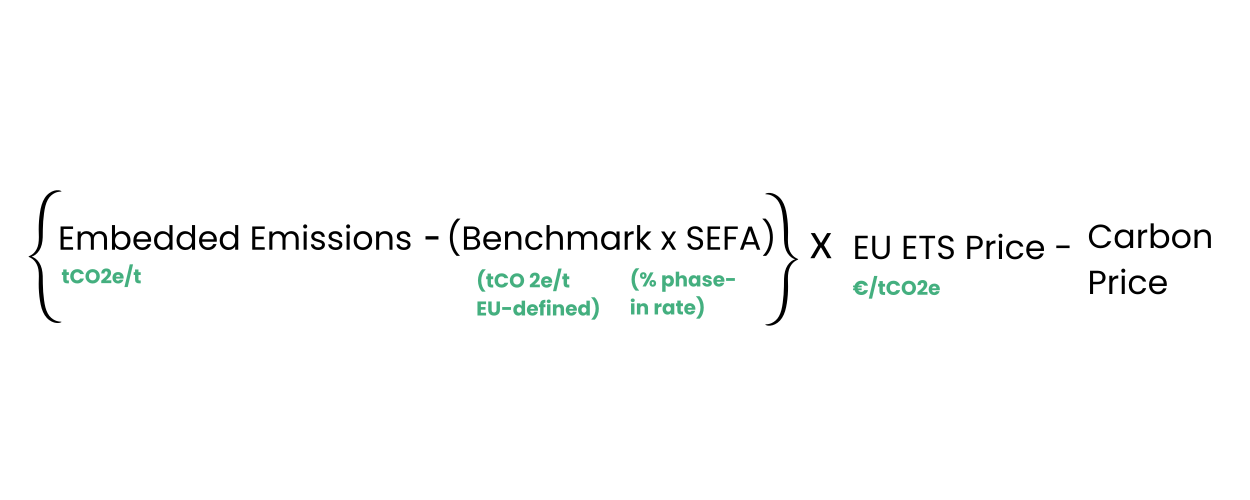
What Each Part of the Formula Means:
Embedded Emissions– The direct greenhouse gas emissions generated during the production of the exported product. These emissions are calculated according to EU CBAM methodology
SEFA (Specific Embedded Free Allocation)– SEFA adjusts emissions using the EU benchmark and phase-in factor, reflecting the gradual removal of free EU ETS allowances between 2026 and 2034.
SEFA is calculated using:
- Specific mass of precursor materials
- EU benchmark emissions
- CBAM phase-in factor
- Cross-sectoral correction factor
CBAM Certificate Price – The CBAM certificate price is linked to the EU Emissions Trading System (EU ETS) and reflects the carbon market price in the EU.
Importers must purchase certificates equivalent to the emissions subject to CBAM.
Carbon Price Already Paid – If a carbon price has already been paid in the exporting country (for example under national carbon pricing systems like India’s CCTS), it can be deducted to avoid double carbon pricing.
The result determines the CBAM cost per tonne of imported goods, which EU importers must pay through CBAM certificates.
UAE ESG requirements at a Glance
The important distinction is that financial-market sustainability reporting and national climate reporting are not the same. SCA, ADX and DFM guide listed-company disclosures, while MOCCAE and competent authorities manage climate and emissions accountability.
Companies operating in the UAE should treat ESG reporting as an integrated compliance and data management process, not only as an annual disclosure activity.
Requirement | Applies To | Status | Main Authority | What Companies Need |
Sustainability reporting in annual / integrated reports | UAE public joint stock companies | Mandatory for eligible listed entities | SCA | ESG disclosure, governance reporting and sustainability information |
ADX ESG Disclosure Guidance | ADX-listed companies and issuers | Exchange-led ESG disclosure guidance | ADX | Environmental, social and governance indicators |
DFM ESG Reporting Guide | DFM-listed companies | Voluntary guide, strongly encouraged | DFM | 32 ESG metrics and indicators |
Climate / GHG-related obligations | Public and private legal persons whose activities release GHGs | Mandatory under climate law | MOCCAE / competent authorities | Emissions measurement, reduction and reporting systems |
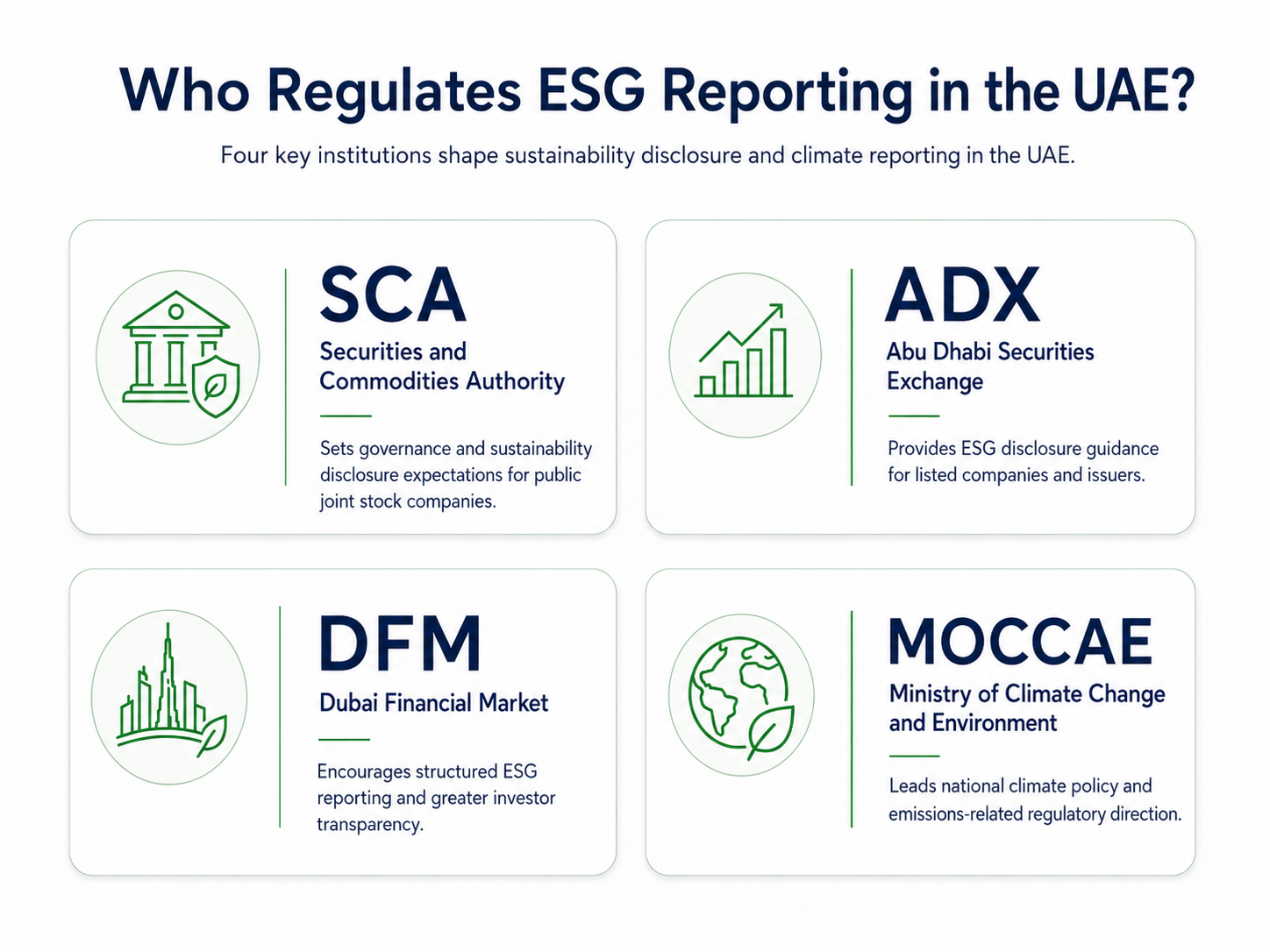
Who Regulates ESG Reporting in the UAE?
ESG reporting in the UAE is shaped by both financial-market disclosure expectations and national climate policy. This means companies may need to look at more than one regulatory layer. Listed companies must consider exchange-level and SCA-related sustainability expectations, while industrial and GHG-emitting companies must also track national climate-related requirements. Understanding the role of each institution is important before deciding what data to collect, which frameworks to follow and how to prepare ESG disclosures.

Securities and Commodities Authority (SCA)
ADX provides ESG disclosure guidance to support listed companies and issuers in structuring high-quality ESG disclosures aligned with global standards and investor expectations.

Abu Dhabi Securities Exchange (ADX)
Employee headcount, diversity, training hours, workplace injuries, community investment, labour practices and workforce wellbeing.

Dubai Financial Market (DFM)
DFM’s ESG Reporting Guide provides a structured ESG disclosure approach and encourages listed companies to disclose against 32 ESG metrics and indicators.
Why ESG reporting matters for UAE industrial companies?
For UAE industrial companies, ESG reporting is becoming more important because it affects regulatory readiness, investor confidence, customer expectations, ESG compliance and long-term competitiveness. As sustainability and climate-related requirements become more structured, companies need reliable ESG and emissions data that can be measured, tracked and reported throughout the year.
- Regulatory and climate readiness
UAE companies may need to align with SCA-related sustainability disclosure, ADX/DFM ESG guidance and climate-related requirements under MOCCAE.
- Climate and emissions accountability
With UAE climate policy becoming more structured, companies need measurable emissions data to support climate-related reporting and reduction planning.
- Procurement and buyer requirements
Large customers, developers and international buyers increasingly ask suppliers for ESG, emissions and sustainability data during procurement.
- Regional competitiveness
Strong ESG reporting helps UAE manufacturers strengthen credibility, improve market positioning and compete in sustainability-linked business opportunities.
How sentra.world Helps with ESG Reporting in UAE?
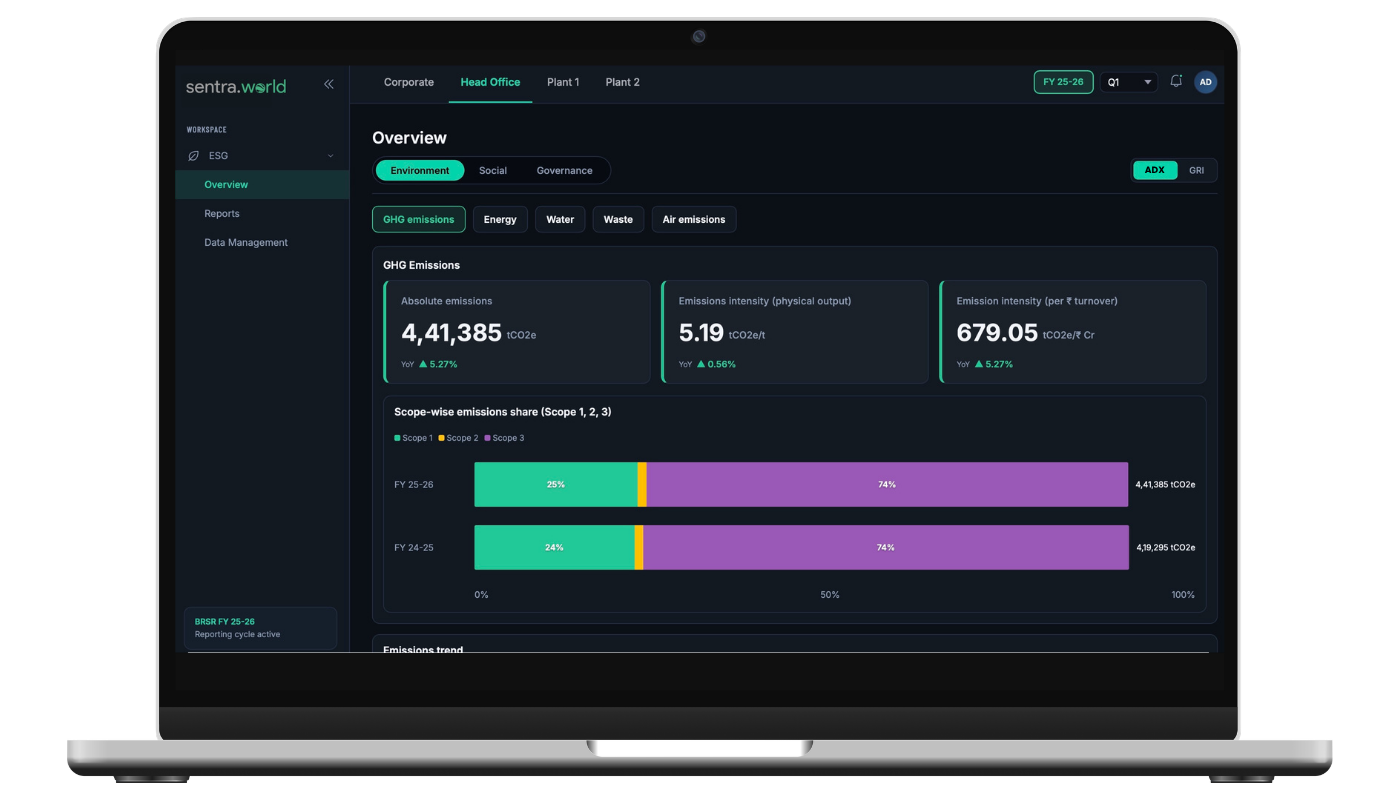
sentra.world provides ESG compliance software for manufacturing companies in the UAE to manage complex sustainability data, carbon accounting, framework mapping and audit-ready disclosures.
Unlike generic ESG tools, sentra.world is built for industrial data complexity. As an automated ESG data collection platform, it connects plant-level activity data, carbon accounting, operational evidence, supplier inputs and reporting workflows into one ESG system.
Automated ESG Data Collection Platform
Collect ESG data from plants, meters, utility bills, ERP systems, EHS records, HR systems and procurement teams.
UAE ESG Framework Mapping
Map one ESG dataset to SCA, ADX, DFM, GRI, ISSB, customer questionnaires and internal dashboards.
Carbon Accounting
Calculate Scope 1, Scope 2, Scope 3, emissions intensity, energy intensity, PCF and CCF.
ESG KPI Dashboards
Track environmental, social and governance performance across the year.
Evidence Repository
Store supporting documents, assumptions, calculation methodology, approvals and audit trails.
ESG Data Management Tools for Reporting
Generate management summaries, ESG disclosure packs, audit-ready reporting outputs and dashboards for enterprise ESG reporting.
UAE ESG Readiness Checklist
Use this checklist to assess whether your UAE ESG reporting process is ready for upcoming disclosure, climate and audit requirements.
- Are ADX or DFM ESG indicators mapped to internal data sources?
- Have you assigned data owners for each metric?
- Are energy, water, waste and emissions data available?
- Are workforce and safety metrics traceable?
- Are ADX or DFM ESG indicators mapped to internal data sources?
- Are Scope 1 and Scope 2 emissions calculated?
- Is supplier data available where required?
- Is ESG evidence stored in one place?
- Can you generate ESG KPI dashboards?
- Can your ESG report be reviewed and audited easily?
- Are you using ESG compliance software to manage ESG data?
- Is ESG data being collected through an automated ESG data collection platform?
- Are ESG reporting tools and services in place for enterprise-level reporting?
Ready to Simplify ESG Reporting in the UAE?
sentra.world helps industrial manufacturers meet ESG reporting requirements with a structured ESG data management platform.
Leading ESG Consultancy for Industrial Manufacturers
Trusted by across India, the Middle East, and Southeast Asia for ESG Reporting, Carbon Accounting, EPD Consulting, and CBAM Consultancy.

















































Frequently asked questions about ESG Reporting in UAE

ESG reporting is mandatory for many UAE-listed companies and is increasingly important for industrial firms due to exchange-level disclosure expectations, SCA-related governance requirements and national climate-related obligations.
UAE ESG reporting is shaped by multiple institutions. SCA oversees listed-company governance and sustainability disclosure expectations, ADX and DFM provide exchange-level ESG guidance, and MOCCAE leads national climate and emissions-related policy.
SCA plays a central role in listed-company governance and sustainability disclosure. For public joint stock companies, ESG reporting is connected with corporate governance, annual reporting and investor transparency.
ADX provides ESG disclosure guidance for listed companies and issuers. DFM provides an ESG reporting guide with structured ESG metrics and indicators. Both help companies improve consistency, comparability and investor-focused sustainability disclosure.
ADX ESG Disclosure Guidance is a voluntary guide, but it complements UAE regulatory frameworks and helps listed companies prepare higher-quality ESG disclosures aligned with investor expectations and global standards.
DFM’s ESG Reporting Guide is generally positioned as guidance, but listed companies are strongly encouraged to use it to disclose structured ESG metrics and improve transparency for investors and stakeholders.
MOCCAE leads national climate policy and climate-related regulations in the UAE. Its role is especially important for companies whose activities release greenhouse gases and need emissions monitoring, reduction and reporting systems.
Companies should map applicable frameworks, identify data owners, collect ESG and emissions data, maintain evidence, calculate Scope 1, Scope 2 and Scope 3 emissions where relevant, and build audit-ready reporting workflows with the help of ESG data management platform.
Latest Blogs
The initial phase of the Carbon Border Adjustment Mechanism (CBAM) was more flexible. Reports could be filed with default values, estimates had fewer

CBAM for engineering exporters is not a future issue, it is an active compliance obligation with consequences already accumulating. Many exporters assume the
For industrial companies navigating compliance requirements in 2025, confusing a sustainability report with an ESG disclosure isn’t just a semantic mistake – it
Just enter your CN Code to check.
