
CBAM for engineering exporters is not a future issue, it is an active compliance obligation with consequences already accumulating.
Many exporters assume the EU CBAM transition period, which concluded at the end of 2025, allowed them time to observe rather than act. That assumption is costly. The transition phase carried its own CBAM reporting requirements: quarterly disclosures of embedded carbon, product volumes, and country of origin. Firms lacking data infrastructure for those disclosures are already vulnerable.
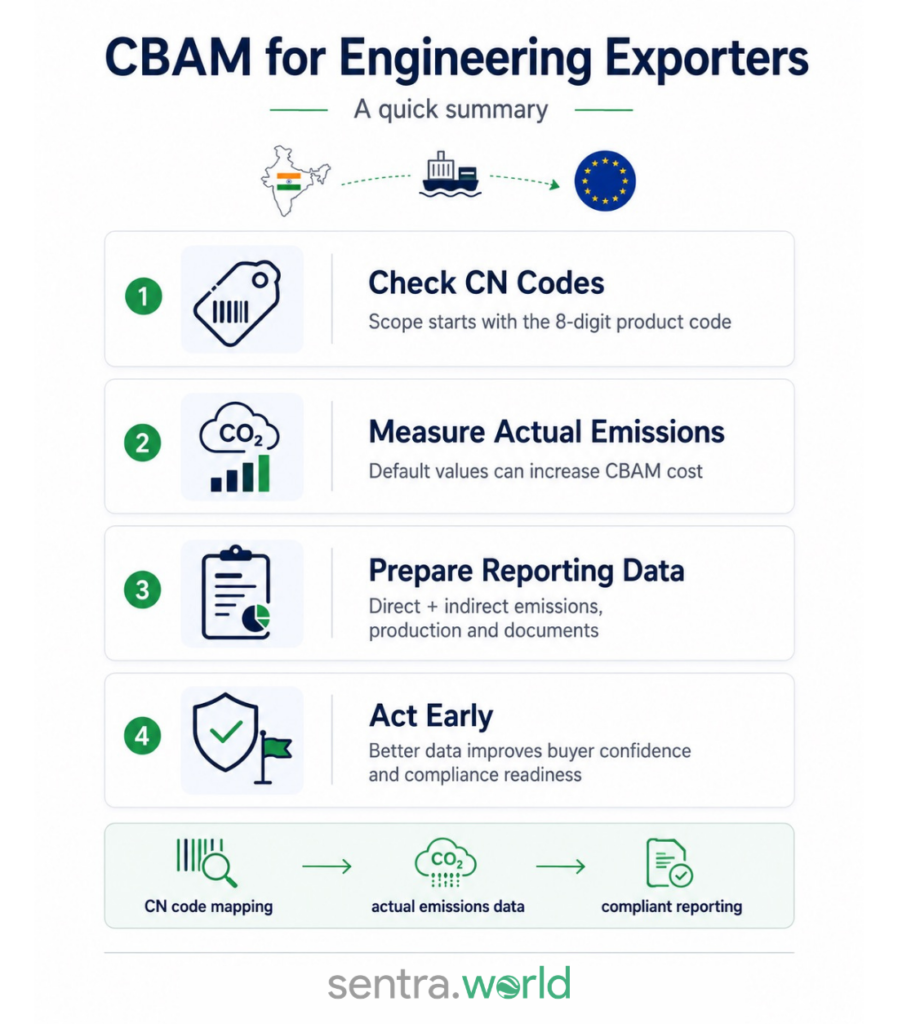
The component trap is where most engineering exporters stumble. Finished machinery may sit outside CBAM’s current scope, but the parts within it frequently do not. Specific items like screws, bolts, nuts, washers under CN 7318, and iron or steel castings under CN 7325, are explicitly listed in Annex I of the CBAM Regulation. A manufacturer exporting an assembled product may believe they are exempt, yet every carbon-intensive component embedded in that assembly tells a different story under EU customs scrutiny.
And the stakes are measurable. Indian engineering exporters face a potential 25% increase in export costs driven by high-carbon, coal-reliant production methods – a figure that grows sharper when firms rely on default carbon values rather than actual emissions data. Default values, set deliberately high by the EU to incentivize accurate reporting, consistently overstate carbon intensity and therefore inflate the financial liability.
The regulatory logic behind this expanding scope is carbon leakage prevention: ensuring that emissions aren’t simply offshored to countries without a carbon price. Understanding which CN codes your products fall under is not an administrative detail – it’s the foundation of your entire CBAM for engineering exposure calculation.
Decoding CBAM for Engineering Product Eligibility: Is Your CN Code Impacted?
Your product’s eligibility under CBAM for engineering is determined not by its common name, but by its precise 8-digit Combined Nomenclature (CN) code, a distinction that catches many engineering exporters off guard.
Generic descriptions like “steel bracket” or “aluminum housing” mean nothing to EU customs authorities. What matters is the CN code assigned to that product, because CBAM obligations attach to specific codes, not categories. A component that appears superficially similar to a covered product may carry a different CN code and face an entirely different compliance posture. This is why any competent CBAM consultant will begin an engagement with a line-by-line audit of your export portfolio’s CN classifications before anything else.
Primary engineering categories currently in scope include:
- Iron and steel products – structural sections, tubes, pipes, castings, and fasteners under CN chapters 72–73
- Aluminium products – unwrought aluminium, plates, sheets, foil, tubes, and structures under CN chapter 76
- Upstream inputs – pig iron, sponge iron, and ferro-alloys that feed into finished components
The exposure, however, extends well beyond these current categories. EU has proposed expanding CBAM to 180 additional downstream products including gearboxes, engines, and other precision-engineered components. That proposal carries a December 2025 timeline for formal consideration.
⚠️ Warning: If your products fall into machinery, automotive parts, or industrial equipment categories, they may be captured under the expanded scope, as the EU CBAM definitive regime took full effect in January 2026. Waiting for official confirmation is a risk your competitors may not be taking.
A structured CBAM Audit of your product portfolio i.e. mapping each SKU to its CN code and cross-referencing against both current and proposed scope is the logical first step. Tools like the sentra.world CBAM eligibility checker can accelerate that mapping process considerably. And that audit, as the next section will make clear, isn’t just a compliance exercise, it’s increasingly a competitive one.
Why Foundries and Component Makers Must Act Now for CBAM Reporting?
Foundries and component manufacturers are discovering that the carbon border adjustment mechanism for engineering exporters reshapes commercial relationships long before any certificate changes hands. EU buyers now need your emissions data to calculate their own CBAM liabilities, which makes your compliance posture a direct input into their cost modeling.
Foundries should not treat CBAM for engineering as a distant 2028 issue. EU buyers now have stronger financial and compliance reasons to ask suppliers for accurate embedded emissions data.That pressure is already materializing in procurement conversations, tender requirements, and supplier qualification questionnaires. If you can’t provide granular, verified emissions data on request, a competitor who can will take your place.
The gap between ‘actual’ and ‘default’ emissions data is also a pricing gap. Default values set conservatively high by the European Commission inflate the carbon cost your EU buyer must account for. Suppliers who provide verified actual data almost always show lower embedded emissions, which directly reduces the buyer’s CBAM exposure. That difference translates into a negotiating advantage that no price concession can easily replicate.
This signals a structural shift: competition is no longer purely price-based, it’s carbon-adjusted.Buyers will increasingly evaluate total landed cost inclusive of CBAM charges, meaning a lower-emissions supplier can command a premium or simply win business on cost grounds. Pre-verification of your embedded emissions, then, isn’t a compliance burden you absorb reluctantly, it’s a sales tool you deploy proactively. Understanding precisely what data your EU customers require, and how to report it accurately, is what the next section addresses directly.
CBAM for Engineering : Navigating the Definitive Period Reporting Requirements
The transition period wasn’t a grace period – it was an active compliance obligation that demanded structured carbon data from exporters. EU importers must submit quarterly CBAM reports covering the embedded emissions in every shipment of in-scope goods, and that data can only come from you, the exporter. Verifying your 8-digit CN codes to confirm product scope was therefore the first administrative step, not an optional one.
Direct vs. indirect emissions : both count. Direct emissions arise from your own production processes – furnace fuel combustion, for instance. Indirect emissions cover the electricity consumed during manufacturing. Both must be reported, and the distinction matters because indirect emissions methodologies vary by jurisdiction, creating complexity for foundries operating on carbon-intensive grids.
Actual vs. Default Data: The stakes are high. During the early transition, EU authorities permitted the use of default emission values, conservative estimates that typically overstate a facility’s real carbon intensity. As the definitive regime approaches, actual, facility-level data becomes mandatory. Exporters who’ve delayed carbon accounting will face a difficult transition, and those submitting inaccurate figures risk substantial financial penalties and potential suspension of import authorizations for their EU buyers.
Engaging specialist CBAM compliance services at this stage isn’t premature – it’s the most practical way to build the measurement and reporting infrastructure now rather than under deadline pressure. The operational steps you take during this transition will directly shape your competitive position when the definitive regime takes full effect which is precisely what the next section addresses.
The Bottom Line: What Engineering Exporters Need to Know
Engineering exporters who delay engaging with the EU carbon border adjustment mechanism CBAM are not avoiding complexity, they’re compounding it at a cost that will become very difficult to reverse.
The single most urgent action is verifying your 8-digit CN codes. Many fasteners, castings, and precision-turned components are already within scope, and a classification error discovered late carries both financial and reputational consequences. Confirm your product eligibility now, not when your EU buyer raises the question first.
Once scope is confirmed, the priority shifts to carbon accounting. Exporters who rely on default values face significantly reduced profit margins compared to those who submit verified, facility-specific emissions data. Actual data almost always comes in lower than the conservative defaults the EU assigns but you have to measure it to use it.
And the regulatory boundary isn’t static. The anticipated expansion of CBAM into downstream machinery and automotive components by 2028 means that even exporters currently outside scope should be building carbon accounting infrastructure now. Waiting for formal confirmation before acting will leave insufficient time to comply without disruption.
Beyond compliance, carbon transparency is emerging as a genuine commercial differentiator. EU procurement teams are increasingly using emissions performance as a contract criterion, not just a regulatory checkbox. Exporters who can demonstrate verified, lower-carbon production will find it meaningfully easier to win and retain high-value EU relationships. The exporters best positioned to capitalize on that shift are already thinking beyond compliance and toward strategy.
Future-Proofing Your EU CBAM for Engineering Export Strategy with sentra.world
Engineering exporters who act now on CBAM transition period reporting requirements will define their competitive position for the decade ahead, those who wait will spend it catching up.
sentra.world is an AI-powered sustainability platform built specifically for industrial manufacturing. Measurement establishes the verified carbon baseline that regulators and EU buyers demand. Mitigation identifies reduction pathways that lower both emissions and future financial liability. Monetization converts that compliance record into a commercial asset – a demonstrable edge in procurement conversations.
sentra.world automates the carbon accounting work that typically consumes weeks of manual effort, pulling facility-level data into structured, submission-ready reports. The platform takes that output through pre-verification, producing documentation that withstands EU declarant scrutiny. And it’s pre-verification that increasingly determines buyer trust as third-party-verified carbon data is rapidly becoming a procurement prerequisite for EU importers.
The next step is straightforward. Assess whether your specific product categories fall within EU CBAM scope, identify your current data gaps, and build a compliance roadmap before the definitive regime locks in financial penalties. Reach out to sentra.world today for a consultation to determine your eligibility and take the first concrete step toward a carbon-ready export strategy for CBAM for Engineering. Get in Touch!