
In Oman, the industrial sector now views ESG compliance as a non-negotiable part of business operations.
Let’s explore why this shift is occurring. The Oman Vision 2040 framework, overseen by the Implementation Support and Follow-up Unit (ISFU), emphasizes transitioning to a green economy. ISFU underscores the necessity for robust digital tools to monitor carbon footprints across various industries. This has evolved from mere discussion to enforceable regulations.
ESG data collection is now becoming a core requirement for Omani companies as ESG compliance moves from voluntary reporting to structured, data-driven disclosure. With MSX ESG reporting requirements, Oman Vision 2040, growing investor expectations and international buyer demands, businesses can no longer depend on scattered spreadsheets and manual data collection.
The acceleration came when theMuscat Stock Exchange (MSX) mandated ESG reporting. Companies listed on MSX are required to report on 30 specific ESG metrics. What was previously optional is now mandatory. For industrial firms, this involves more than just checking boxes; it’s fulfilling essential requirements to operate, with potential penalties for non-compliance.
The MSX mandate is just one aspect. Oman’s Carbon Control Target System (CCTS) also demands that industrial polluters remain vigilant. Companies must consistently track and report emissions, not just annually. The pressure from the EU’s Carbon Border Adjustment further intensifies the situation for Omani industries.
So, what’s next for compliance teams? They need to fully understand these requirements, particularly the 30 MSX metrics.
Navigating the MSX ESG Disclosure Requirements
Omani companies listed on the MSX have new guidelines to adhere to, with understanding the requirements as the first step.
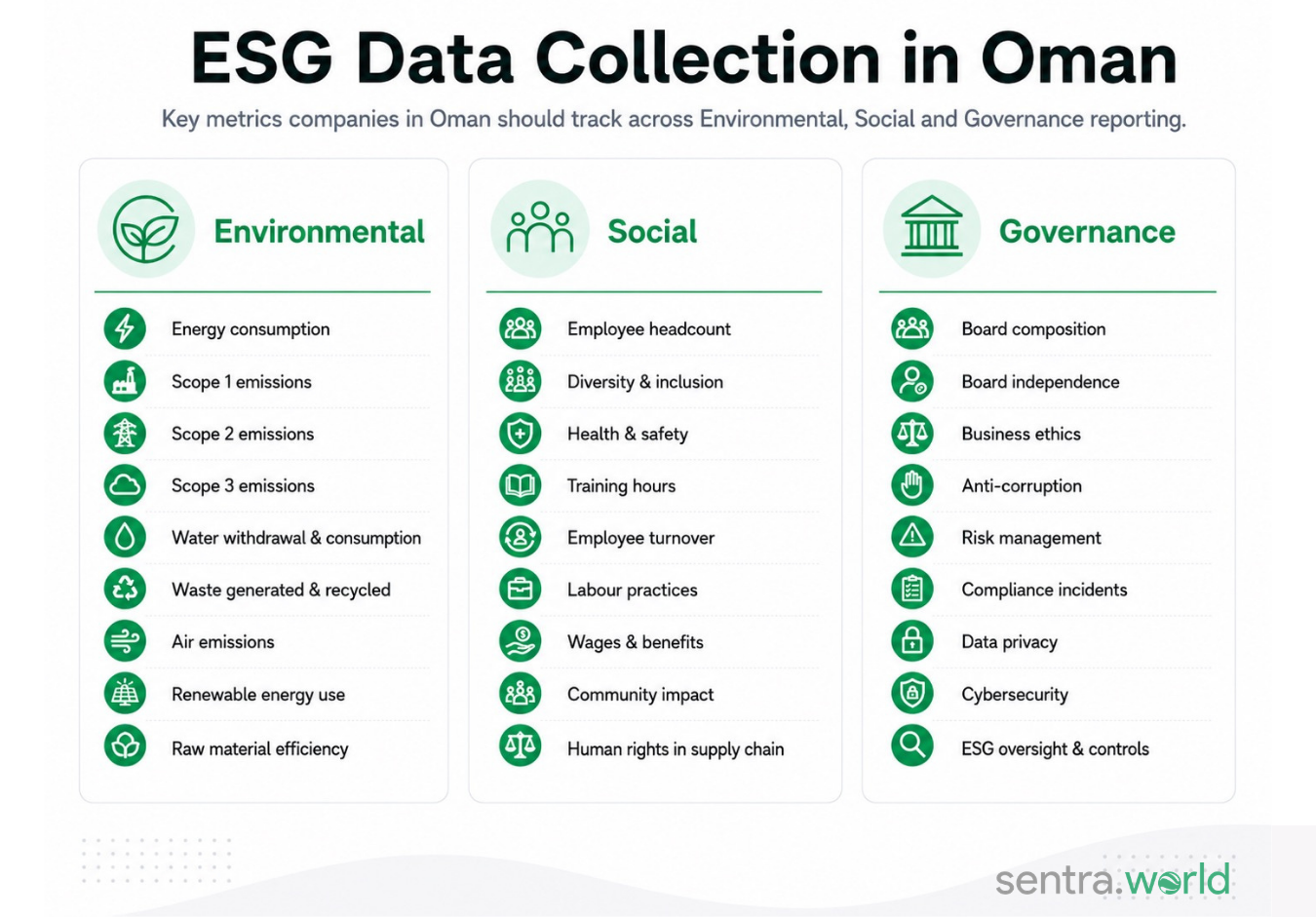
In 2025, Muscat Stock Exchange implemented mandatory ESG reporting for listed companies, covering 30 ESG metrics across three main categories:
- Environmental: Energy usage, GHG emissions, water consumption, waste management, and environmental incidents.
- Social: Workforce diversity, employee health and safety, training, community investment, and labor practices.
- Governance: Board composition, anti-corruption measures, data privacy, executive pay ratios, and shareholder rights.
The MSX guidelines aim to provide transparency and comparability for both local and global investors. It’s not just about numbers; it’s about consistency. Companies can’t alter their reporting methods without explanation. Industries with varying energy usage and emissions need solid systems in place.
The framework aligns with global standards such as GRI and SASB, crucial since investors and regulators assess disclosures against these benchmarks.
The previous “comply or explain” approach is no longer sufficient. While smaller companies might have some flexibility, major players in steel, petrochemicals, and manufacturing do not. Unexplained gaps now raise red flags, financially impacting Omani exports reaching EU customs.
What is ESG Data and How to Use it?
ESG data is the set of measurable information a company uses to understand its sustainability performance across environmental, social, and governance areas. This may include emissions, energy use, water consumption, waste generation, workplace safety, employee practices, compliance, ethics, and supply chain performance. When captured accurately, ESG data gives organisations a clearer view of their operational impact and helps them report transparently to regulators, investors, customers, and other stakeholders.
The real value of ESG data comes from how it is used and how accurate ESG data collection is done. Companies can use it to monitor performance, identify gaps, compare progress across sites or time periods, support audits, and make better business decisions. By bringing ESG data into a structured digital system, organisations can improve data quality, reduce manual reporting effort, and connect sustainability performance with risk management, cost reduction, compliance, and long-term business strategy.
Environmental ESG Data Collection : Beyond Simple Carbon Tracking
For Omani industrial companies, environmental compliance encompasses more than just emissions, it’s about a comprehensive data system covering energy, water, waste, and carbon.
MSX ESG reporting requires companies to track energy use across operations, including renewables. As Oman expands its solar and wind capacity under Vision 2040, industrial facilities must report not only total energy use but also the source breakdown to demonstrate progress toward cleaner operations.
Water management is another critical area. Operating in one of the most water-stressed regions, Omani companies face intense scrutiny over water usage and recycling. Waste reduction metrics, both hazardous and non-hazardous, are also crucial under the ESG reporting guide for Oman.
The Carbon Control Target System (CCTS) also plays a significant role. According to the Oman Ministry of Energy and Minerals, the CCTS demands rigorous Monitoring, Reporting, and Verification (MRV) of emissions. Manual data collection poses risks here. MRV protocols require audit-ready data. Gaps or errors can lead to non-compliance during verification.
In practice, environmental ESG data collection isn’t just a back office task. It’s a technical, multi-faceted discipline crucial for compliance and as we’ll see next, it’s equally important for social and governance metrics.
Social and Governance Metrics in the Omani Context
ESG reporting in Oman encompasses more than environmental factors,social and governance elements are equally significant for regulators and investors.
- Workforce data makes social compliance measurable – Omanization ratios, or the percentage of Omani nationals in a workforce, are legally required. Tracking them is key under the Oman Investment Authority’s ESG Guidelines, which emphasize local talent and workforce safety. This means maintaining verified headcount records and training logs.
- Health and safety reporting demands precision – Injury rates, near-miss logs, and safety training must be accurately recorded. Industrial environments generate continuous safety data. Manual tracking often misses entries, leading to discrepancies that fail against third-party reviews.
- Governance metrics are often underestimated – Board diversity, anti-corruption policies, and whistleblower records directly impact how analysts view a company on the Muscat Stock Exchange. According to Oman’s ESG reporting framework, companies must systematically disclose governance structures. Poor governance data affects scores and capital access.
Collecting accurate social and governance data raises an important question: how to ensure data survives scrutiny?
The Audit Trail: Why Source Documentation is Non-negotiable
In Oman, sustainability reporting now requires proof behind every number.
“Audit-ready” means each metric can be traced back to a source, like a meter reading or payroll record with a clear chain of origin to disclosure.
The gap between a report and an audit-ready dataset is often underestimated. A polished report may look good but won’t hold up if supporting evidence can’t be produced.
Manual spreadsheets are a major weak point. They can be overwritten, and histories are lost, making verification tough. Third-party assurance is becoming essential because data integrity must be shown, not just assumed.
Digital evidence trails are crucial for Omani companies seeking green financing. Banks need primary evidence before offering favorable terms. Companies with well-documented metrics move faster through due diligence. For more details on MSX disclosure timelines, see mandatory reporting cycles.
Understanding why documentation fails points to a deeper issue-one affecting smaller manufacturers, as we’ll explore next.
Common ESG Data Collection Challenges for Omani MSMEs
Smaller firms face significant ESG reporting challenges, with rising compliance standards but limited resources.
- Fragmented data is a major issue : Energy data is in Operations, while HR holds headcount records. Without a unified system, compiling these figures is a manual task that introduces inconsistencies. MSMEs often lack the digital tools to meet global supply chain reporting needs.
- The Scope 3 burden adds pressure : Larger Omani buyers are passing reporting obligations to suppliers. An MSME may need to track emissions not previously required, just to stay on vendor lists. This creates a compliance dependency flowing from export markets to local shops.
- ESG expertise is scarce in MSMEs : Most don’t have a sustainability officer, relying on costly consultants instead. This can strain a small firm’s budget, making compliance a financial burden. These realities highlight the need for tech-driven solutions, which we’ll discuss next.
Can ESG data collection be automated?
ESG Data is scattered across operations and departments and that’s why it is becoming essential to have a robust ESG Data collection to track number of indicators, various data types and their available sources and other regulatory requirements spanned across different levels. To automated this data collection for better management of data several technologies can be adopted by the organisation, such as:
- API (Application Programming Interfaces) : This is the most safe and secure way to store and collect data as these automatically connect ERP systems, IoT sensors and various supplier databases.
- AI and NLP (Natural Language Processing) : This technology can analyse unstructured documents to automatically extract ESG indicators and other main indicators just by simple and structured prompt.
- ETL (Extract, Transform and Load) : ETL pipelines enable the integration and standardization of ESG data from multiple sources and formats. They help convert raw operational data into consistent, decision-ready metrics, such as converting electricity consumption from kWh into tCO₂e, calculating ESG performance ratios, applying emission factors, and validating data consistency across reporting periods.
- Data Lakes : Data lakes act as a centralized repository for all ESG and sustainability-related information, allowing teams to store, manage, and analyze structured and unstructured data in one place. They improve comparability across business units, reporting periods, and data sources, while helping ESG teams identify anomalies, track data lineage, and maintain a reliable audit trail for internal reviews, assurance, and regulatory reporting.
Key Takeaways for Omani Compliance
ESG data collection is now a crucial requirement, with increasing stakes for mistakes.
Here’s what we’ve learned: mandatory MSX disclosure, CBAM’s impact on steel exporters, and audit pitfalls. Let’s sum up with five key points every Omani industrial operator should note:
- MSX compliance starts now. The Muscat Stock Exchange requires tracking 30 metrics from 2024. There’s no grace period.
- CBAM turns emissions into dollars. For exporters, the EU’s CBAM means unverified figures lead to higher levies. Primary emissions data is critical.
- Spreadsheets are a compliance risk. Manual entry errors are common audit issues. Poor data quality often causes reports to fail assurance reviews.
- Digital MRV systems are essential. Oman’s Net Zero goal demands tighter reporting. Manual processes can’t be kept up.
- Compliance costs can be a competitive edge. Automating data collection builds verifiable green credentials, attracting buyers and investors.
The next question is which tools can deliver on this promise – let’s explore that next.
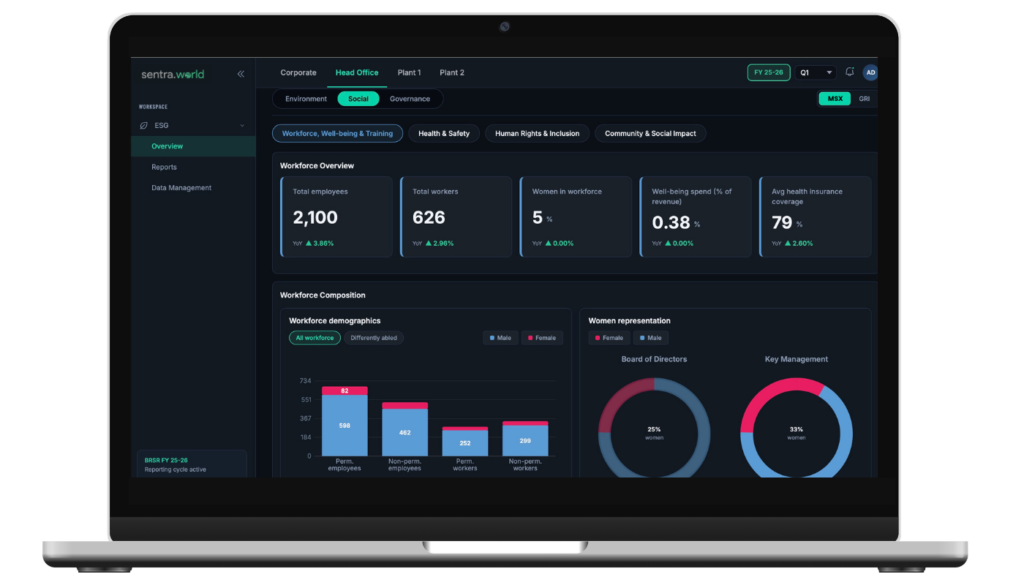
Automating the Journey: How sentra.world Scales Omani Industrial ESG Data Collection
Manual ESG data collection is inefficient, time-consuming and difficult to scale for Omani companies facing MSX disclosure requirements, investor expectations and international buyer demands. Sustainability data is often scattered across departments, plants, utility bills, ERP systems, supplier records and spreadsheets, making it difficult to maintain accuracy, traceability and audit-ready evidence.
sentra.world helps companies simplify ESG reporting by bringing data collection, emissions tracking, framework mapping, evidence management and reporting workflows into one structured digital system. This allows businesses to move from manual reporting to reliable, review-ready sustainability disclosures, while also preparing for customer documentation requests, carbon accounting requirements and future compliance needs.
Want to simplify your ESG Reporting Journey by automated ESG data collection? Get in Touch Now!