
For industrial companies listed on UAE exchanges, UAE ESG reporting is a must-have, not merely a nice-to-have. However, understanding what’s required isn’t as simple as flipping through one rulebook. It’s a complex mix of federal regulations, exchange-specific mandates, and national climate policies. Thus, knowing who’s in charge and what they’re demanding is the first crucial step. Utilizing ESG reporting tools and services for enterprises can significantly aid in this process.
A strong UAE ESG Reporting approach helps companies bring together regulatory disclosure, investor expectations, and internal sustainability data into one clear reporting process. The UAE ESG requirements are built on five key concepts every compliance team should be well-versed in, including leveraging ESG data management tools for reporting:
SCA (Securities and Commodities Authority)
This federal regulator oversees all companies listed on UAE exchanges. According to its Master Plan 2023, the SCA requires ESG disclosures to be part of the annual board report, making sustainability a board-level issue rather than just a PR move, supported by an automated ESG data collection platform.
ADX (Abu Dhabi Securities Exchange) vs. DFM (Dubai Financial Market)
Both exchanges fall under SCA’s umbrella but have their own disclosure frameworks. ADX and DFM differ in metrics, focus areas, and alignment with global standards, details that are crucial when planning your strategy using an ESG data management platform.
MOCCAE (Ministry of Climate Change and Environment)
This national body sets the UAE’s climate agenda. MOCCAE’s goals, such as the UAE’s Net Zero 2050 pledge, influence the policy landscape where exchange-level ESG rules operate and are expected to tighten over time, necessitating the use of ESG compliance software.
Comply or Explain
This regulation offers companies structured flexibility. Under this model -applicable to all UAE-listed companies per the SCA’s mandate, companies must either disclose required ESG info or explain why they haven’t. Silence isn’t an option and this highlights the need for ESG compliance software for manufacturing companies.
Scope 1, 2, and 3 Emissions
Scope 1 covers direct emissions from owned sources; Scope 2 covers purchased energy; Scope 3 includes the entire value chain -suppliers, logistics, and end-use. For industries like steel, Scope 3 often constitutes the largest emissions share, making value chain transparency both a reporting challenge and a material risk.
These elements all interact. The SCA establishes the federal baseline, MOCCAE defines climate ambitions, and ADX and DFM translate these into specific disclosure expectations highlighting where the exchanges differ.
Before deciding on a reporting framework, align your regulatory duties with each body: SCA, your exchange, and MOCCAE’s climate goals, using ESG compliance software.To build a strong UAE ESG Reporting strategy, companies need to understand how SCA, ADX, DFM and MOCCAE requirements work together. Before building a UAE ESG Reporting workflow, companies need to understand which regulator applies to them and what disclosure expectations they need to meet.
SCA vs. ADX vs. DFM: UAE ESG Reporting Requirements in Comparison
With the basics covered, the next question for any industrial firm is simple: which ESG reporting requirement applies to you? In the UAE, SCA sets the overall disclosure framework for listed companies, while ADX and DFM provide exchange-level ESG guidance with different levels of structure and emphasis. Understanding this distinction helps companies avoid gaps in UAE ESG Reporting and compliance preparation.
This isn’t just an administrative decision. It impacts how your sustainability team uses resources, which international frameworks you align with, and how your disclosures mesh with broader obligations like the MOCCAE climate law and UAE Net Zero 2050 goals. Here’s a quick comparison of the key differences.
| Regulator | Primary Focus | Mandatory Metrics | Reporting Vehicle |
| SCA | Overall governance; sets mandatory ESG disclosure triggers for all UAE-listed entities | Baseline environmental, social, and governance disclosures; triggers vary by market cap and sector | Annual sustainability report integrated with corporate governance report |
| ADX | GHG emissions quantification and environmental stewardship; alignment with GRI and TCFD | 31 distinct ESG indicators aligned with SSE/WFE and mapped to GRI/SDGs. | Standalone ESG disclosure report; data submitted via ADX reporting portal, facilitated by an ESG data management platform |
| DFM | Low-carbon transition roadmap; Scope 1, 2, and 3 emissions disclosure | Qualitative and quantitative metrics mapped to GRI Standards and SASB industry guides | ESG report aligned with DFM’s ESG Reporting Guide; annual cadence |
Mandatory vs. voluntary thresholds are common stumbling blocks for industrial firms. SCA’s rules form the compliance baseline -listed companies must disclose. ADX adds specifics: its 31-indicator framework leaves little room for selective reporting. DFM provides a roadmap; as the DFM ESG Reporting Guide states, it’s meant to aid companies in transitioning to a low-carbon economy by providing a clear path for disclosing Scope 1, 2, and 3 emissions.
Reporting frequency is annual across all three regulators, but integration requirements vary. ADX-listed firms must sync ESG data with their financial governance cycle, ensuring emissions figures and social metrics are audit-ready alongside financial statements. DFM-listed companies face similar timing, with an added expectation of narrative context around climate risk management -a factor directly linked to how carbon pricing mechanisms are reshaping global capital allocation.
Choose ADX guidance if your firm needs a structured, metric-by-metric checklist and your operations generate significant direct GHG emissions. Opt for DFM’s framework if your priority is showcasing a credible low-carbon transition narrative alongside quantitative data. Either way, SCA’s baseline requirements are non-negotiable -and for industrial operators, the real complexity begins where these exchange-level obligations meet sector-specific mandates, necessitating ESG compliance software.
Industrial Compliance Challenges: From Steel to Supply Chains for UAE ESG Reporting
After distinguishing between SCA, ADX, and DFM requirements, the tougher question arises: how do industrial manufacturers -especially in capital-intensive sectors like steel, cement, and chemicals -fulfill these overlapping mandates without getting bogged down by administrative overhead?
For industrial firms, UAE ESG Reporting is not only about annual disclosure; it also requires reliable emissions, supplier, energy, water, waste and governance data that can stand up to review.
Data complexity is the first hurdle. Scope 3 emissions, covering indirect value-chain impacts, require upstream supplier data that most UAE-based industrial firms lack standardized access to. A steel producer may source materials from five countries, each with its own carbon tracking systems. The SCA mandates a dedicated sustainability section in governance reports, making ESG data legally binding and audited at the board level -so incomplete Scope 3 figures aren’t just a reporting gap; they’re a governance issue. For MSMEs, managing emissions data across scattered suppliers without dedicated ESG teams is a structural challenge that demands process redesign, not just better spreadsheets, highlighting the need for ESG data management tools for reporting.
Regulatory overlap adds to the complexity. A manufacturing firm listed on DFM while exporting goods to Europe faces at least three simultaneous reporting frameworks: DFM ESG reporting requirements, SCA governance mandates, and the EU’s Carbon Border Adjustment Mechanism (CBAM), which imposes charges based on embedded carbon in industrial goods. These frameworks don’t share a common metric system, which means firms often produce the same data three times in different formats.
Here’s where these pressures hit hardest across firm sizes:
| Firm Profile | Primary Compliance Pressure | Biggest Risk | Key Priority |
| Large listed industrial (ADX/DFM) | Full ESG disclosure + SCA governance audit | Greenwashing exposure in board reports | Verified, auditable Scope 1–3 data |
| MSME steel exporter (unlisted) | CBAM carbon documentation for EU trade | Trade barriers from undocumented embedded carbon | Lightweight carbon accounting aligned to CBAM |
| Free zone manufacturer | MOCCAE / competent authority emissions reporting requirements, where applicable. | Regulatory non-compliance under UAE Climate Law | Board-level ESG governance structure |
Greenwashing risk is a significant concern. As highlighted by ESG experts in the UAE, qualitative sustainability claims in annual reports not backed by verified data are increasingly scrutinized by regulators and institutional investors. A board-level sustainability section claiming commitment to net zero without quantified baselines poses a reputational and legal risk, not just a communications failure.This is why UAE ESG Reporting should be treated as an ongoing data management process, not just a year-end report preparation exercise.
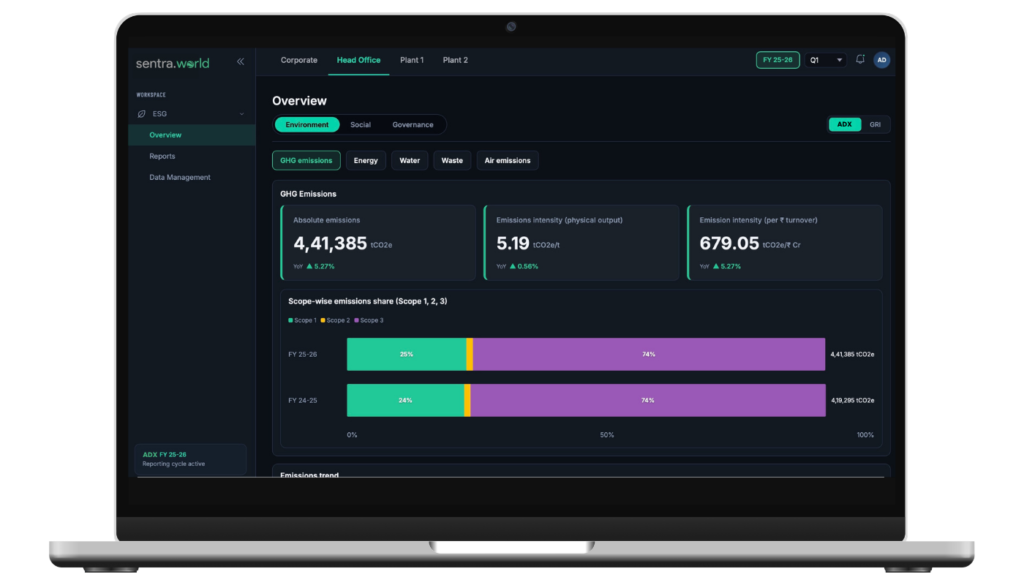
For MSMEs, the solution doesn’t require enterprise-scale infrastructure but the right framework: a scalable approach to ESG compliance that yields audit-ready outputs without needing a full sustainability department. sentra.world helps companies simplify UAE ESG Reporting by centralising ESG, carbon, energy, water, waste, supplier and governance data into one digital platform.
Addressing these challenges systematically -rather than treating each regulator as a separate issue -is precisely what a unified ESG strategy can achieve, which makes the practical roadmap in the next section essential.
Industrial firms that treat UAE exchange reporting and international trade compliance as a single data challenge, not two separate issues, will encounter significantly lower overhead and stronger audit outcomes.
The Bottom Line: Streamlining Your UAE ESG Reporting Strategy
Navigating UAE ESG Reporting across three regulators doesn’t have to mean managing three separate compliance programs. The smarter approach is convergence creating one robust disclosure system that satisfies SCA, ADX, and DFM simultaneously, then tailoring outputs for each body’s specific format, using ESG compliance software.
Before deciding where to focus your efforts, it helps to compare the three frameworks side by side one last time:
| Regulator | Disclosure Model | Industrial Firm Priority | Forward Exposure |
| SCA | Comply-or-explain; mandatory justification for emissions | Board governance structure, audit trail | Baseline for all UAE-listed entities |
| ADX | 31 quantitative indicators, voluntary GRI/TCFD alignment | Scope 1–3 emissions, water, waste intensity | Supports emissions data readiness |
| DFM | Narrative + metrics, stakeholder engagement emphasis | Supply chain disclosures, social indicators | Growing pressure toward mandatory thresholds |
Pick ADX as your measurement baseline if your firm deals with carbon-intensive goods -the 31 indicators align most directly with the data points that EU CBAM will eventually require. Anchor to SCA governance rules regardless of listing venue, SCA requirements apply to UAE-listed companies, while MSMEs may face ESG and emissions data expectations through customers, investors, free-zone requirements, MOCCAE climate rules, and export-linked frameworks such as CBAM. Incorporate DFM’s stakeholder narrative if your investor base includes Dubai-listed securities or retail shareholders responsive to qualitative context.
Four key actions can make a big difference:
- Centralize carbon accounting first. A unified data layer eliminates duplicate reporting cycles and provides auditors with a single source of truth across all three regulators.
- Use the 31 ADX indicators as your minimum viable disclosure set. They meet SCA’s quantitative expectations and provide the detailed emissions data that external frameworks like CBAM will require.
- Formalize board-level ESG oversight now. SCA’s governance mandates are the compliance requirements most likely to trigger enforcement action if left unaddressed.
- Automate the Measure | Mitigate | Monetize cycle. AI-powered platforms connecting plant-level data to regulatory templates reduce manual workload and flag disclosure gaps before submission deadlines.
Local compliance is also about future-proofing. Firms that get detailed on UAE emissions data today will enter cross-border carbon markets – whether it’s India’s CCTS or the EU’s CBAM border adjustments with verified baselines rather than estimates. Explore how UAE compliance connects to global frameworks to see where local obligations intersect with international ones already taking shape.
Industrial firms that treat SCA, ADX, and DFM not as three separate burdens but as one integrated disclosure program will be better positioned to compete and report – confidently as UAE sustainability requirements continue to tighten. A unified UAE ESG Reporting approach can help companies reduce duplication, improve audit readiness and prepare for future climate-linked requirements.
sentra.world helps companies simplify UAE ESG Reporting by centralising ESG, carbon, energy, water, waste, supplier and governance data into one digital platform. Our platform supports structured data collection, automated dashboards, audit-ready evidence management, Scope 1, 2 and 3 emissions accounting, and reporting workflows aligned with SCA, ADX, DFM and global sustainability requirements. For industrial companies, sentra.world helps move ESG reporting from scattered spreadsheets and manual follow-ups to a reliable, traceable and decision-ready system. Get in Touch!